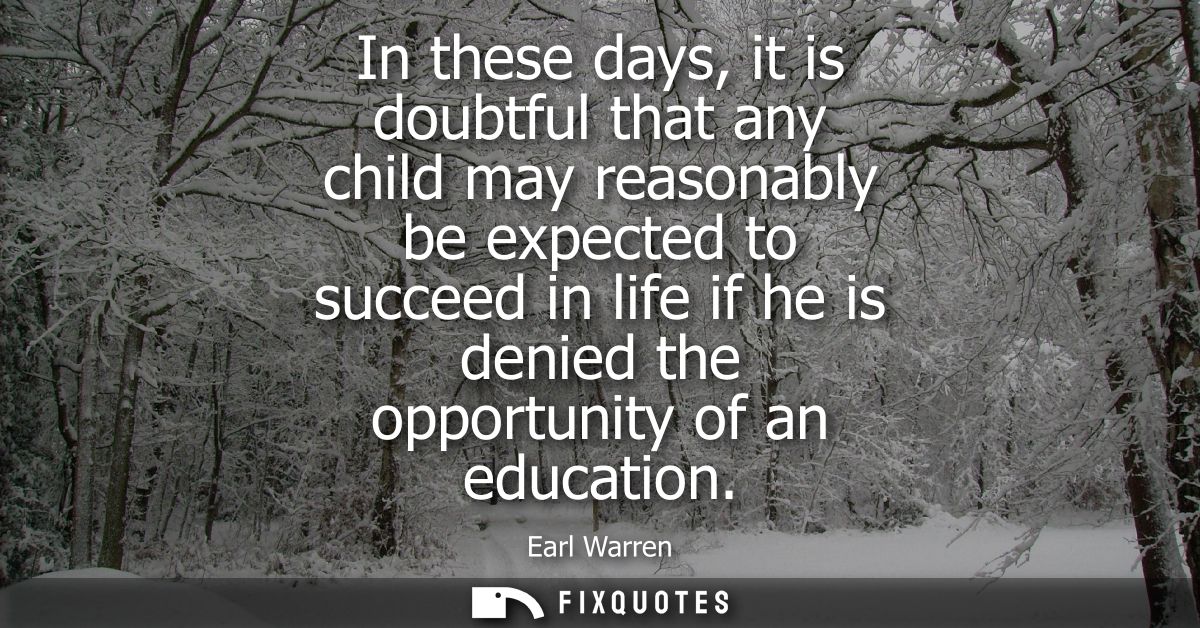
"In these days, it is doubtful that any child may reasonably be expected to succeed in life if he is denied the opportunity of an education"
About this Quote
The context is the Warren Court’s constitutional revolution, especially Brown v. Board of Education and its downstream logic: education isn’t explicitly named in the Constitution, but it functions like a gateway right. Without it, other rights become ornamental. The subtext is that segregation and unequal funding aren’t just inconveniences; they manufacture failure, then blame children for the outcomes they were engineered to produce.
Warren’s intent is strategic as much as ethical. By tying education to “succeed in life,” he makes the claim legible beyond the courtroom, to parents and taxpayers who might not be moved by abstract equal protection doctrine. It’s a jurist’s version of plain speech: a baseline promise of democratic participation, framed as the minimum we owe the next generation.
Quote Details
| Topic | Learning |
|---|---|
| Source | Brown v. Board of Education, 347 U.S. 483 (1954), unanimous opinion by Chief Justice Earl Warren (U.S. Supreme Court). |
| Cite |
Citation Formats
APA Style (7th ed.)
Warren, Earl. (2026, January 17). In these days, it is doubtful that any child may reasonably be expected to succeed in life if he is denied the opportunity of an education. FixQuotes. https://fixquotes.com/quotes/in-these-days-it-is-doubtful-that-any-child-may-65595/
Chicago Style
Warren, Earl. "In these days, it is doubtful that any child may reasonably be expected to succeed in life if he is denied the opportunity of an education." FixQuotes. January 17, 2026. https://fixquotes.com/quotes/in-these-days-it-is-doubtful-that-any-child-may-65595/.
MLA Style (9th ed.)
"In these days, it is doubtful that any child may reasonably be expected to succeed in life if he is denied the opportunity of an education." FixQuotes, 17 Jan. 2026, https://fixquotes.com/quotes/in-these-days-it-is-doubtful-that-any-child-may-65595/. Accessed 1 Apr. 2026.