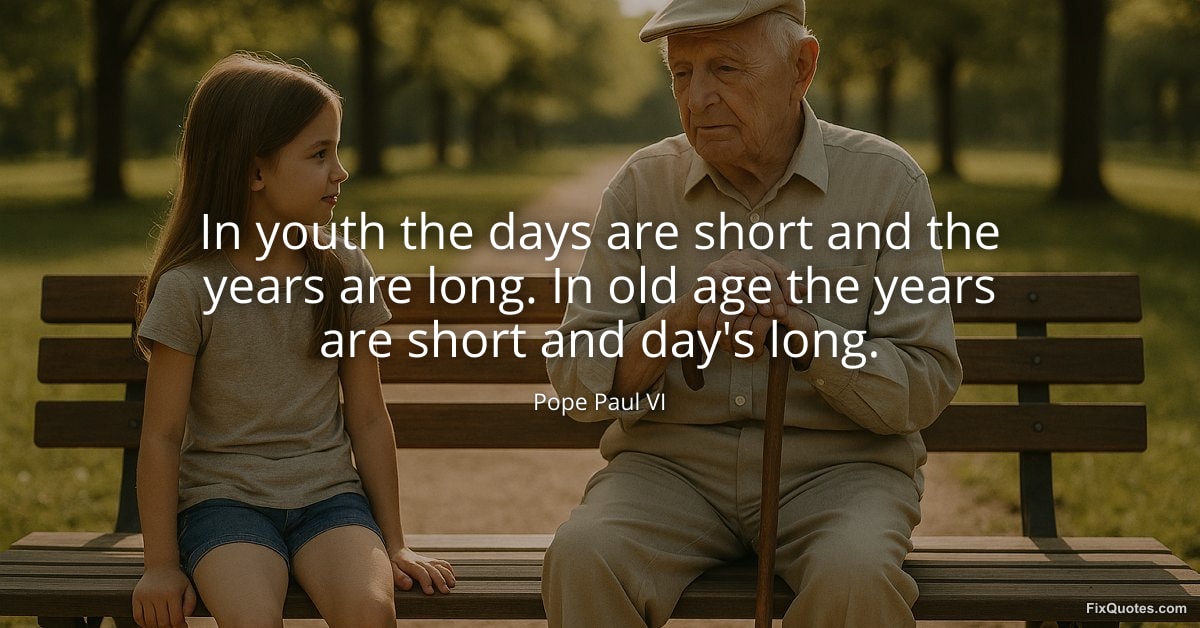
"In youth the days are short and the years are long. In old age the years are short and day's long"
About this Quote
Time, in Pope Paul VI's hands, becomes a moral instrument: not just something we measure, but something that measures us back. The line turns on a clean inversion - days versus years, youth versus old age - and that symmetry is doing more than sounding poetic. It dramatizes a spiritual truth Christianity has always been good at naming: that the texture of life changes as our horizon changes.
"In youth the days are short and the years are long" captures the restless economy of early life. Individual days vanish into school bells, first jobs, obligations you don't fully own yet. But the years feel enormous because the self is still under construction; each season seems to alter your identity. The subtext is impatience: youth experiences time as a corridor, always leading elsewhere.
Then comes the sober flip: "In old age the years are short and day's long". The grammar slips - "day's" instead of "days" - but the meaning sharpens. Years compress because the future has fewer chapters; time accelerates when there's less of it to imagine. Days, meanwhile, lengthen under the weight of memory, physical fragility, solitude, prayer. A day can feel vast when it's filled with reflection rather than anticipation.
As a pope of the postwar, post-Vatican II world, Paul VI watched modernity teach people to live fast while avoiding finitude. This aphorism quietly resists that denial. It's pastoral, not sentimental: a reminder that aging isn't merely decline but a different vocation, where attention replaces speed and the long day can become contemplative space rather than empty time.
"In youth the days are short and the years are long" captures the restless economy of early life. Individual days vanish into school bells, first jobs, obligations you don't fully own yet. But the years feel enormous because the self is still under construction; each season seems to alter your identity. The subtext is impatience: youth experiences time as a corridor, always leading elsewhere.
Then comes the sober flip: "In old age the years are short and day's long". The grammar slips - "day's" instead of "days" - but the meaning sharpens. Years compress because the future has fewer chapters; time accelerates when there's less of it to imagine. Days, meanwhile, lengthen under the weight of memory, physical fragility, solitude, prayer. A day can feel vast when it's filled with reflection rather than anticipation.
As a pope of the postwar, post-Vatican II world, Paul VI watched modernity teach people to live fast while avoiding finitude. This aphorism quietly resists that denial. It's pastoral, not sentimental: a reminder that aging isn't merely decline but a different vocation, where attention replaces speed and the long day can become contemplative space rather than empty time.
Quote Details
| Topic | Aging |
|---|---|
| Source | Later attribution: Life Lessons of Wisdom & Motivation - Volume II (M.I. Seka, 2014) modern compilationISBN: 9781310009143 · ID: cl_zAgAAQBAJ
Evidence: ... In youth the days are short and the years are long. In old age the years are short and day's long. - Pope Paul VI 1897 – 1978; Italian head of the Catholic Church from 1963 – 1978. It lies in human nature that where you experience your ... Other candidates (1) Pope Paul VI (Pope Paul VI) compilation35.3% discreet the depths of the spirit remain within me me and god the colloquy with god must be full and endless private |
| Video | Watch Video Quote |
| Featured | This quote was our Quote of the Day on December 1, 2025 |
More Quotes by Pope
Add to List