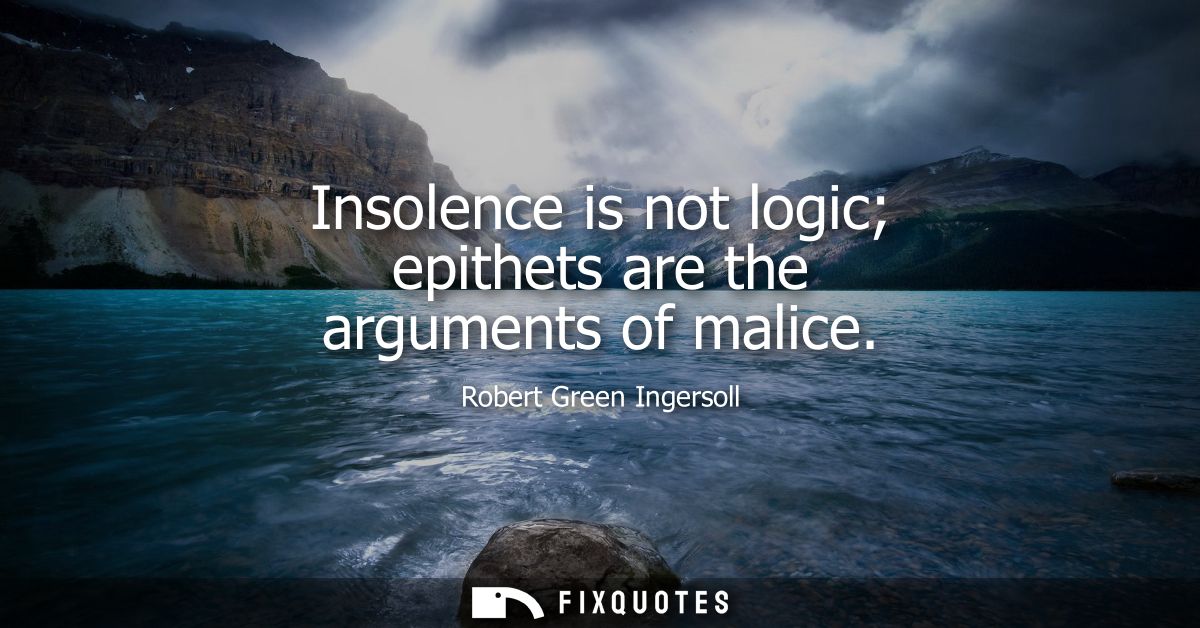
"Insolence is not logic; epithets are the arguments of malice"
About this Quote
Ingersoll is drawing a bright procedural line between persuasion and poisoning the well, and he does it with the crisp severity of a trial lawyer who’s seen too many juries nudged by vibes instead of evidence. “Insolence” isn’t just rudeness here; it’s a tactic that tries to win by dominating the room. By saying it’s “not logic,” he refuses to treat swagger as a substitute for reasoning. The sentence is built like a cross-examination: two clauses, two identifications, two verdicts. It doesn’t debate the heckler; it disqualifies the method.
The second half goes sharper. “Epithets” are name-tags thrown like stones, and Ingersoll frames them as the preferred currency of “malice.” That word matters. He’s not merely condemning sloppy thinking; he’s diagnosing motive. If you reach for slurs, you’re not trying to clarify the truth, you’re trying to injure a person’s standing so their ideas don’t have to be met on the merits. It’s an early, compact critique of ad hominem as a moral failure, not just a logical one.
Context does a lot of work. Ingersoll, a famed 19th-century orator and freethinker as well as a lawyer, spent a career in public controversy where religious and political debates routinely slid into character assassination. The line reads like a self-defense manual for secular argument in a culture that policed dissent with insults. It’s also a warning to any side: once discourse becomes theater for contempt, truth loses on procedure even before it loses on facts.
The second half goes sharper. “Epithets” are name-tags thrown like stones, and Ingersoll frames them as the preferred currency of “malice.” That word matters. He’s not merely condemning sloppy thinking; he’s diagnosing motive. If you reach for slurs, you’re not trying to clarify the truth, you’re trying to injure a person’s standing so their ideas don’t have to be met on the merits. It’s an early, compact critique of ad hominem as a moral failure, not just a logical one.
Context does a lot of work. Ingersoll, a famed 19th-century orator and freethinker as well as a lawyer, spent a career in public controversy where religious and political debates routinely slid into character assassination. The line reads like a self-defense manual for secular argument in a culture that policed dissent with insults. It’s also a warning to any side: once discourse becomes theater for contempt, truth loses on procedure even before it loses on facts.
Quote Details
| Topic | Reason & Logic |
|---|
More Quotes by Robert
Add to List