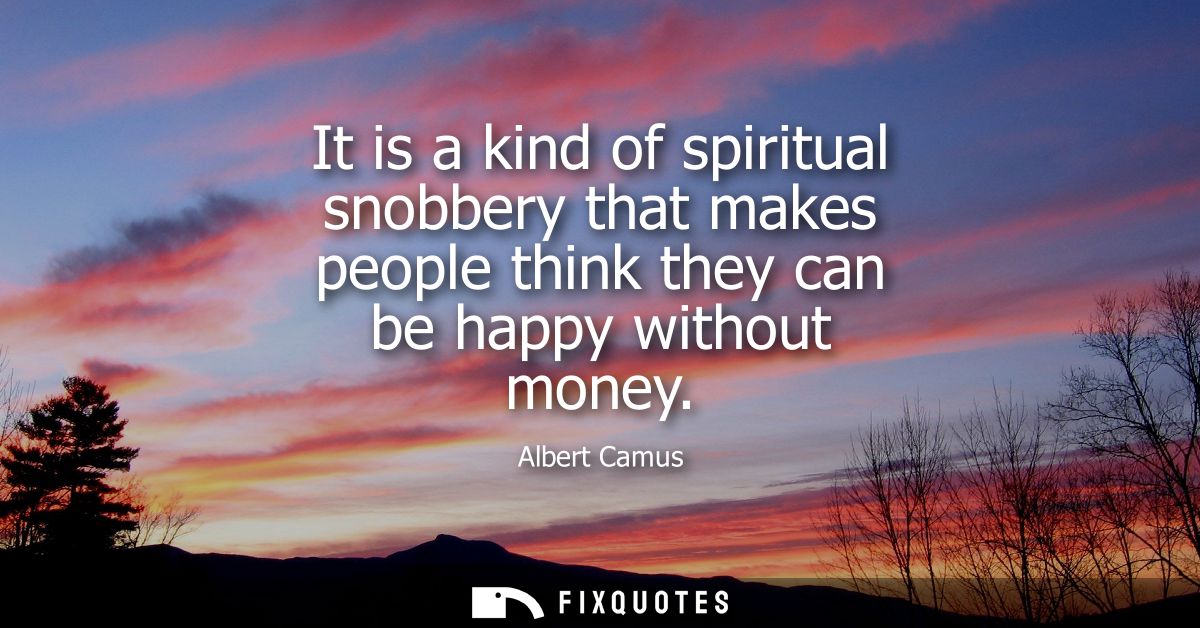
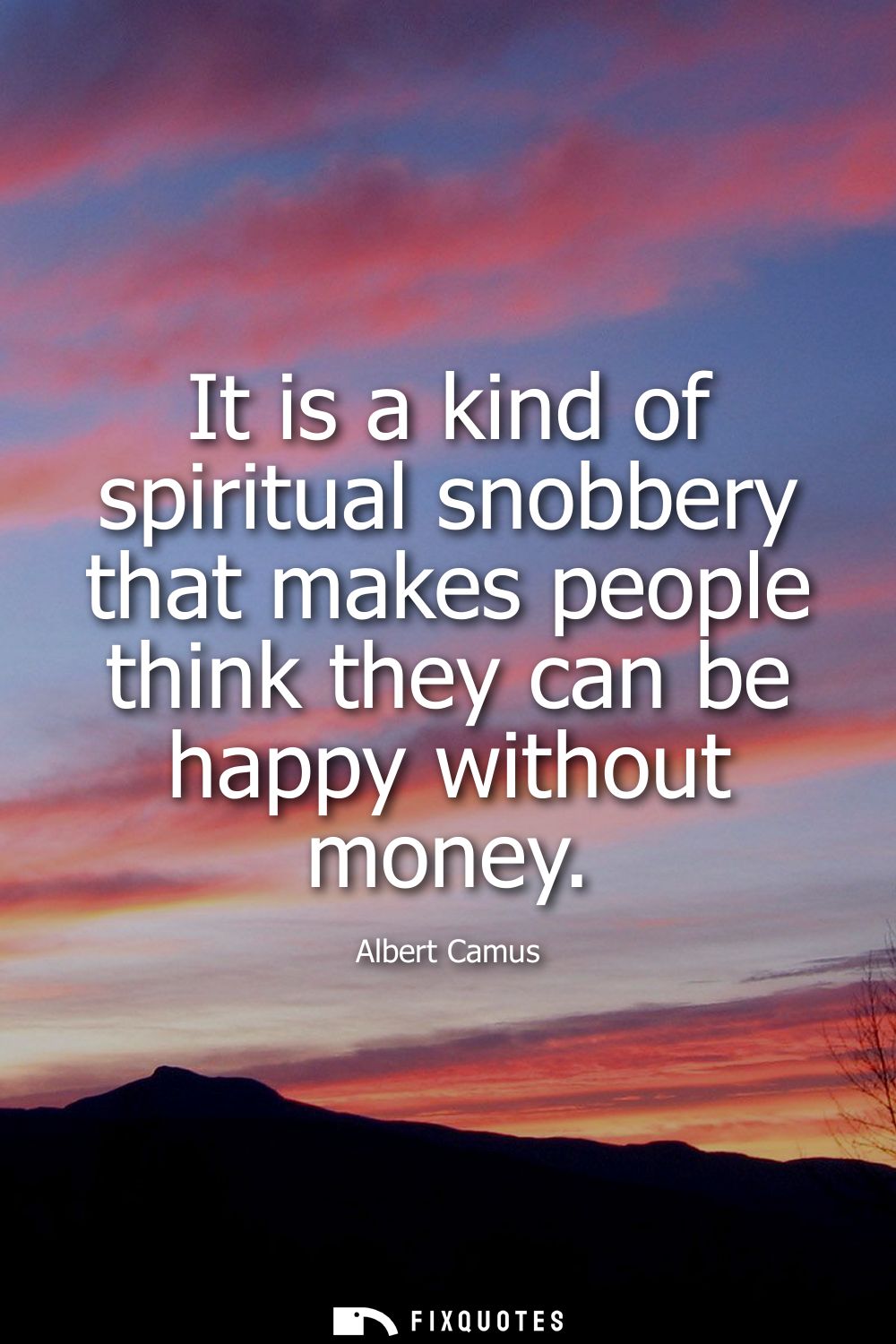
"It is a kind of spiritual snobbery that makes people think they can be happy without money"
About this Quote
The intent isn’t to crown wealth as the meaning of life. It’s to expose how moral rhetoric gets used to launder material inequality. Camus grew up in near-poverty in French Algeria; he knew the tyranny of rent, hunger, illness, and the slow humiliation of not having choices. When people romanticize happiness detached from money, they often smuggle in assumptions: that someone else is paying, that community safety nets exist, that time and health are abundant. “Spiritual” is doing double duty here: it names a genuine yearning for meaning, then turns it into a weaponized aesthetic, a lifestyle pose.
The subtext is political without sounding like a manifesto. Camus is suspicious of grand consolations - religious, ideological, or self-help. This sentence functions like a corrective to existential heroics: you can preach lucidity and revolt all you like, but a stomach still growls. It’s also a demand for honesty. If you want to talk about happiness, start by admitting the price of being able to pursue it.
Quote Details
| Topic | Money |
|---|---|
| Source | Help us find the source |
| Cite |
Citation Formats
APA Style (7th ed.)
Camus, Albert. (2026, January 18). It is a kind of spiritual snobbery that makes people think they can be happy without money. FixQuotes. https://fixquotes.com/quotes/it-is-a-kind-of-spiritual-snobbery-that-makes-15137/
Chicago Style
Camus, Albert. "It is a kind of spiritual snobbery that makes people think they can be happy without money." FixQuotes. January 18, 2026. https://fixquotes.com/quotes/it-is-a-kind-of-spiritual-snobbery-that-makes-15137/.
MLA Style (9th ed.)
"It is a kind of spiritual snobbery that makes people think they can be happy without money." FixQuotes, 18 Jan. 2026, https://fixquotes.com/quotes/it-is-a-kind-of-spiritual-snobbery-that-makes-15137/. Accessed 12 Feb. 2026.