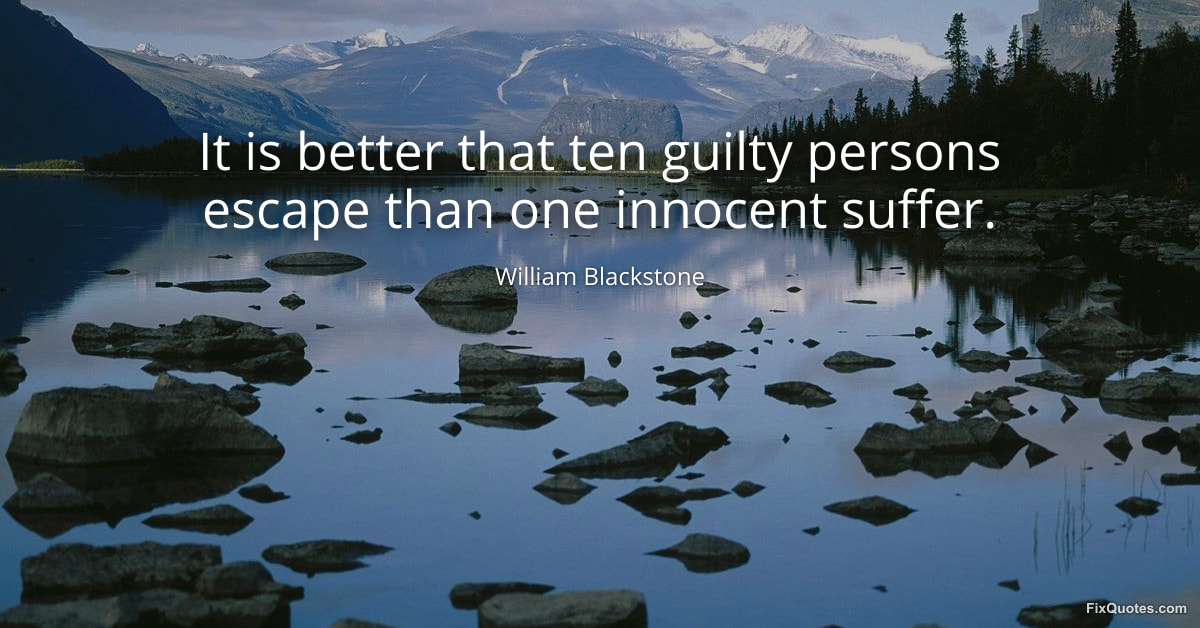
"It is better that ten guilty persons escape than one innocent suffer"
About this Quote
The subtext is about asymmetry. A guilty person escaping is a failure of enforcement; an innocent person suffering is a failure of justice itself. Blackstone treats those failures as morally and politically unequal, because punishment isn’t just a bad outcome, it’s the state’s most intimate intrusion on the body and life. If the state can’t reliably distinguish guilt from innocence, its authority becomes indistinguishable from coercion.
The “ten” isn’t actuarial math; it’s rhetorical calibration. By making the ratio explicit, Blackstone forces readers to confront a trade-off most societies prefer to pretend doesn’t exist. The line functions as a constraint on prosecutorial zeal, public vengeance, and the seductive narrative that safety justifies shortcuts. It’s a warning: the credibility of law is purchased with restraint, and the invoice comes due precisely when the crowd demands certainty.
Quote Details
| Topic | Justice |
|---|---|
| Source | Help us find the source |
| Cite |
Citation Formats
APA Style (7th ed.)
Blackstone, William. (2026, January 11). It is better that ten guilty persons escape than one innocent suffer. FixQuotes. https://fixquotes.com/quotes/it-is-better-that-ten-guilty-persons-escape-than-173713/
Chicago Style
Blackstone, William. "It is better that ten guilty persons escape than one innocent suffer." FixQuotes. January 11, 2026. https://fixquotes.com/quotes/it-is-better-that-ten-guilty-persons-escape-than-173713/.
MLA Style (9th ed.)
"It is better that ten guilty persons escape than one innocent suffer." FixQuotes, 11 Jan. 2026, https://fixquotes.com/quotes/it-is-better-that-ten-guilty-persons-escape-than-173713/. Accessed 19 Feb. 2026.