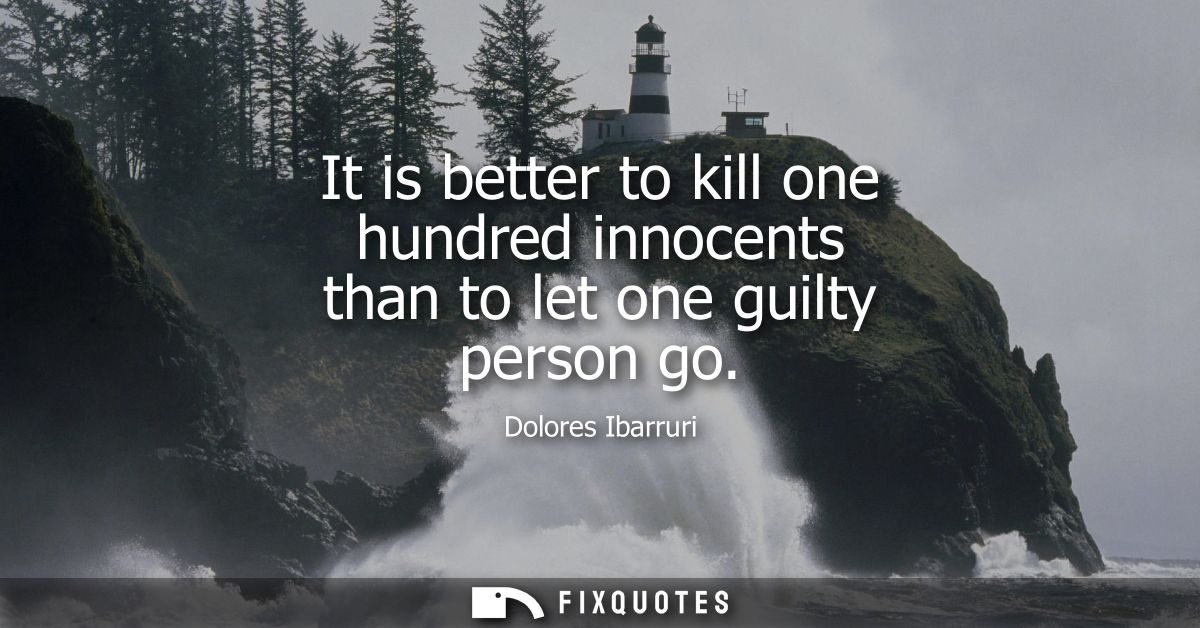
"It is better to kill one hundred innocents than to let one guilty person go"
About this Quote
The line lands like a moral car crash: a deliberate inversion of the liberal premise that the state must restrain its violence because it is uniquely powerful. "Better" does the dirty work here. It pretends there is a clean utilitarian calculus, a ledger where lives can be traded for security, and it normalizes mass harm as prudence rather than atrocity. The phrasing also performs political theater: it dares the listener to choose softness over survival, to feel ashamed of due process in the face of an enemy.
Coming from Dolores Ibarruri, the famed communist leader of Spain's Civil War era and the voice behind "No pasaran!", the quote reads less as abstract philosophy than as wartime rhetoric under siege logic. In the 1930s, "innocents" and "guilty" were not stable categories; they were labels assigned in a struggle where loyalty could be inferred from class, religion, or rumor. The subtext is disciplinary: justice is recast as a luxury, hesitation as complicity. It is also a claim about who gets to define innocence in the first place - a revolutionary movement, like any state in crisis, expands the definition of threat until it can justify preemptive violence.
As propaganda, it works because it offers emotional relief: the promise that terror can be purified into necessity. As a moral statement, it reveals the authoritarian temptation at the heart of emergency politics: when the cause is sacred, individual lives become expendable, and the machinery of punishment stops distinguishing protection from power.
Coming from Dolores Ibarruri, the famed communist leader of Spain's Civil War era and the voice behind "No pasaran!", the quote reads less as abstract philosophy than as wartime rhetoric under siege logic. In the 1930s, "innocents" and "guilty" were not stable categories; they were labels assigned in a struggle where loyalty could be inferred from class, religion, or rumor. The subtext is disciplinary: justice is recast as a luxury, hesitation as complicity. It is also a claim about who gets to define innocence in the first place - a revolutionary movement, like any state in crisis, expands the definition of threat until it can justify preemptive violence.
As propaganda, it works because it offers emotional relief: the promise that terror can be purified into necessity. As a moral statement, it reveals the authoritarian temptation at the heart of emergency politics: when the cause is sacred, individual lives become expendable, and the machinery of punishment stops distinguishing protection from power.
Quote Details
| Topic | Justice |
|---|---|
| Source | Help us find the source |
More Quotes by Dolores
Add to List