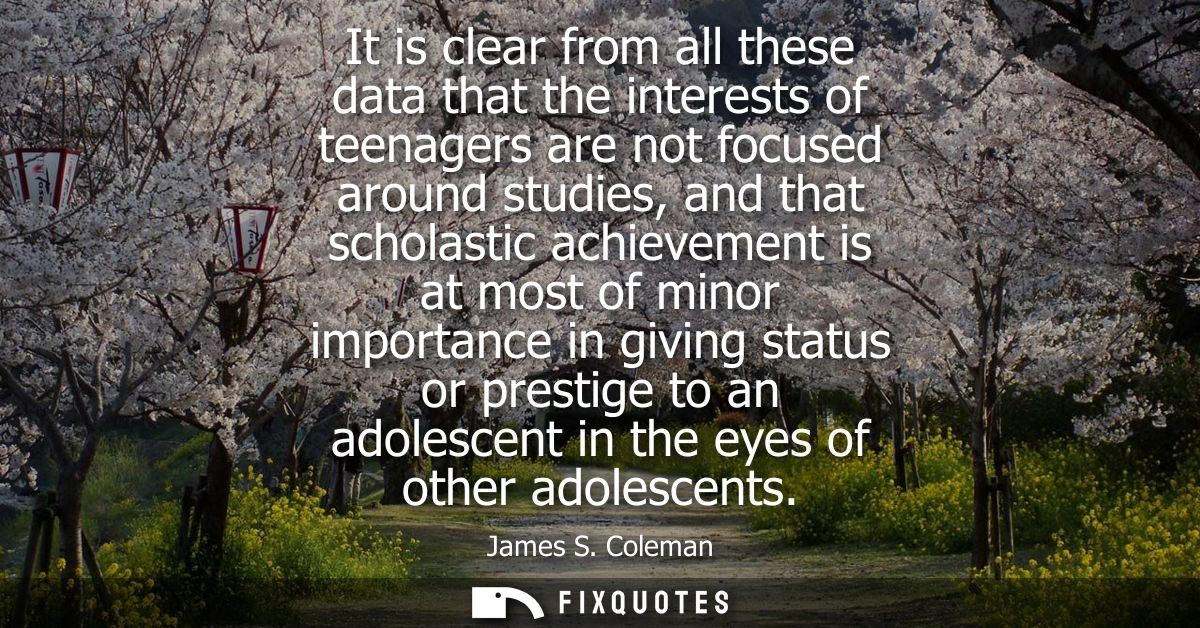
"It is clear from all these data that the interests of teenagers are not focused around studies, and that scholastic achievement is at most of minor importance in giving status or prestige to an adolescent in the eyes of other adolescents"
About this Quote
James S. Coleman argues that adolescent status hierarchies are built far less on grades than on social currencies like popularity, athletics, style, and dating. Drawing on mid-20th century studies of American high schools, he locates a stark mismatch between the official purpose of school and the peer-driven economy that dominates student life. Schools present academics as the path to success, yet the daily rewards that matter to teenagers often flow through visibility, charm, and participation in high-prestige extracurriculars, especially sports. The result is a quiet but powerful incentive structure: work that raises grades but lowers social standing can be rationally avoided.
This insight reframes underachievement not as apathy or incapacity, but as a response to a competing status system. Labels like try-hard or nerd reflect the social penalties for visible studiousness where peer norms prize ease and cool. Teachers and administrators can offer grades and diplomas, but adolescence is lived among peers, and recognition there frequently trumps adult validation. Coleman implies that educational reforms ignoring peer effects will struggle, because motivation is not only individual; it is relational.
The observation does not claim that teenagers inherently devalue learning. Many care deeply but negotiate conflicting signals. Status structures vary across schools and subcultures, sometimes flipping in selective or immigrant communities where academic excellence is prestigious. Still, the dominant pattern Coleman described has proved durable, amplified by media that magnify popularity cues while also enabling niche prestige markets for academic or technical skills.
The policy implication is to realign prestige with scholastic achievement: elevate academic teams with the same ritual and visibility as athletics, harness peer leadership to set pro-learning norms, design collaborative work that links mastery to belonging, and showcase intellectual risk-taking as socially admired. When the symbolic rewards inside the adolescent world reinforce rather than undercut academic effort, achievement becomes a route to status, not a tradeoff against it.
This insight reframes underachievement not as apathy or incapacity, but as a response to a competing status system. Labels like try-hard or nerd reflect the social penalties for visible studiousness where peer norms prize ease and cool. Teachers and administrators can offer grades and diplomas, but adolescence is lived among peers, and recognition there frequently trumps adult validation. Coleman implies that educational reforms ignoring peer effects will struggle, because motivation is not only individual; it is relational.
The observation does not claim that teenagers inherently devalue learning. Many care deeply but negotiate conflicting signals. Status structures vary across schools and subcultures, sometimes flipping in selective or immigrant communities where academic excellence is prestigious. Still, the dominant pattern Coleman described has proved durable, amplified by media that magnify popularity cues while also enabling niche prestige markets for academic or technical skills.
The policy implication is to realign prestige with scholastic achievement: elevate academic teams with the same ritual and visibility as athletics, harness peer leadership to set pro-learning norms, design collaborative work that links mastery to belonging, and showcase intellectual risk-taking as socially admired. When the symbolic rewards inside the adolescent world reinforce rather than undercut academic effort, achievement becomes a route to status, not a tradeoff against it.
Quote Details
| Topic | Student |
|---|---|
| Source | James S. Coleman, The Adolescent Society: The Social Life of the Teenager and Its Impact on Education, 1961 (Coleman's study arguing adolescent status is tied more to peer interests than scholastic achievement). |
More Quotes by James
Add to List