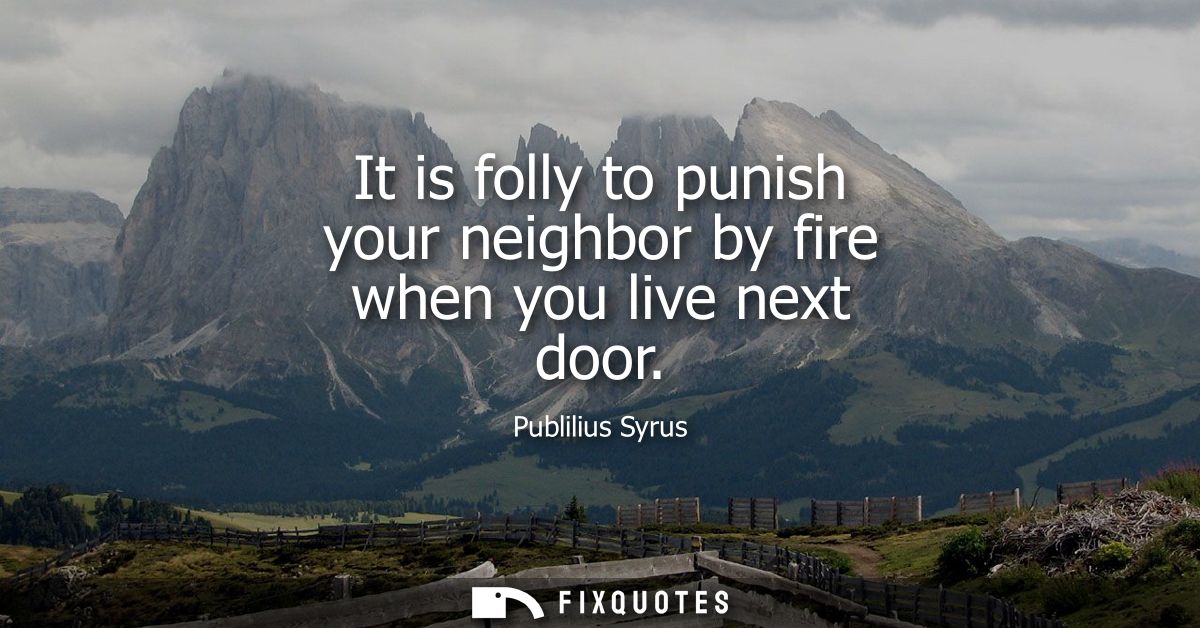
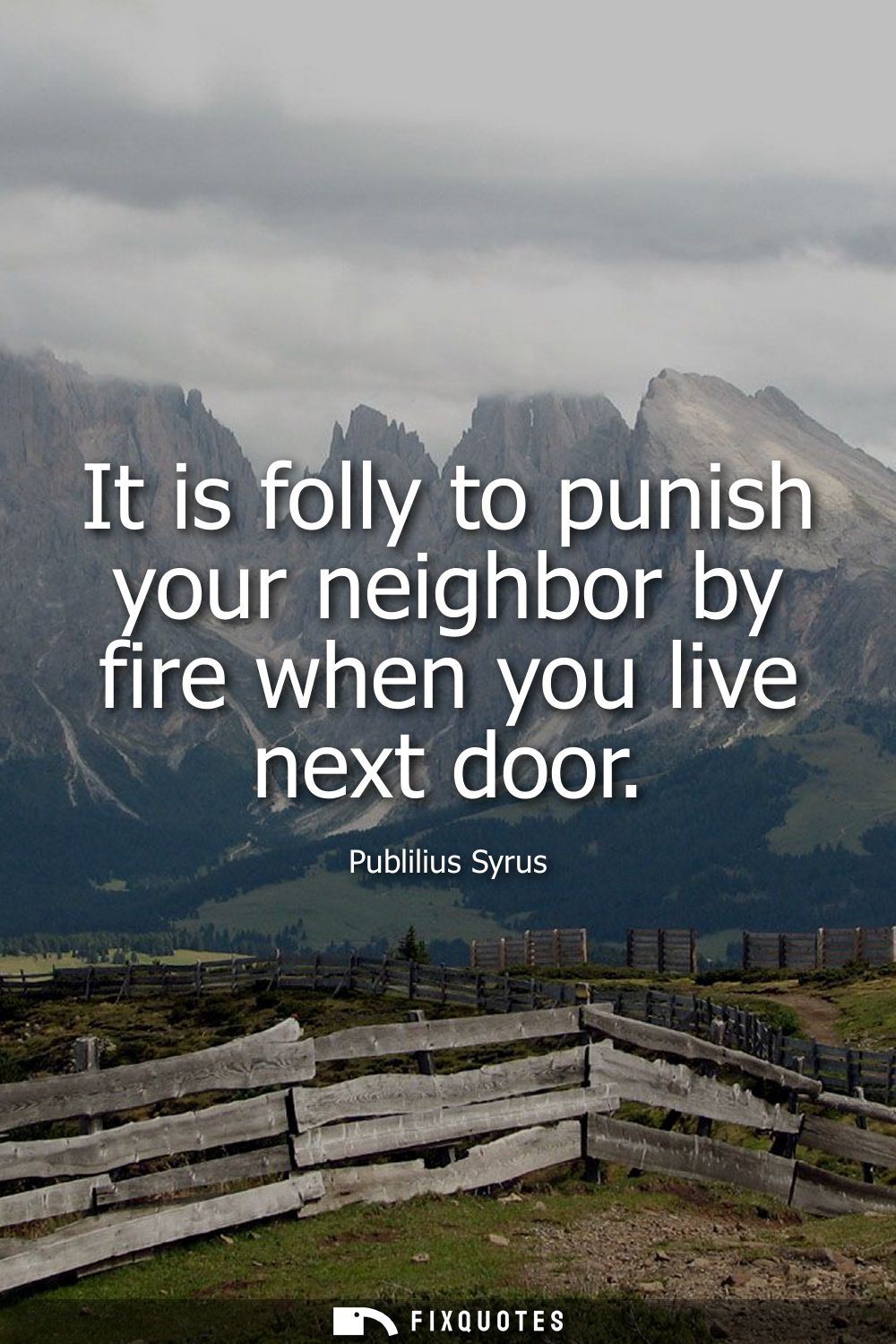
"It is folly to punish your neighbor by fire when you live next door"
About this Quote
Arson as moral lesson is the kind of revenge that exposes its own stupidity. Publilius Syrus nails the physics of retaliation: harm is not a clean, targeted weapon; it’s a force that travels. If you live next door, your neighbor’s house is basically an extension of your own risk. The line works because it refuses to argue ethics first. It starts with consequence, the blunt reality that spite is often a bad investment.
Syrus wrote in late Republican Rome, a world where urban density, shared walls, and literal fire made “private” conflict a public hazard. But the proverb’s real target isn’t architecture; it’s the psychology of escalation. People convince themselves that punishment can be neatly contained, that the person they’re mad at will absorb the damage while they stand safely outside the blast radius. Syrus punctures that fantasy with a simple spatial image: next door.
The subtext is a warning about how revenge disguises self-sabotage as righteousness. You don’t just burn their house; you degrade the neighborhood, the trust, the shared conditions that make your own life livable. Read it socially and it’s about community: you can’t torch a relationship, a workplace, a civic institution, and pretend you’re not breathing the smoke. Read it politically and it’s a critique of punitive power: states and factions reach for fire to prove strength, then act shocked when the conflagration spreads. The wit is in the understatement. “Folly” is polite; the behavior is suicidal.
Syrus wrote in late Republican Rome, a world where urban density, shared walls, and literal fire made “private” conflict a public hazard. But the proverb’s real target isn’t architecture; it’s the psychology of escalation. People convince themselves that punishment can be neatly contained, that the person they’re mad at will absorb the damage while they stand safely outside the blast radius. Syrus punctures that fantasy with a simple spatial image: next door.
The subtext is a warning about how revenge disguises self-sabotage as righteousness. You don’t just burn their house; you degrade the neighborhood, the trust, the shared conditions that make your own life livable. Read it socially and it’s about community: you can’t torch a relationship, a workplace, a civic institution, and pretend you’re not breathing the smoke. Read it politically and it’s a critique of punitive power: states and factions reach for fire to prove strength, then act shocked when the conflagration spreads. The wit is in the understatement. “Folly” is polite; the behavior is suicidal.
Quote Details
| Topic | Latin Phrases |
|---|---|
| Source | Help us find the source |
| Cite |
Citation Formats
APA Style (7th ed.)
Syrus, Publilius. (2026, January 14). It is folly to punish your neighbor by fire when you live next door. FixQuotes. https://fixquotes.com/quotes/it-is-folly-to-punish-your-neighbor-by-fire-when-33025/
Chicago Style
Syrus, Publilius. "It is folly to punish your neighbor by fire when you live next door." FixQuotes. January 14, 2026. https://fixquotes.com/quotes/it-is-folly-to-punish-your-neighbor-by-fire-when-33025/.
MLA Style (9th ed.)
"It is folly to punish your neighbor by fire when you live next door." FixQuotes, 14 Jan. 2026, https://fixquotes.com/quotes/it-is-folly-to-punish-your-neighbor-by-fire-when-33025/. Accessed 12 Feb. 2026.
More Quotes by Publilius
Add to List