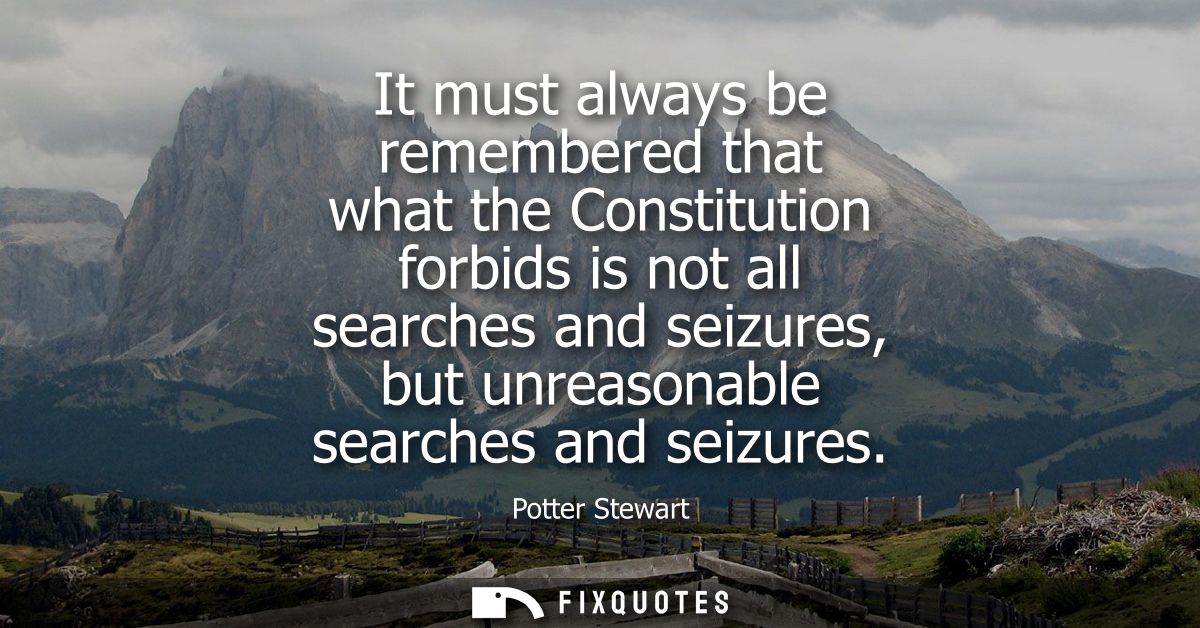
"It must always be remembered that what the Constitution forbids is not all searches and seizures, but unreasonable searches and seizures"
About this Quote
Stewart’s line is a scalpel aimed at America’s favorite constitutional fantasy: that rights are self-executing and absolute. He reminds you that the Fourth Amendment isn’t a blanket ban on government intrusion; it’s a rule of calibration. The operative word isn’t "searches" or "seizures" but "unreasonable" - a term that smuggles judgment, balancing, and, inevitably, power into what many people want to treat as a bright-line prohibition.
The specific intent is judicial discipline. Stewart is warning lawyers, police, and the public not to litigate the Fourth Amendment as moral outrage alone. The Amendment is written as a standard, not a checklist. That matters because standards invite context: what was known at the time, what the officers did, what courts are willing to tolerate. It’s a quiet rebuttal to the idea that any government look into your life is automatically unconstitutional.
The subtext is less comforting: if "reasonableness" is the gatekeeper, then the gate is staffed by judges, informed by prevailing social fears. The definition of reasonable expands in eras of panic and contracts in moments of reform. That elasticity is both feature and bug - it lets the law adapt to new realities (cars, phones, now data), but it also risks ratifying whatever invasive practice has become normal.
Stewart’s rhetorical move works because it demystifies the Constitution while exposing its hinge. The Fourth Amendment doesn’t simply restrain the state; it forces a continuous argument about how much state we’re willing to live with.
The specific intent is judicial discipline. Stewart is warning lawyers, police, and the public not to litigate the Fourth Amendment as moral outrage alone. The Amendment is written as a standard, not a checklist. That matters because standards invite context: what was known at the time, what the officers did, what courts are willing to tolerate. It’s a quiet rebuttal to the idea that any government look into your life is automatically unconstitutional.
The subtext is less comforting: if "reasonableness" is the gatekeeper, then the gate is staffed by judges, informed by prevailing social fears. The definition of reasonable expands in eras of panic and contracts in moments of reform. That elasticity is both feature and bug - it lets the law adapt to new realities (cars, phones, now data), but it also risks ratifying whatever invasive practice has become normal.
Stewart’s rhetorical move works because it demystifies the Constitution while exposing its hinge. The Fourth Amendment doesn’t simply restrain the state; it forces a continuous argument about how much state we’re willing to live with.
Quote Details
| Topic | Justice |
|---|
More Quotes by Potter
Add to List