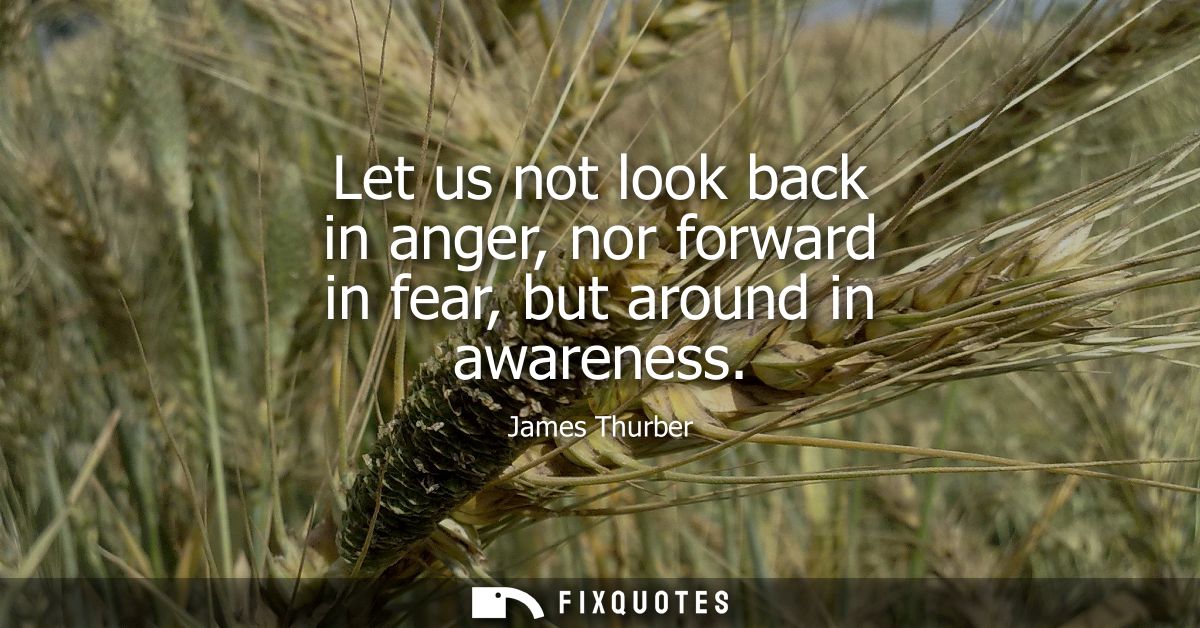
"Let us not look back in anger, nor forward in fear, but around in awareness"
About this Quote
Thurber’s line is a tidy piece of comedic stagecraft: it disarms you with balance, then quietly changes the rules of the conversation. “Not look back in anger” and “nor forward in fear” are the expected moral opposites, the kind of advice you might find stitched on a pillow. Then he swivels the camera. “But around in awareness” refuses the comforting timeline entirely. The joke is that our favorite places to live are imaginary: the grievance museum of the past, the anxiety arcade of the future. Thurber doesn’t scold those impulses so much as expose their theatricality.
The intent is practical, almost antiseptic. Anger and fear are both narrative emotions; they depend on stories we tell ourselves about what happened and what might happen. “Awareness” isn’t a story. It’s a stance. By choosing “around” instead of “within,” he nudges attention away from self-mythologizing and toward the actual room: people, consequences, details. That’s where comedy often lives too. Thurber built a career on the absurdity of human misperception, the way we barrel into situations armed with assumptions and miss what’s plainly in front of us.
Context matters: he wrote through the churn of two World Wars, the Depression, and the rise of modern mass media. In that world, nostalgia and dread were lucrative commodities. The subtext is a refusal to be emotionally conscripted by either. It’s not optimism; it’s clearance. Stay present, he implies, because the present is the only place you can correct yourself.
The intent is practical, almost antiseptic. Anger and fear are both narrative emotions; they depend on stories we tell ourselves about what happened and what might happen. “Awareness” isn’t a story. It’s a stance. By choosing “around” instead of “within,” he nudges attention away from self-mythologizing and toward the actual room: people, consequences, details. That’s where comedy often lives too. Thurber built a career on the absurdity of human misperception, the way we barrel into situations armed with assumptions and miss what’s plainly in front of us.
Context matters: he wrote through the churn of two World Wars, the Depression, and the rise of modern mass media. In that world, nostalgia and dread were lucrative commodities. The subtext is a refusal to be emotionally conscripted by either. It’s not optimism; it’s clearance. Stay present, he implies, because the present is the only place you can correct yourself.
Quote Details
| Topic | Live in the Moment |
|---|
More Quotes by James
Add to List