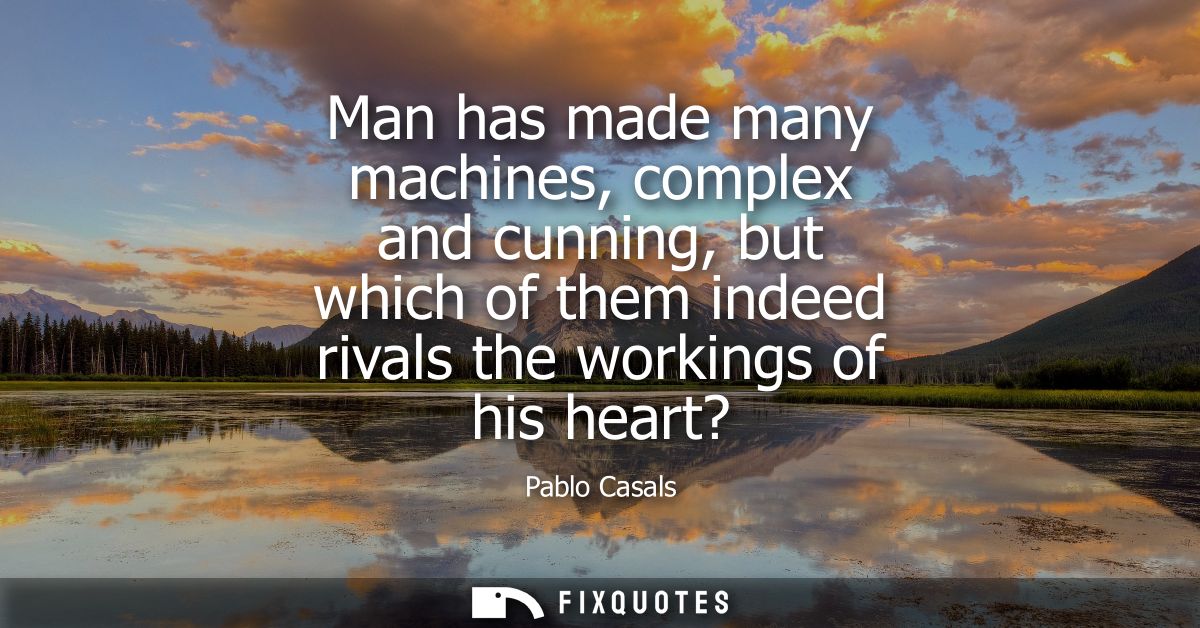
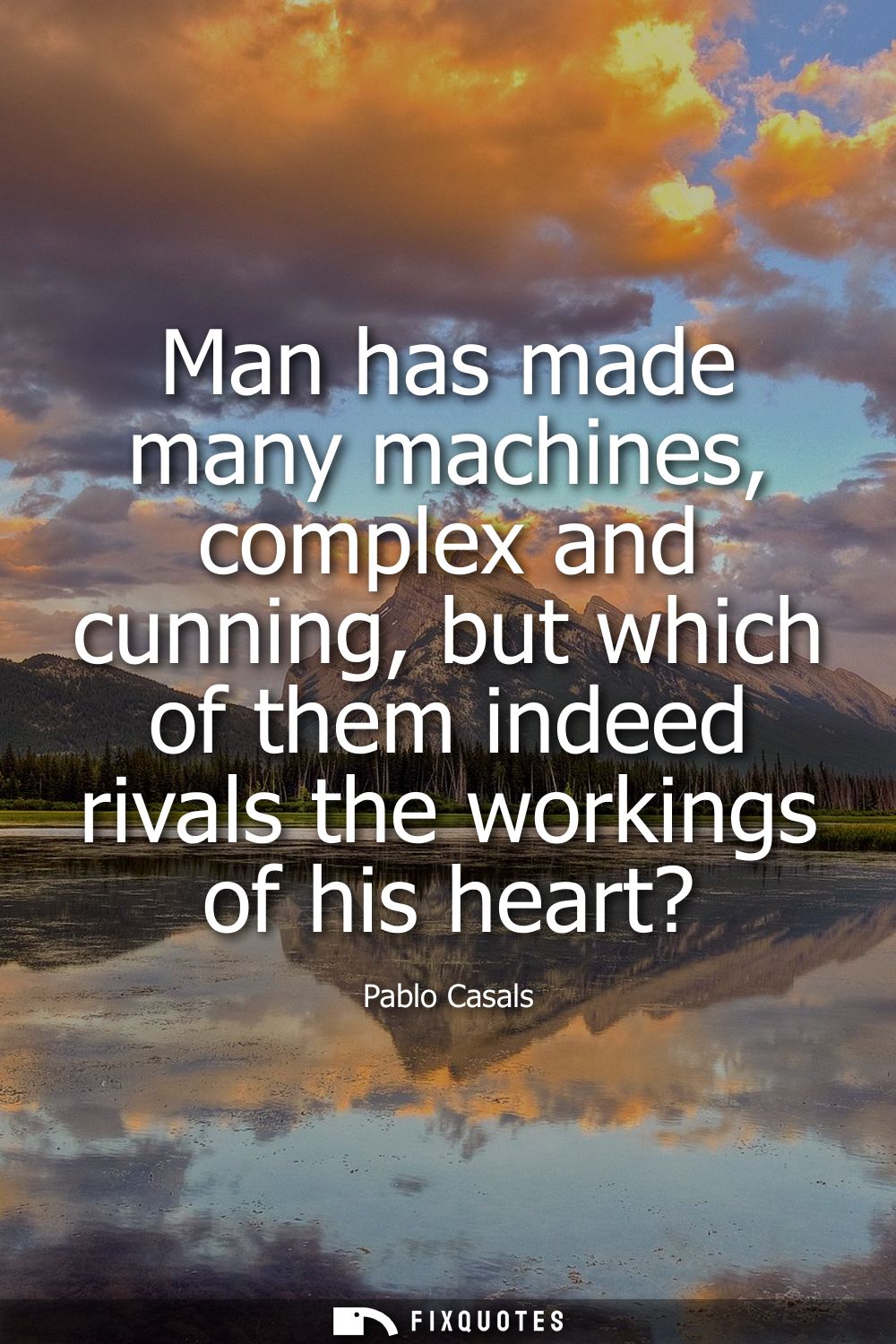
"Man has made many machines, complex and cunning, but which of them indeed rivals the workings of his heart?"
About this Quote
The subtext carries a moral edge. "Machines" implies control: we build systems to extend our power and outsource our labor. The heart refuses that fantasy. It malfunctions, contradicts itself, wants what it shouldn’t, mourns on schedule no engineer can optimize. By asking "which of them indeed rivals", Casals uses a rhetorical question as a rebuke: we keep betting the future on cleverness while neglecting the messy internal technology that makes us worth saving.
Context matters: Casals was a Catalan artist who took an outspoken stand against Franco and lived through wars that turned industrial progress into efficient cruelty. Read that way, the quote is less Hallmark than warning. The problem isn’t that machines are impressive; it’s that they’re easy to admire. The heart demands responsibility.
Quote Details
| Topic | Deep |
|---|---|
| Source | Evidence: Man has made many machines, complex and cunning, but which of them indeed rivals the workings of his heart?. The strongest primary-source lead is Pablo Casals's book 'Joys and Sorrows: Reflections' (as told to Albert E. Kahn), published in 1970. Multiple secondary quote indexes explicitly attribute this quotation to that book, and Google Books confirms the book's existence and 1970 publication by Simon and Schuster. However, I was not able to verify the exact page number from a fully viewable scan in the sources I accessed, so the page remains unconfirmed. I also did not find evidence that the line first appeared earlier in a speech, interview, song lyric, or article prior to the 1970 book. Pablo Casals was a cellist/conductor, not a singer-songwriter source in this case. Because the exact page could not be directly inspected in a primary scan, confidence is medium rather than high. Other candidates (2) AN Optimist's Tour of the Future (Mark Stevenson, 2011) compilation95.0% ... Man has made many machines , complex and cunning , but which of them indeed rivals the workings of his heart ? -P... State of the Union 1901 (Theodore Roosevelt, 1901) primary60.0% Song: "State of the Union 1901" by Theodore Roosevelt |
| Cite |
Citation Formats
APA Style (7th ed.)
Casals, Pablo. (2026, March 6). Man has made many machines, complex and cunning, but which of them indeed rivals the workings of his heart? FixQuotes. https://fixquotes.com/quotes/man-has-made-many-machines-complex-and-cunning-168226/
Chicago Style
Casals, Pablo. "Man has made many machines, complex and cunning, but which of them indeed rivals the workings of his heart?" FixQuotes. March 6, 2026. https://fixquotes.com/quotes/man-has-made-many-machines-complex-and-cunning-168226/.
MLA Style (9th ed.)
"Man has made many machines, complex and cunning, but which of them indeed rivals the workings of his heart?" FixQuotes, 6 Mar. 2026, https://fixquotes.com/quotes/man-has-made-many-machines-complex-and-cunning-168226/. Accessed 29 Mar. 2026.