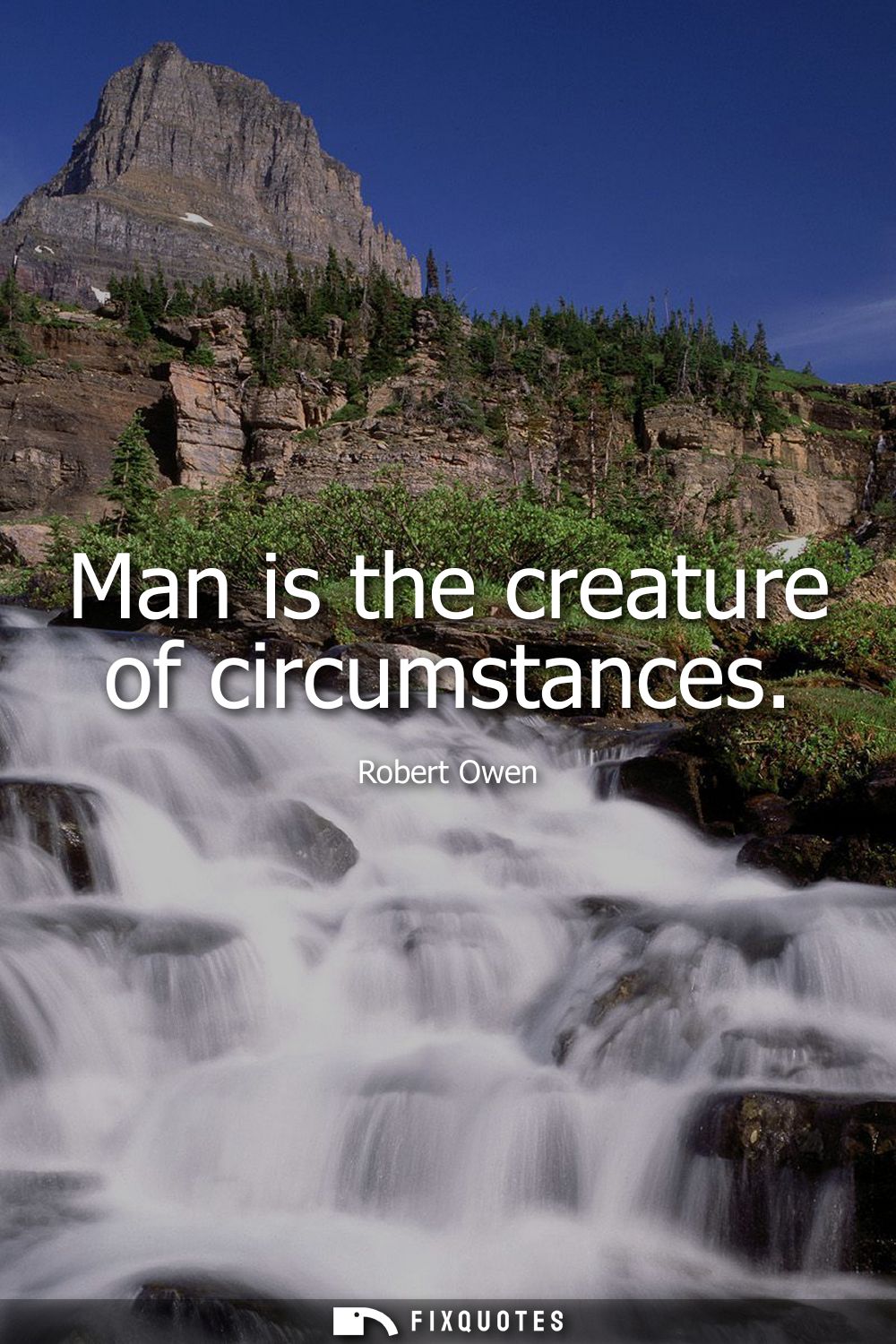
"Man is the creature of circumstances"
About this Quote
Robert Owen’s line lands like a quiet demolition charge under the Victorian cult of “self-made” virtue. “Man is the creature of circumstances” isn’t a shrug about fate; it’s an accusation aimed at a society that punishes the poor for conditions it manufactures. Owen, the factory owner-turned-social reformer, had seen how the era’s new industrial order didn’t just organize labor but engineered people: long hours, child work, alcoholism, crime, and “moral failure” weren’t mysterious flaws of character so much as predictable outputs of a brutal system.
The phrasing does tactical work. “Creature” makes the human being sound shaped, trained, almost bred - less sovereign agent than living product. That word choice is the subtextual punch: if people are made, they can be remade. Owen’s intent is reformist and pragmatic, not merely philosophical. He’s arguing for education, humane working conditions, and communal supports (the New Lanark experiment, later utopian projects) as technologies of character formation. The implication is ethically destabilizing for an audience invested in blame: if a thief is a “creature” of deprivation, then punishment alone is theater, not solution.
Context sharpens the edge. Late 18th- and early 19th-century Britain was rewriting daily life at factory speed while moral discourse lagged behind, clinging to individual sin and merit. Owen’s sentence offers a new moral math: responsibility doesn’t vanish, but it relocates upward, toward employers, lawmakers, and institutions. It’s an early, steel-framed version of what we’d now call structural analysis - delivered as a deceptively simple claim about human nature.
The phrasing does tactical work. “Creature” makes the human being sound shaped, trained, almost bred - less sovereign agent than living product. That word choice is the subtextual punch: if people are made, they can be remade. Owen’s intent is reformist and pragmatic, not merely philosophical. He’s arguing for education, humane working conditions, and communal supports (the New Lanark experiment, later utopian projects) as technologies of character formation. The implication is ethically destabilizing for an audience invested in blame: if a thief is a “creature” of deprivation, then punishment alone is theater, not solution.
Context sharpens the edge. Late 18th- and early 19th-century Britain was rewriting daily life at factory speed while moral discourse lagged behind, clinging to individual sin and merit. Owen’s sentence offers a new moral math: responsibility doesn’t vanish, but it relocates upward, toward employers, lawmakers, and institutions. It’s an early, steel-framed version of what we’d now call structural analysis - delivered as a deceptively simple claim about human nature.
Quote Details
| Topic | Free Will & Fate |
|---|
More Quotes by Robert
Add to List