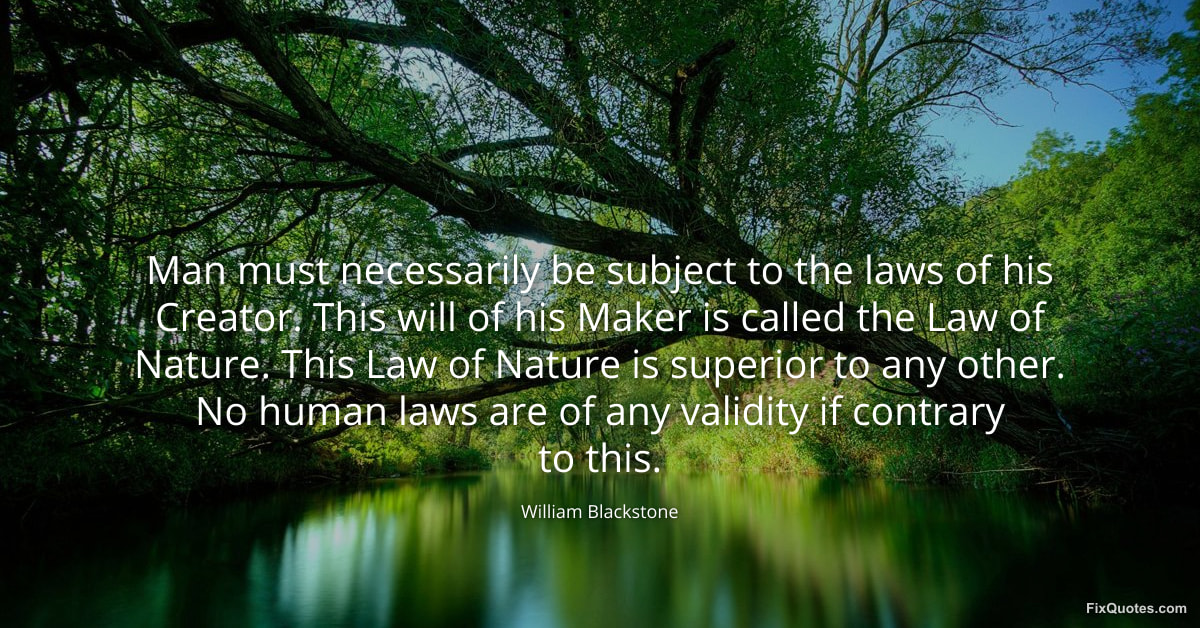
"Man must necessarily be subject to the laws of his Creator. This will of his Maker is called the Law of Nature. This Law of Nature is superior to any other. No human laws are of any validity if contrary to this"
About this Quote
The subtext is both conservative and incendiary. Conservative, because tethering law to the “Creator” promises stability, continuity, and an objective standard beyond fickle rulers. Incendiary, because once you claim a higher law, you hand dissidents a weapon: unjust statutes can be branded not merely bad policy but invalid law. That’s a powerful rhetorical lever in a world of expanding commerce, empire, and state power - and it becomes even more combustible when imported into American revolutionary thinking and later abolitionist arguments.
Blackstone’s elegance is that he frames this as plain reality, not theology. “Law of Nature” functions like an early-modern cheat code: it smuggles moral reasoning into legal doctrine while keeping the tone procedural. The line “No human laws are of any validity if contrary to this” isn’t a pious flourish; it’s a warning shot at sovereignty itself.
Quote Details
| Topic | Ethics & Morality |
|---|---|
| Source | Help us find the source |
| Cite |
Citation Formats
APA Style (7th ed.)
Blackstone, William. (2026, January 11). Man must necessarily be subject to the laws of his Creator. This will of his Maker is called the Law of Nature. This Law of Nature is superior to any other. No human laws are of any validity if contrary to this. FixQuotes. https://fixquotes.com/quotes/man-must-necessarily-be-subject-to-the-laws-of-173716/
Chicago Style
Blackstone, William. "Man must necessarily be subject to the laws of his Creator. This will of his Maker is called the Law of Nature. This Law of Nature is superior to any other. No human laws are of any validity if contrary to this." FixQuotes. January 11, 2026. https://fixquotes.com/quotes/man-must-necessarily-be-subject-to-the-laws-of-173716/.
MLA Style (9th ed.)
"Man must necessarily be subject to the laws of his Creator. This will of his Maker is called the Law of Nature. This Law of Nature is superior to any other. No human laws are of any validity if contrary to this." FixQuotes, 11 Jan. 2026, https://fixquotes.com/quotes/man-must-necessarily-be-subject-to-the-laws-of-173716/. Accessed 3 Apr. 2026.