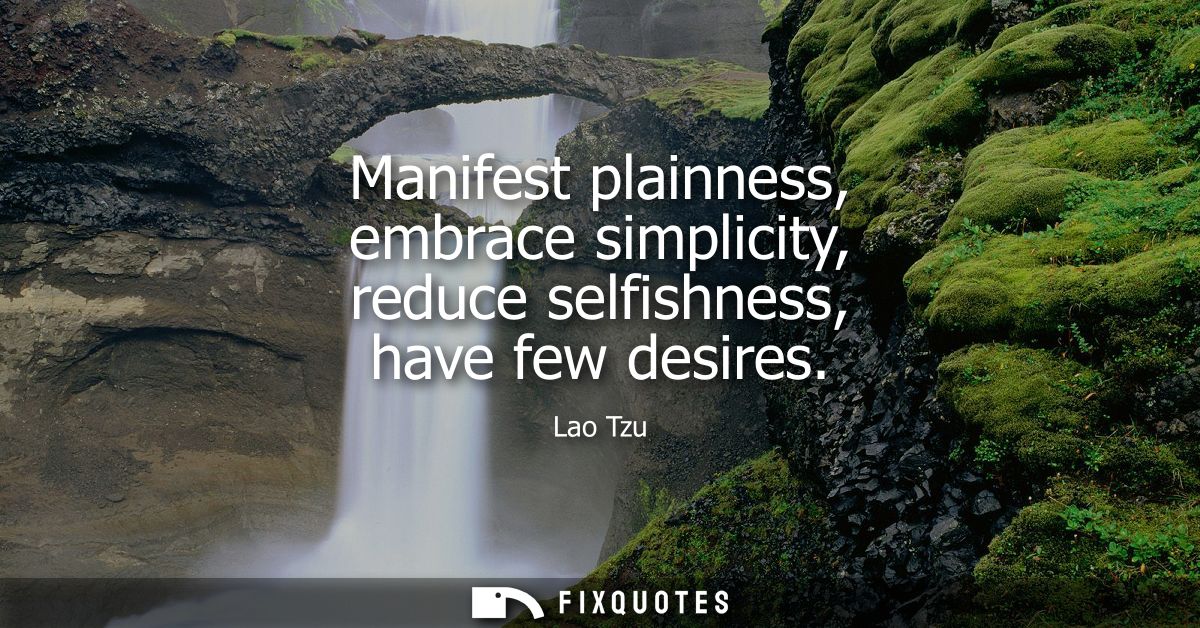
"Manifest plainness, embrace simplicity, reduce selfishness, have few desires"
About this Quote
Austere on the surface, this line is really a piece of philosophical judo: Lao Tzu doesn’t argue you into virtue, he drains the fight out of you. “Manifest plainness” isn’t about rustic aesthetics so much as a refusal of performance. In a culture where status, ritual competence, and ambition could harden into a social arms race, plainness becomes a kind of camouflage - a way of stepping out of the economy of showing off.
The sequencing matters. “Embrace simplicity” follows “plainness” because the move is internal as well as public: simplify the self, then simplify the life. “Reduce selfishness” is the pivot. Lao Tzu’s target isn’t pleasure in the modern sense; it’s the ego that turns every want into a project, every relationship into leverage, every achievement into identity. The clincher, “have few desires,” reads like deprivation until you catch the Daoist subtext: desire is not sinful, it’s noisy. It drags you into striving, comparison, and coercion - the exact behaviors that make rulers brutal and subjects brittle.
Context sharpens the stakes. Early Chinese thought is preoccupied with how to produce social order in eras of fragmentation and violence. Confucianism answers with ritual and hierarchy; Lao Tzu counters with subtraction. The intent is political as much as personal: a population less inflamed by craving is harder to manipulate, and a leader less invested in self is less tempted to overgovern. It’s minimalism as statecraft, an ethic that claims the most radical freedom comes from wanting less to begin with.
The sequencing matters. “Embrace simplicity” follows “plainness” because the move is internal as well as public: simplify the self, then simplify the life. “Reduce selfishness” is the pivot. Lao Tzu’s target isn’t pleasure in the modern sense; it’s the ego that turns every want into a project, every relationship into leverage, every achievement into identity. The clincher, “have few desires,” reads like deprivation until you catch the Daoist subtext: desire is not sinful, it’s noisy. It drags you into striving, comparison, and coercion - the exact behaviors that make rulers brutal and subjects brittle.
Context sharpens the stakes. Early Chinese thought is preoccupied with how to produce social order in eras of fragmentation and violence. Confucianism answers with ritual and hierarchy; Lao Tzu counters with subtraction. The intent is political as much as personal: a population less inflamed by craving is harder to manipulate, and a leader less invested in self is less tempted to overgovern. It’s minimalism as statecraft, an ethic that claims the most radical freedom comes from wanting less to begin with.
Quote Details
| Topic | Chinese Proverbs |
|---|
More Quotes by Lao
Add to List