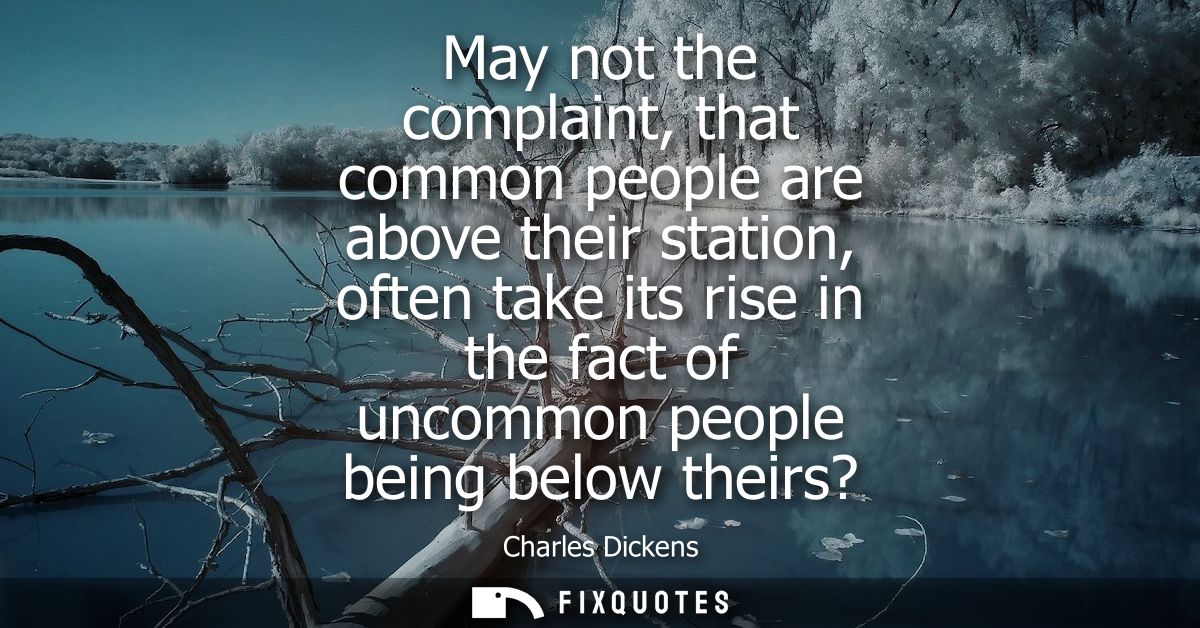
"May not the complaint, that common people are above their station, often take its rise in the fact of uncommon people being below theirs?"
About this Quote
The familiar complaint that common people are acting above their station often disguises a more uncomfortable truth: those deemed uncommon, the socially elevated, are failing to live up to theirs. Dickens pivots the accusation, turning a standard piece of class snobbery into a mirror for the elite. If hierarchy is supposed to rest on virtue, responsibility, and leadership, then the grumbling about insolent servants or presumptuous workers may simply register the collapse of virtue at the top rather than presumption below.
Victorian Britain buzzed with anxiety about mobility. Industrial wealth, political reform, and urban growth unsettled old hierarchies. Against this backdrop, Dickens repeatedly exposes how claims of privilege without service corrode social order. The problem is not that a blacksmith learns refinement or a clerk voices an opinion, but that baronets, financiers, and self-styled gentlemen neglect duty, charity, and honesty. Rank without character becomes a masquerade; the costume slips, and those underneath protest that the lower ranks are getting above themselves. Dickens implies that what looks like breach of deference is often a response to a vacuum of example.
Across his novels, he draws the contrast sharply. Moral dignity frequently belongs to the so-called common: Joe Gargery’s steadfastness, Stephen Blackpool’s conscience, the quiet decency of people without titles or fortune. By contrast, the uncommon often include the idle, vain, and predatory: aristocrats clinging to ceremony while ignoring justice, nouveau-riche poseurs polishing their image while crushing others. The irony bites because it reframes authority as a test of merit. If the top lived above reproach, honoring obligations and using power for the common good, complaints about the bottom would ring less loudly.
The line still resonates. Blame aimed downward can be a deflection from failures above. Status should be proved by conduct, not proclaimed by birth or balance sheet. When excellence and service fall short at the summit, aspiration below will look like insubordination, but it may be the most faithful tribute to the standards the summit abandoned.
Victorian Britain buzzed with anxiety about mobility. Industrial wealth, political reform, and urban growth unsettled old hierarchies. Against this backdrop, Dickens repeatedly exposes how claims of privilege without service corrode social order. The problem is not that a blacksmith learns refinement or a clerk voices an opinion, but that baronets, financiers, and self-styled gentlemen neglect duty, charity, and honesty. Rank without character becomes a masquerade; the costume slips, and those underneath protest that the lower ranks are getting above themselves. Dickens implies that what looks like breach of deference is often a response to a vacuum of example.
Across his novels, he draws the contrast sharply. Moral dignity frequently belongs to the so-called common: Joe Gargery’s steadfastness, Stephen Blackpool’s conscience, the quiet decency of people without titles or fortune. By contrast, the uncommon often include the idle, vain, and predatory: aristocrats clinging to ceremony while ignoring justice, nouveau-riche poseurs polishing their image while crushing others. The irony bites because it reframes authority as a test of merit. If the top lived above reproach, honoring obligations and using power for the common good, complaints about the bottom would ring less loudly.
The line still resonates. Blame aimed downward can be a deflection from failures above. Status should be proved by conduct, not proclaimed by birth or balance sheet. When excellence and service fall short at the summit, aspiration below will look like insubordination, but it may be the most faithful tribute to the standards the summit abandoned.
Quote Details
| Topic | Equality |
|---|
More Quotes by Charles
Add to List