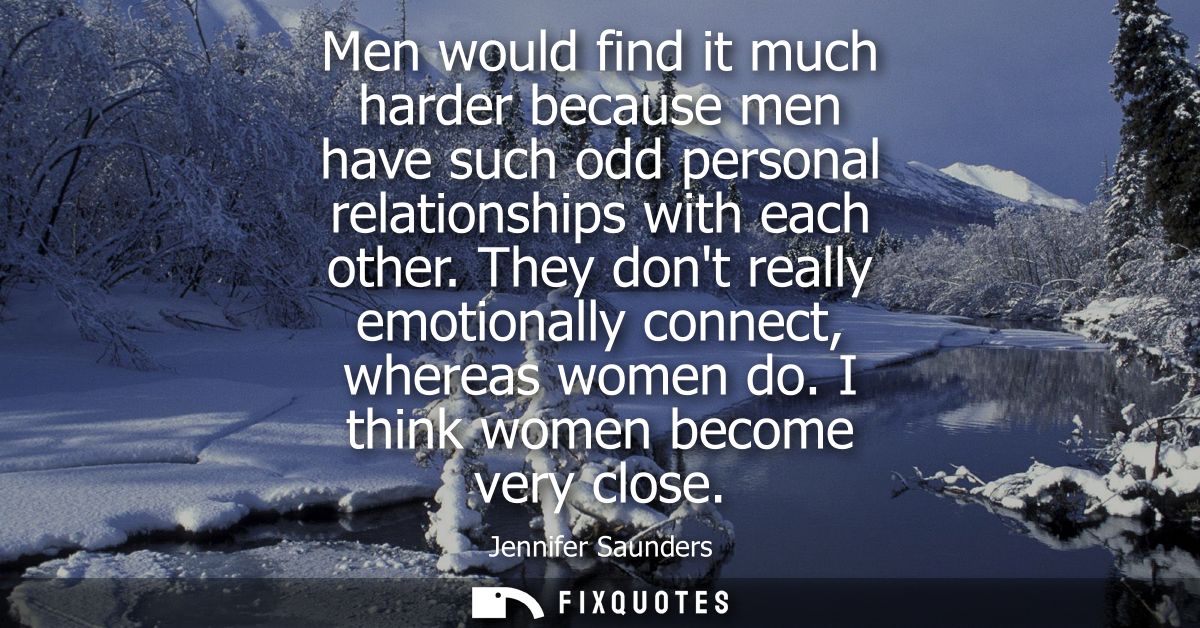
"Men would find it much harder because men have such odd personal relationships with each other. They don't really emotionally connect, whereas women do. I think women become very close!"
About this Quote
The subtext isn’t simply “women are better at emotions.” It’s that masculinity often forces relationships into narrow, performative lanes: connection must be disguised as humor, competition, or shared activity. Saunders’ “don’t really emotionally connect” lands as both jab and lament. The joke has teeth because it’s built on a recognizable cultural script: men are socialized to treat vulnerability as suspicious, even slightly indecent, while women are permitted - expected, even - to do the relational labor of checking in, escalating intimacy, making closeness legible.
Context matters: Saunders comes out of a British comedy tradition (and her own work, from Absolutely Fabulous onward) that thrives on puncturing polite fictions about gender and friendship. She’s not delivering sociology; she’s isolating an everyday tension and compressing it into a punchy generalization. It works because it flatters nobody. Women’s closeness reads as strength, but also as obligation; men’s distance reads as “odd,” but also as a cage they helped build.
Quote Details
| Topic | Friendship |
|---|---|
| Source | Help us find the source |
| Cite |
Citation Formats
APA Style (7th ed.)
Saunders, Jennifer. (2026, February 18). Men would find it much harder because men have such odd personal relationships with each other. They don't really emotionally connect, whereas women do. I think women become very close! FixQuotes. https://fixquotes.com/quotes/men-would-find-it-much-harder-because-men-have-68990/
Chicago Style
Saunders, Jennifer. "Men would find it much harder because men have such odd personal relationships with each other. They don't really emotionally connect, whereas women do. I think women become very close!" FixQuotes. February 18, 2026. https://fixquotes.com/quotes/men-would-find-it-much-harder-because-men-have-68990/.
MLA Style (9th ed.)
"Men would find it much harder because men have such odd personal relationships with each other. They don't really emotionally connect, whereas women do. I think women become very close!" FixQuotes, 18 Feb. 2026, https://fixquotes.com/quotes/men-would-find-it-much-harder-because-men-have-68990/. Accessed 6 Mar. 2026.