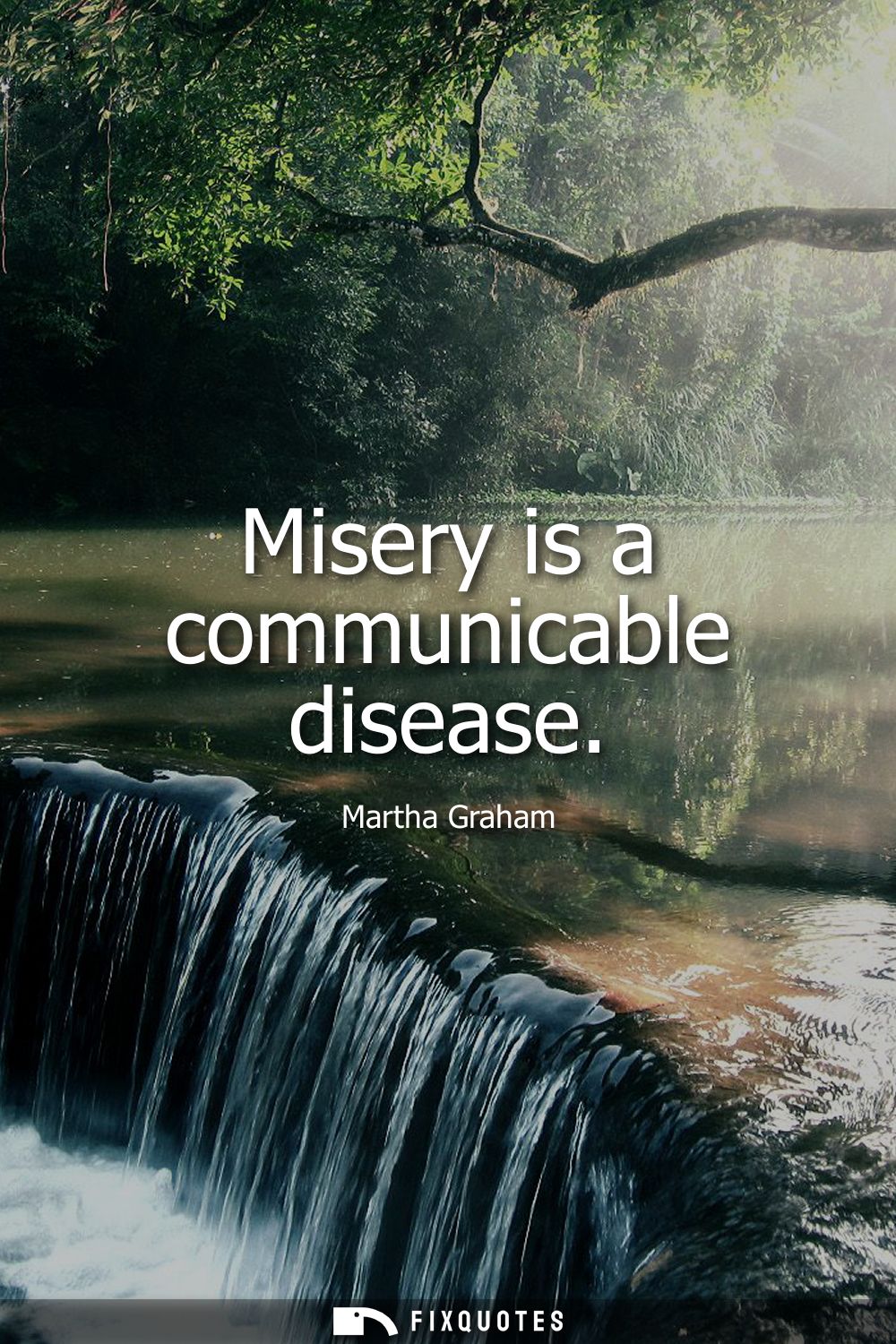
"Misery is a communicable disease"
About this Quote
Graham’s line is less self-help mantra than rehearsal-room epidemiology: misery spreads because bodies copy bodies. As a dancer who built a whole technique around breath, contraction, release, she knew emotion isn’t just “felt,” it’s transmitted through posture, timing, and attention. Call it communicable and she yanks sadness out of the realm of private tragedy and into public health. That’s the sting: if misery behaves like a pathogen, then we’re not innocent bystanders. We’re vectors.
The intent feels practical, even disciplinary. In a studio, one performer’s collapse of energy can infect the group’s focus; one cynical eye-roll can turn rigor into drift. Graham’s phrasing implies containment and responsibility: quarantine the habit, don’t romanticize it. She’s also quietly attacking the cultural glamour we attach to suffering, especially in the arts, where “tortured” often gets mistaken for “serious.” By naming misery as disease, she refuses to award it moral depth. It’s not proof of sensitivity; it’s a condition with consequences.
Context matters: Graham’s career ran through wars, depression, and the modernist conviction that art should metabolize crisis, not wallow in it. Her dances made anguish legible, but this quote suggests a boundary between using pain as material and letting pain become atmosphere. The subtext is bracing: your inner weather is not just yours. Your mood drafts a room. In an era that treats feelings as authenticity credentials, Graham offers a harder ethic: manage what you emit, because other people have to breathe it.
The intent feels practical, even disciplinary. In a studio, one performer’s collapse of energy can infect the group’s focus; one cynical eye-roll can turn rigor into drift. Graham’s phrasing implies containment and responsibility: quarantine the habit, don’t romanticize it. She’s also quietly attacking the cultural glamour we attach to suffering, especially in the arts, where “tortured” often gets mistaken for “serious.” By naming misery as disease, she refuses to award it moral depth. It’s not proof of sensitivity; it’s a condition with consequences.
Context matters: Graham’s career ran through wars, depression, and the modernist conviction that art should metabolize crisis, not wallow in it. Her dances made anguish legible, but this quote suggests a boundary between using pain as material and letting pain become atmosphere. The subtext is bracing: your inner weather is not just yours. Your mood drafts a room. In an era that treats feelings as authenticity credentials, Graham offers a harder ethic: manage what you emit, because other people have to breathe it.
Quote Details
| Topic | Sadness |
|---|
More Quotes by Martha
Add to List