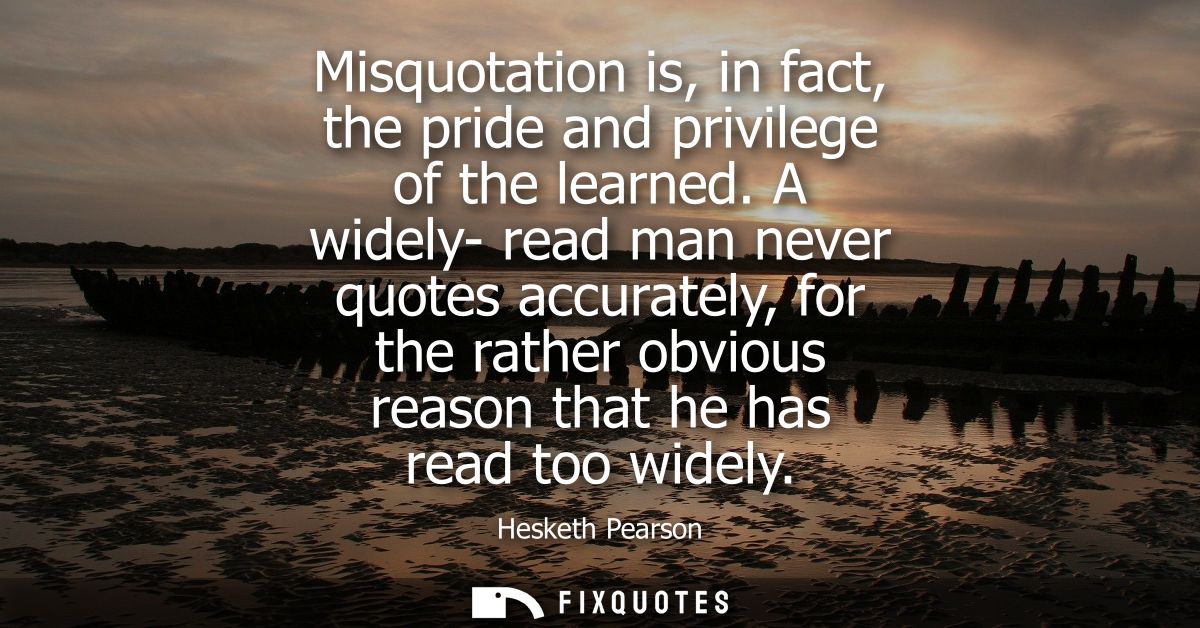
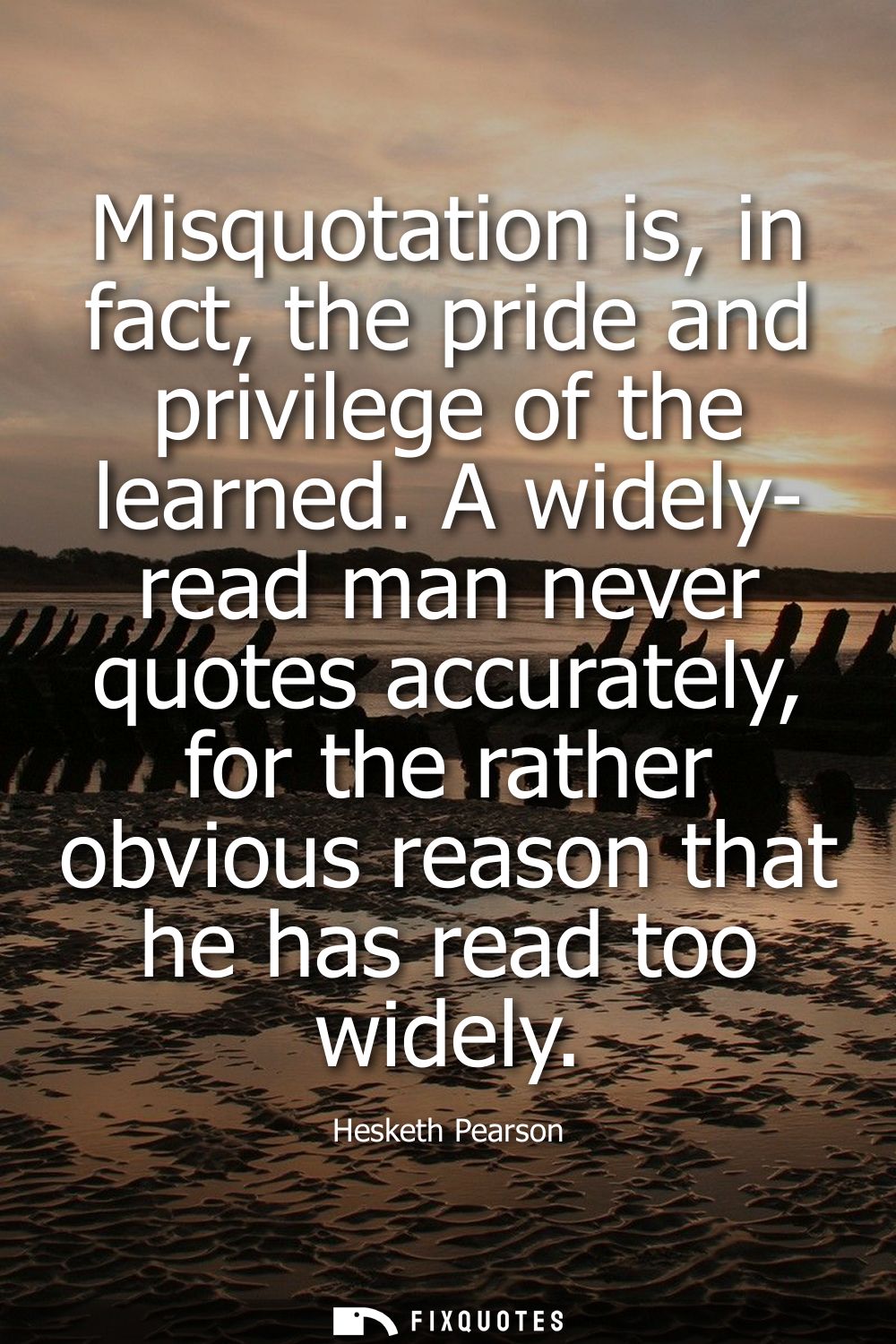
"Misquotation is, in fact, the pride and privilege of the learned. A widely- read man never quotes accurately, for the rather obvious reason that he has read too widely"
About this Quote
Hesketh Pearson's quote "Misquotation is, in reality, the pride and privilege of the found out. A widely-read male never ever prices estimate properly, for the rather obvious reason that he has actually read too extensively" uses a nuanced point of view on the nature of knowledge, memory, and the human tendency to reinterpret info. At its core, the declaration highlights the stress between extensive accuracy and the expansive breadth of a well-read person's knowledge.
Firstly, Pearson recommends that misquotation-- a relatively unfavorable act-- is in fact a hallmark of the learned. This assertion may initially appear paradoxical. How can misquoting, often thought about a mistake, provide pride for the educated? The reasoning here is not about celebrating inaccuracy however acknowledging that those who have actually consumed large quantities of details typically focus on understanding and synthesizing concepts, instead of verbatim retention. Misquotation, in this sense, becomes a reflection of processing, personal analysis, and the natural evolution of concepts as they are internalized and re-expressed by individuals.
The expression "a widely-read male never ever quotes accurately" discuss the idea that with extensive reading comes an abundance of influences. A person who has checked out broadly will inevitably draw from a large swimming pool of understanding and experiences. In the process of absorbing this info, the accurate phrasing of any provided quote might fade. What's retained is the essence or the thematic significance rather than the precise language. This reflects a more comprehensive intellectual engagement where the information, though still pertinent, are secondary to the overarching concepts they represent.
By asserting that large reading types misquotation, Pearson acknowledges human cognitive constraints-- it's almost difficult to keep verbatim all that one checks out-- however likewise raises the act of distillation and synthesis as important to facing complex, interconnected ideas. This point of view lines up with the more comprehensive philosophical concept that knowledge and knowledge are not simply about the accumulation of facts however about understanding, interpreting, and applying them in significant methods.
In essence, Pearson's quote underlines the value of intellectual synthesis over rote memorization, commemorating those who, through their extensive reading, contribute to the constant advancement of idea.
About the Author