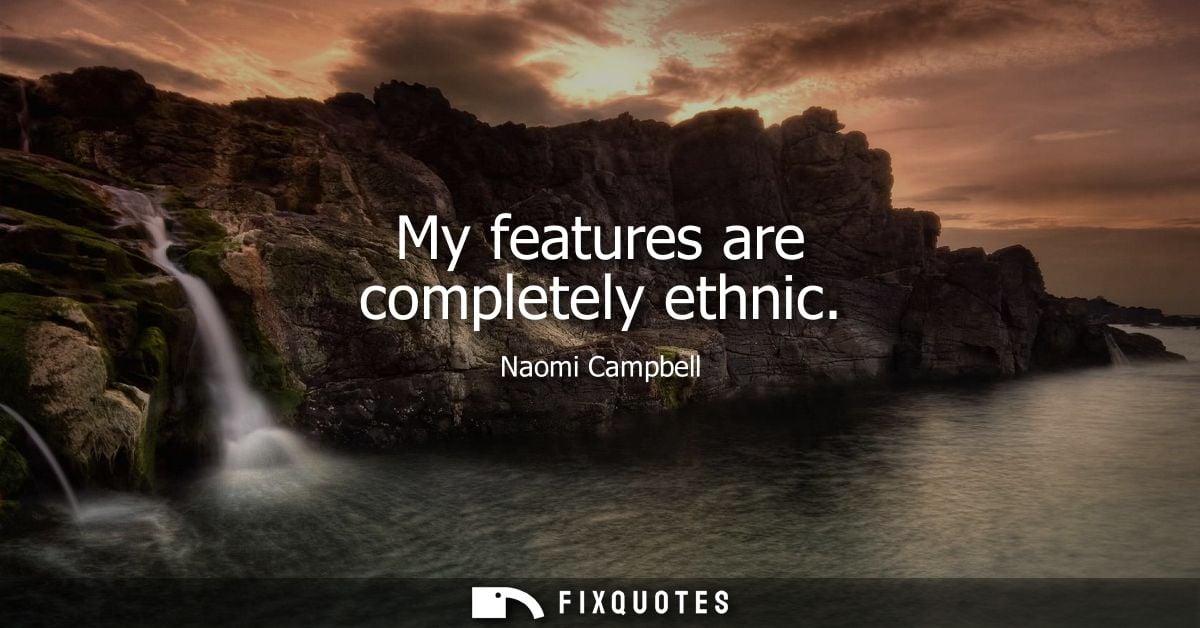
"My features are completely ethnic"
About this Quote
Spoken by a Black British supermodel who broke barriers in a notoriously Eurocentric industry, the statement functions as both declaration and refusal. It openly claims facial features associated with African and Afro-Caribbean ancestry in a world that long treated narrow, European profiles as the default ideal. Instead of softening, apologizing for, or concealing those traits, it asserts them as complete, sufficient, and beautiful.
The word ethnic is loaded. In fashion and beauty, it has often operated as a euphemism for nonwhite, a way of othering that marks some faces as deviations from a norm. Agencies and editors historically preferred ambiguous looks that could be marketed as exotic without confronting the industry’s biases. By saying her features are completely ethnic, Naomi Campbell flips the term’s logic. The fullness is the point. There is no halfway accommodation to Eurocentric standards, no promise to be palatable through dilution. The phrase reads as pride but also as a critique of the gaze that needs such labeling in the first place.
Context deepens its power. Campbell rose during an era when Black models were frequently excluded from runways and covers, when makeup artists and stylists were unprepared for darker skin and textured hair, and when casting directors limited representation to a token or two. She forced visibility, putting a face the industry had sidelined at the very center of global fashion. The statement draws a line between her personal identity and the cultural politics of appearance: acceptance of her features is not only self-affirmation, it is a demand that the market recalibrate its definitions of desirability.
There is also a sly universality. Everyone has an ethnicity; every face is ethnically situated. What gets called ethnic is simply what power has not normalized. By owning the label and insisting on wholeness, Campbell exposes that asymmetry and turns it into leverage, expanding what counts as beautiful and who gets to define it.
The word ethnic is loaded. In fashion and beauty, it has often operated as a euphemism for nonwhite, a way of othering that marks some faces as deviations from a norm. Agencies and editors historically preferred ambiguous looks that could be marketed as exotic without confronting the industry’s biases. By saying her features are completely ethnic, Naomi Campbell flips the term’s logic. The fullness is the point. There is no halfway accommodation to Eurocentric standards, no promise to be palatable through dilution. The phrase reads as pride but also as a critique of the gaze that needs such labeling in the first place.
Context deepens its power. Campbell rose during an era when Black models were frequently excluded from runways and covers, when makeup artists and stylists were unprepared for darker skin and textured hair, and when casting directors limited representation to a token or two. She forced visibility, putting a face the industry had sidelined at the very center of global fashion. The statement draws a line between her personal identity and the cultural politics of appearance: acceptance of her features is not only self-affirmation, it is a demand that the market recalibrate its definitions of desirability.
There is also a sly universality. Everyone has an ethnicity; every face is ethnically situated. What gets called ethnic is simply what power has not normalized. By owning the label and insisting on wholeness, Campbell exposes that asymmetry and turns it into leverage, expanding what counts as beautiful and who gets to define it.
Quote Details
| Topic | Equality |
|---|
More Quotes by Naomi
Add to List