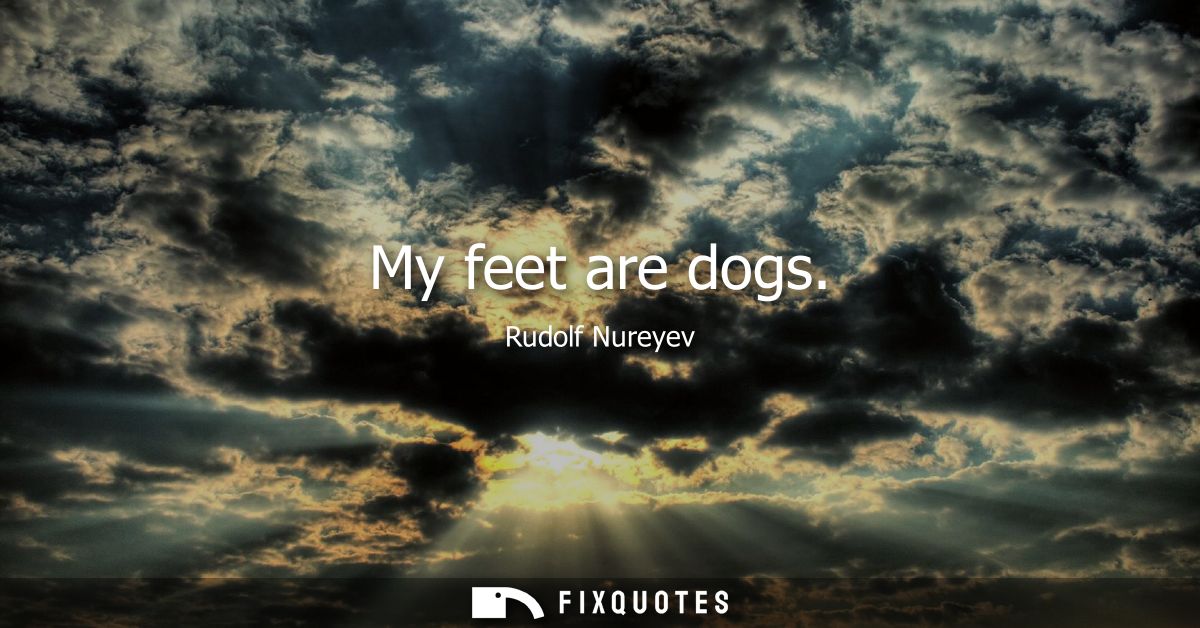
"My feet are dogs"
About this Quote
Nureyev’s line lands like a tossed-off joke, but it’s really a dancer’s private apocalypse rendered in four blunt words. “My feet are dogs” is comic degradation: the instrument that makes him divine onstage is, offstage, a pair of beaten animals. He doesn’t say his feet hurt or ache; he gives them a species, a smell, a stubborn, panting life of their own. The phrasing carries the weary affection of someone who depends on them while resenting what they demand.
The intent is both deflection and confession. Dancers are trained to aestheticize suffering, to turn strain into line and lift. Nureyev refuses the pretty euphemism. He collapses glamour into the low, physical reality of labor: blisters, bunions, bruised toenails, the cumulative damage that ballet’s clean silhouettes politely hide. Calling them “dogs” also sneaks in class and grit. Ballet sells aristocratic polish; Nureyev, the Soviet defector who became an international myth, flags the working body under the crown.
The subtext is control, too. Feet are a dancer’s currency and their captivity. They travel the world, they earn the applause, they also tether you to constant maintenance and pain. In the context of Nureyev’s reputation - ferocious technique, voracious ambition, a life lived at high voltage - the line reads as a grim punchline about the cost of virtuosity. The audience gets transcendence; the dancer goes home with animals at the end of his legs, demanding to be fed, bandaged, and taken out again tomorrow.
The intent is both deflection and confession. Dancers are trained to aestheticize suffering, to turn strain into line and lift. Nureyev refuses the pretty euphemism. He collapses glamour into the low, physical reality of labor: blisters, bunions, bruised toenails, the cumulative damage that ballet’s clean silhouettes politely hide. Calling them “dogs” also sneaks in class and grit. Ballet sells aristocratic polish; Nureyev, the Soviet defector who became an international myth, flags the working body under the crown.
The subtext is control, too. Feet are a dancer’s currency and their captivity. They travel the world, they earn the applause, they also tether you to constant maintenance and pain. In the context of Nureyev’s reputation - ferocious technique, voracious ambition, a life lived at high voltage - the line reads as a grim punchline about the cost of virtuosity. The audience gets transcendence; the dancer goes home with animals at the end of his legs, demanding to be fed, bandaged, and taken out again tomorrow.
Quote Details
| Topic | Witty One-Liners |
|---|
More Quotes by Rudolf
Add to List