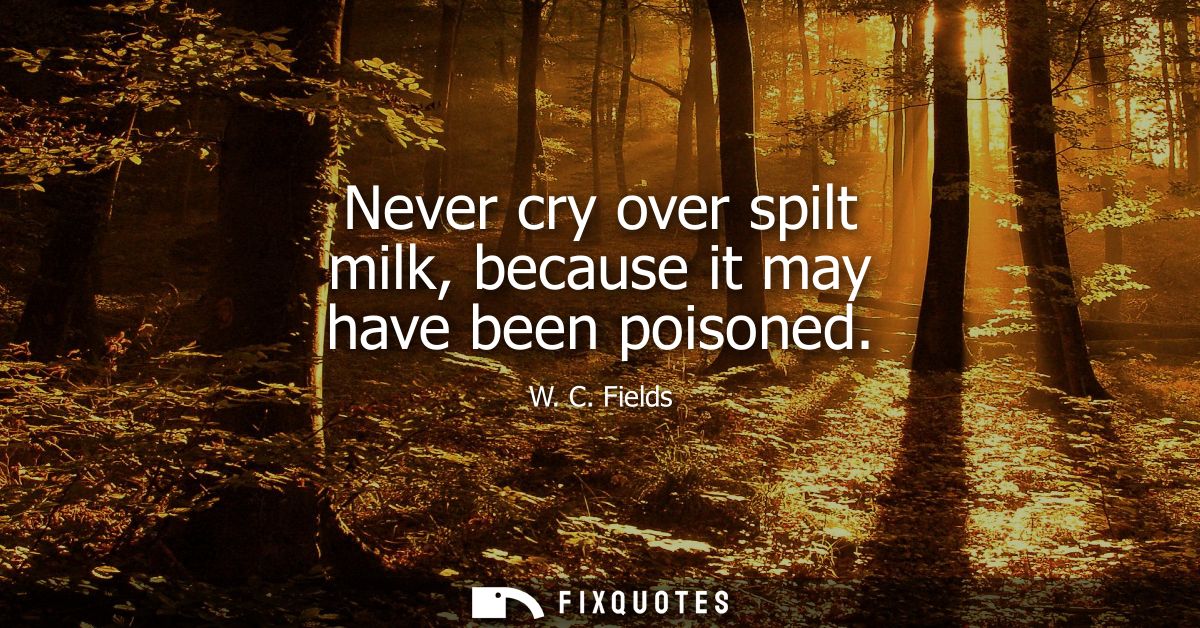
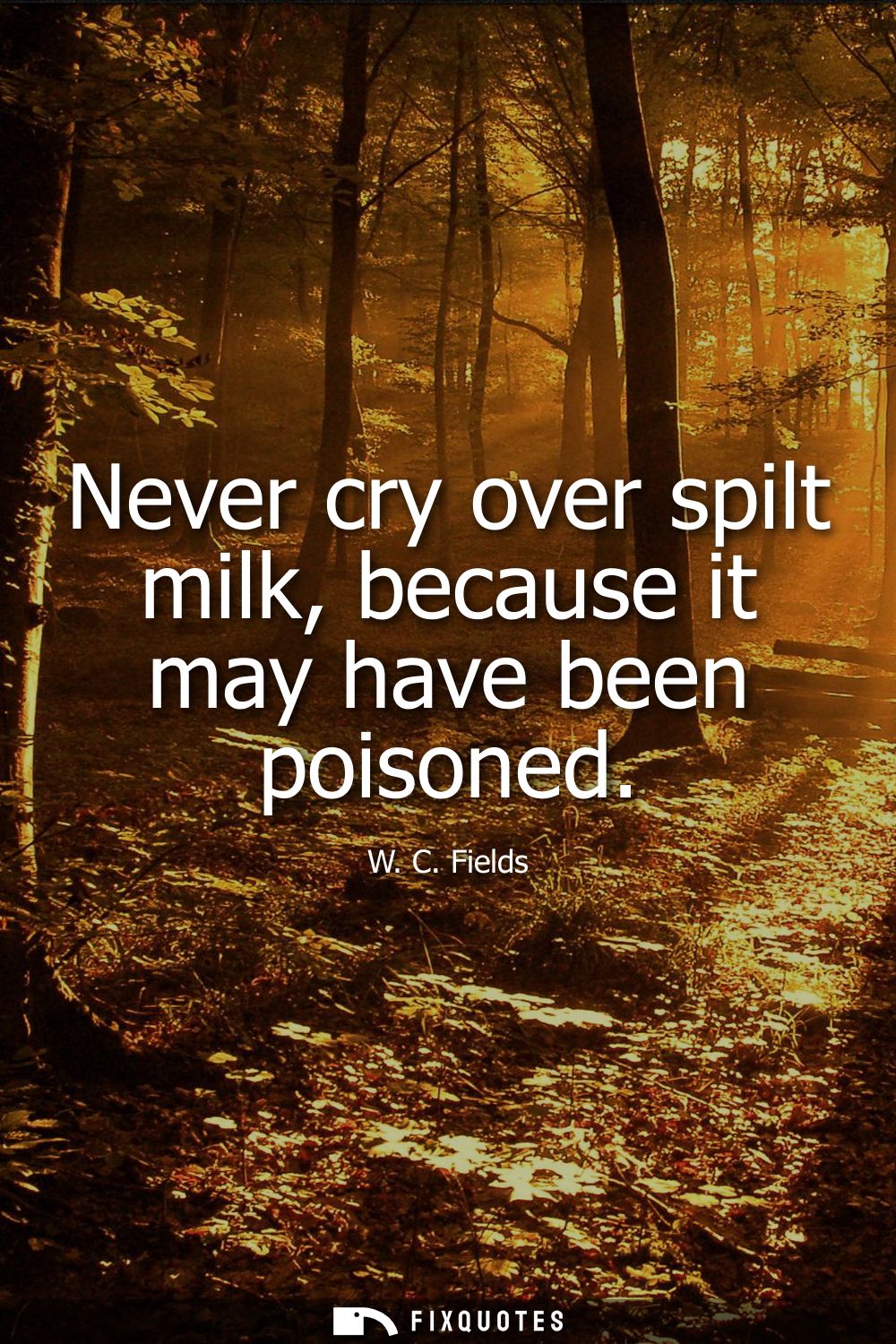
"Never cry over spilt milk, because it may have been poisoned"
About this Quote
Fields takes a nursery-grade moral lesson and spikes it with a wink of arsenic. The familiar proverb is designed to soothe: accidents happen, don’t dwell. He keeps the cadence but yanks the comfort out from under it, suggesting the real problem isn’t the mess, it’s that the mess might have saved you. That turn is pure W. C. Fields: a man whose screen persona treated optimism as a scam and good manners as a con job with better lighting.
The specific intent is comedic sabotage. By adding “because it may have been poisoned,” Fields weaponizes paranoia as punchline, revealing how easily “common sense” can be repurposed to justify suspicion. It’s not advice so much as a worldview in miniature: catastrophe is always plausible, and even the consolations we inherit are unreliable. The joke lands because it turns emotional regulation into self-preservation. Don’t cry, not because it’s petty, but because your grief might be misplaced; the universe isn’t merely indifferent, it’s potentially hostile.
Subtextually, it’s also a jab at moralizing. Proverbs pretend to be wisdom without cost. Fields exposes their thinness by proposing an equally “wise” add-on that’s obviously absurd yet weirdly coherent. The line invites the audience to laugh at how easily we can rationalize anything after the fact, especially if it flatters our cynicism.
Context matters: Fields comes out of vaudeville and early Hollywood, eras when hard luck, grift, and mistrust were common material. The poisoned milk is hyperbole, but the mood is Depression-era realism dressed as a one-liner: when life spills, assume it wasn’t pure to begin with.
The specific intent is comedic sabotage. By adding “because it may have been poisoned,” Fields weaponizes paranoia as punchline, revealing how easily “common sense” can be repurposed to justify suspicion. It’s not advice so much as a worldview in miniature: catastrophe is always plausible, and even the consolations we inherit are unreliable. The joke lands because it turns emotional regulation into self-preservation. Don’t cry, not because it’s petty, but because your grief might be misplaced; the universe isn’t merely indifferent, it’s potentially hostile.
Subtextually, it’s also a jab at moralizing. Proverbs pretend to be wisdom without cost. Fields exposes their thinness by proposing an equally “wise” add-on that’s obviously absurd yet weirdly coherent. The line invites the audience to laugh at how easily we can rationalize anything after the fact, especially if it flatters our cynicism.
Context matters: Fields comes out of vaudeville and early Hollywood, eras when hard luck, grift, and mistrust were common material. The poisoned milk is hyperbole, but the mood is Depression-era realism dressed as a one-liner: when life spills, assume it wasn’t pure to begin with.
Quote Details
| Topic | Witty One-Liners |
|---|---|
| Source | Help us find the source |
| Cite |
Citation Formats
APA Style (7th ed.)
Fields, W. C. (2026, January 16). Never cry over spilt milk, because it may have been poisoned. FixQuotes. https://fixquotes.com/quotes/never-cry-over-spilt-milk-because-it-may-have-137817/
Chicago Style
Fields, W. C. "Never cry over spilt milk, because it may have been poisoned." FixQuotes. January 16, 2026. https://fixquotes.com/quotes/never-cry-over-spilt-milk-because-it-may-have-137817/.
MLA Style (9th ed.)
"Never cry over spilt milk, because it may have been poisoned." FixQuotes, 16 Jan. 2026, https://fixquotes.com/quotes/never-cry-over-spilt-milk-because-it-may-have-137817/. Accessed 31 Mar. 2026.
More Quotes by C. Fields
Add to List