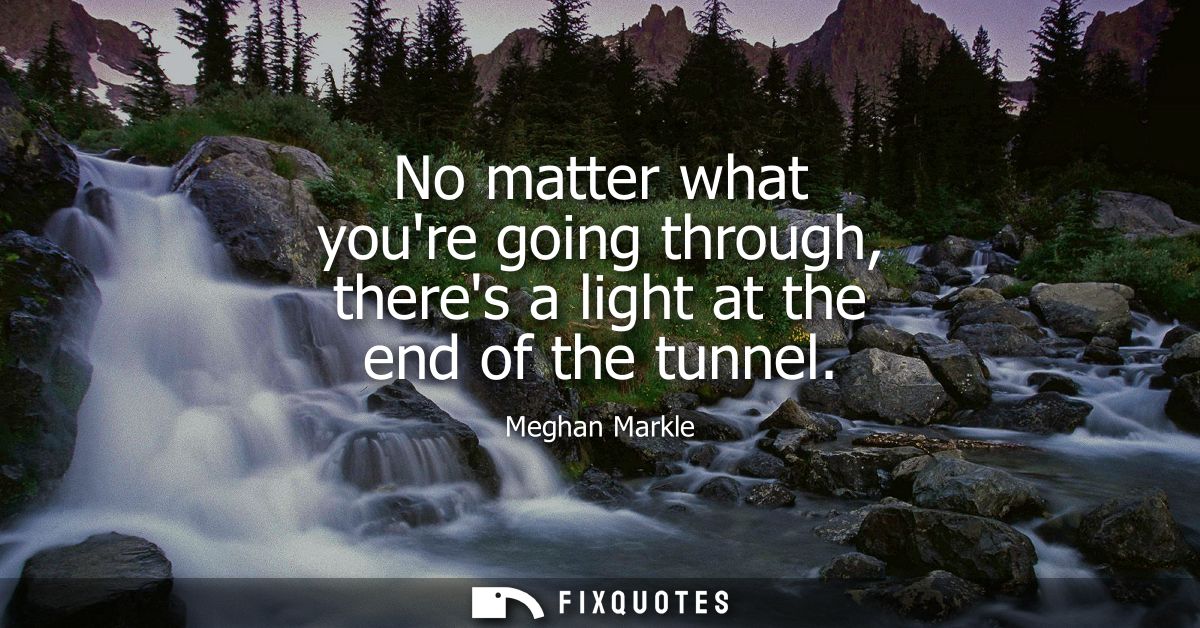
"No matter what you're going through, there's a light at the end of the tunnel"
About this Quote
The subtext is where it gets sharper. “No matter what you’re going through” performs radical inclusivity, but it also politely refuses specifics. In Markle’s orbit - celebrity, monarchy, tabloid harassment, mental health disclosures - specificity becomes ammunition. Vagueness isn’t laziness here; it’s a shield. The tunnel metaphor does the rest: it frames suffering as linear and time-bound, a passage rather than a home. That’s psychologically potent because it relocates pain from identity (“I am broken”) to narrative (“I am moving through something”).
Culturally, this is modern wellness-speak with good PR instincts. It’s aspirational without being preachy, therapeutic without sounding clinical, and it fits a media environment that rewards portable hope: a sentence that can live on a caption, a keynote stage, or a crisis hotline poster. The risk is the same as its strength: light-at-the-end messaging can feel inadequate to people trapped in structural darkness. Still, as celebrity rhetoric, it works because it offers hope while quietly sidestepping the question everyone always asks: “So what exactly happened?”
Quote Details
| Topic | Hope |
|---|---|
| Source | Help us find the source |
| Cite |
Citation Formats
APA Style (7th ed.)
Markle, Meghan. (2026, January 15). No matter what you're going through, there's a light at the end of the tunnel. FixQuotes. https://fixquotes.com/quotes/no-matter-what-youre-going-through-theres-a-light-171804/
Chicago Style
Markle, Meghan. "No matter what you're going through, there's a light at the end of the tunnel." FixQuotes. January 15, 2026. https://fixquotes.com/quotes/no-matter-what-youre-going-through-theres-a-light-171804/.
MLA Style (9th ed.)
"No matter what you're going through, there's a light at the end of the tunnel." FixQuotes, 15 Jan. 2026, https://fixquotes.com/quotes/no-matter-what-youre-going-through-theres-a-light-171804/. Accessed 2 Apr. 2026.