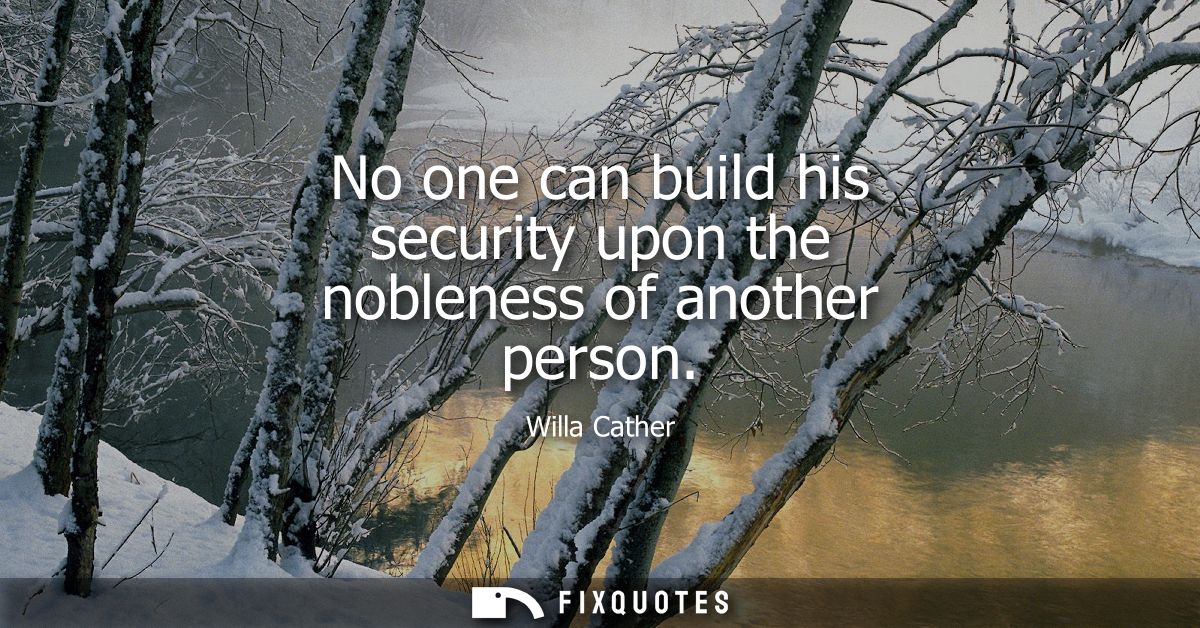
"No one can build his security upon the nobleness of another person"
About this Quote
The line warns against the seductive comfort of borrowed virtue. Nobleness names generosity, honor, steadfastness. Those qualities in someone else can shelter us for a while, but they cannot be a foundation. People tire, falter, change, or die; circumstances shift; and even the most principled person cannot control every outcome. To base safety, identity, or moral standing on another’s character is to mistake a gift for a guarantee.
Willa Cather often wrote about communities that orbited a single admirable figure, the gracious patron, the honorable pioneer, the steadfast matriarch. When that center gives way, the orbit collapses and a harder, more opportunistic world floods in. The observation here carries the clear-eyed realism of the prairie, where survival depended less on sentiment than on inner resources and practical arrangements. It is not a rejection of nobility; it is a refusal to make nobility do the work of prudence.
The insight reaches from private life to civic life. In love or friendship, admiration can become abdication, a way of outsourcing conscience, livelihood, or boundaries to someone we believe will always do right by us. That is a fragile wager. In politics, trusting a leader’s goodness to protect rights neglects the sturdier work of laws, institutions, and shared responsibility. Charisma and virtue may inspire, but they cannot replace systems and habits that outlast individuals.
Cather’s fiction often charts the passage from an era of personal honor to one of impersonal forces. The ethical task, she suggests, is not to become cynical but to be adult: grateful for the noble, yet committed to building security on what we can cultivate and maintain ourselves. Integrity, competence, community bonds, and resilient structures are the ground. Nobleness from others is grace, not insurance.
Willa Cather often wrote about communities that orbited a single admirable figure, the gracious patron, the honorable pioneer, the steadfast matriarch. When that center gives way, the orbit collapses and a harder, more opportunistic world floods in. The observation here carries the clear-eyed realism of the prairie, where survival depended less on sentiment than on inner resources and practical arrangements. It is not a rejection of nobility; it is a refusal to make nobility do the work of prudence.
The insight reaches from private life to civic life. In love or friendship, admiration can become abdication, a way of outsourcing conscience, livelihood, or boundaries to someone we believe will always do right by us. That is a fragile wager. In politics, trusting a leader’s goodness to protect rights neglects the sturdier work of laws, institutions, and shared responsibility. Charisma and virtue may inspire, but they cannot replace systems and habits that outlast individuals.
Cather’s fiction often charts the passage from an era of personal honor to one of impersonal forces. The ethical task, she suggests, is not to become cynical but to be adult: grateful for the noble, yet committed to building security on what we can cultivate and maintain ourselves. Integrity, competence, community bonds, and resilient structures are the ground. Nobleness from others is grace, not insurance.
Quote Details
| Topic | Wisdom |
|---|
More Quotes by Willa
Add to List