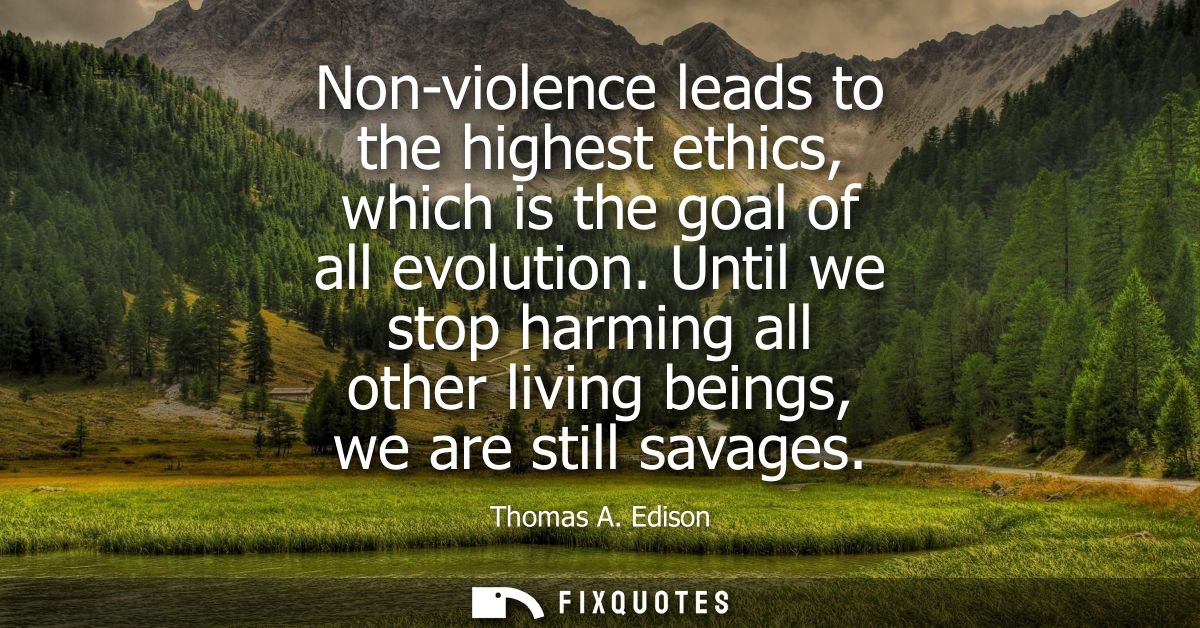
"Non-violence leads to the highest ethics, which is the goal of all evolution. Until we stop harming all other living beings, we are still savages"
About this Quote
Edison, the patron saint of applied ingenuity, reaches for a moral voltage here: progress is meaningless if it only powers bigger appetites. The line flatters the modern faith in evolution and improvement, then flips it into an indictment. If evolution has a destination, he argues, it is ethical refinement, not just smarter tools. That’s a shrewd move from an inventor whose reputation is built on making life more efficient; he’s quietly warning that efficiency without restraint is just a faster kind of brutality.
The phrasing is doing deliberate work. “Highest ethics” sounds like a technical benchmark, as if morality can be engineered, measured, upgraded. It’s a culturally savvy pitch to an industrial age that worshiped optimization. Then comes the insult: “savages.” It’s blunt, even inflammatory, and it reveals the period’s moral hierarchy language, where “civilization” is a badge and “savage” a cudgel. Edison weaponizes that binary to shame the reader into identifying with the “advanced” side - and to suggest that violence toward animals (and, by implication, the natural world) is the tell that we’re still primitive.
The subtext is also self-protective: if the 20th century is going to remake the planet with electricity, factories, and mass production, it needs a counterweight that keeps “innovation” from becoming an alibi. Nonviolence becomes not saintliness but a definition of what real progress would look like: extending the circle of consideration beyond our species, or admitting that our celebrated modernity is just savagery with better lighting.
The phrasing is doing deliberate work. “Highest ethics” sounds like a technical benchmark, as if morality can be engineered, measured, upgraded. It’s a culturally savvy pitch to an industrial age that worshiped optimization. Then comes the insult: “savages.” It’s blunt, even inflammatory, and it reveals the period’s moral hierarchy language, where “civilization” is a badge and “savage” a cudgel. Edison weaponizes that binary to shame the reader into identifying with the “advanced” side - and to suggest that violence toward animals (and, by implication, the natural world) is the tell that we’re still primitive.
The subtext is also self-protective: if the 20th century is going to remake the planet with electricity, factories, and mass production, it needs a counterweight that keeps “innovation” from becoming an alibi. Nonviolence becomes not saintliness but a definition of what real progress would look like: extending the circle of consideration beyond our species, or admitting that our celebrated modernity is just savagery with better lighting.
Quote Details
| Topic | Ethics & Morality |
|---|
More Quotes by Thomas
Add to List