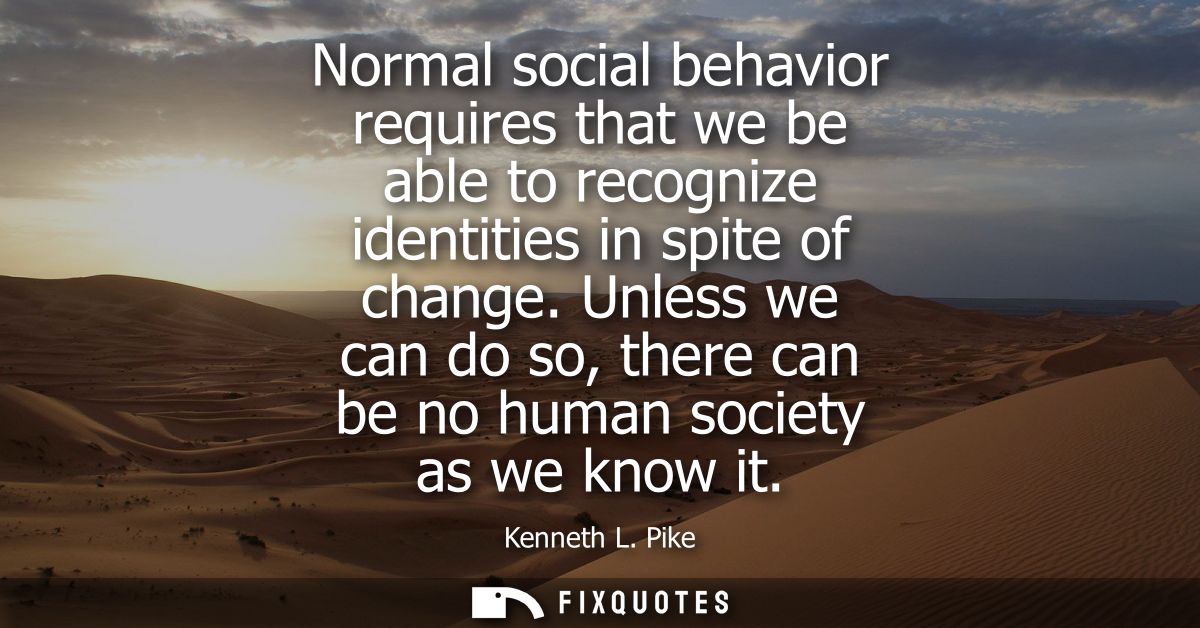
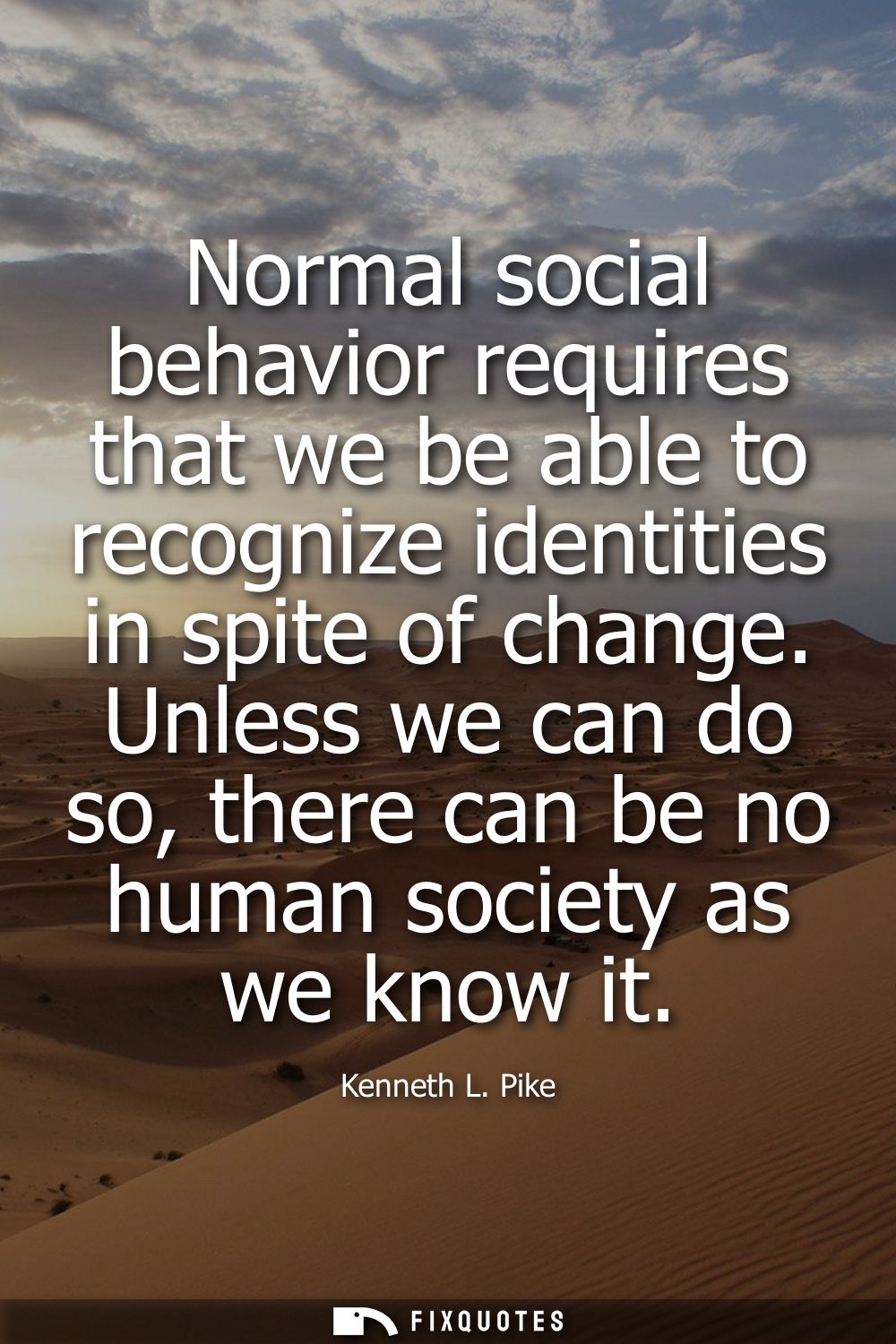
"Normal social behavior requires that we be able to recognize identities in spite of change. Unless we can do so, there can be no human society as we know it"
About this Quote
Society runs on a quiet cognitive trick: we pretend continuity where life keeps insisting on flux. Pike’s line isn’t romantic about community; it’s almost infrastructural. “Normal social behavior” sounds bland, but it’s doing heavy lifting, pointing to the ordinary rituals that make a day legible: greeting a friend after a haircut, trusting a coworker after a mistake, treating a parent as the same person across decades. The quote frames identity-recognition not as a philosophical luxury but as a precondition for coordination. Without it, every interaction resets to zero.
The intent is diagnostic. Pike is naming the social payoff of a mental capacity we rarely notice: stabilizing persons, roles, and obligations despite visible change. The subtext is that identity is less a discovered essence than a negotiated pattern. We agree, socially, to keep counting you as “you” even as your body ages, your opinions shift, your status rises or collapses. That agreement is what makes promises enforceable, forgiveness possible, and accountability meaningful. If you can’t recognize sameness through change, you can’t sustain trust; if you can’t sustain trust, you don’t get institutions, only crowds.
Context matters: Pike worked in mid-20th-century social science, when scholars were preoccupied with how meaning and order are produced, not merely assumed. His phrasing anticipates later anxieties about modernity: mobility, bureaucracy, and rapid cultural change strain the mechanisms that let us file people into stable categories. The line reads like a warning shot: destabilize identity-recognition and you don’t just confuse individuals - you unmake the social world that relies on that shared, convenient fiction.
The intent is diagnostic. Pike is naming the social payoff of a mental capacity we rarely notice: stabilizing persons, roles, and obligations despite visible change. The subtext is that identity is less a discovered essence than a negotiated pattern. We agree, socially, to keep counting you as “you” even as your body ages, your opinions shift, your status rises or collapses. That agreement is what makes promises enforceable, forgiveness possible, and accountability meaningful. If you can’t recognize sameness through change, you can’t sustain trust; if you can’t sustain trust, you don’t get institutions, only crowds.
Context matters: Pike worked in mid-20th-century social science, when scholars were preoccupied with how meaning and order are produced, not merely assumed. His phrasing anticipates later anxieties about modernity: mobility, bureaucracy, and rapid cultural change strain the mechanisms that let us file people into stable categories. The line reads like a warning shot: destabilize identity-recognition and you don’t just confuse individuals - you unmake the social world that relies on that shared, convenient fiction.
Quote Details
| Topic | Reason & Logic |
|---|
More Quotes by Kenneth
Add to List