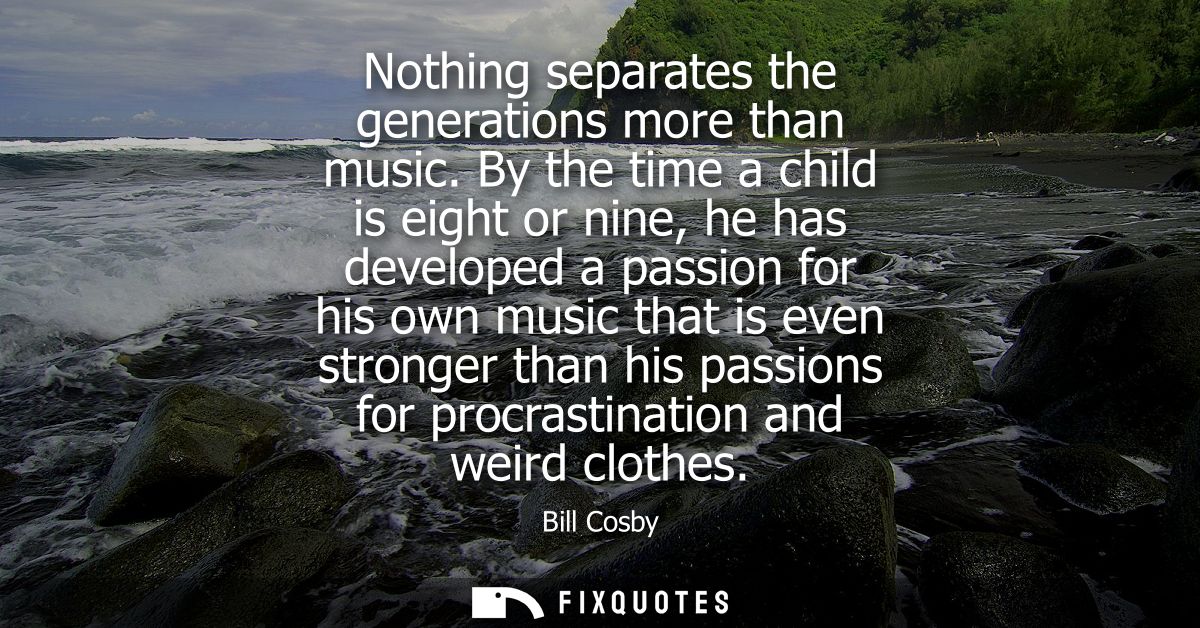
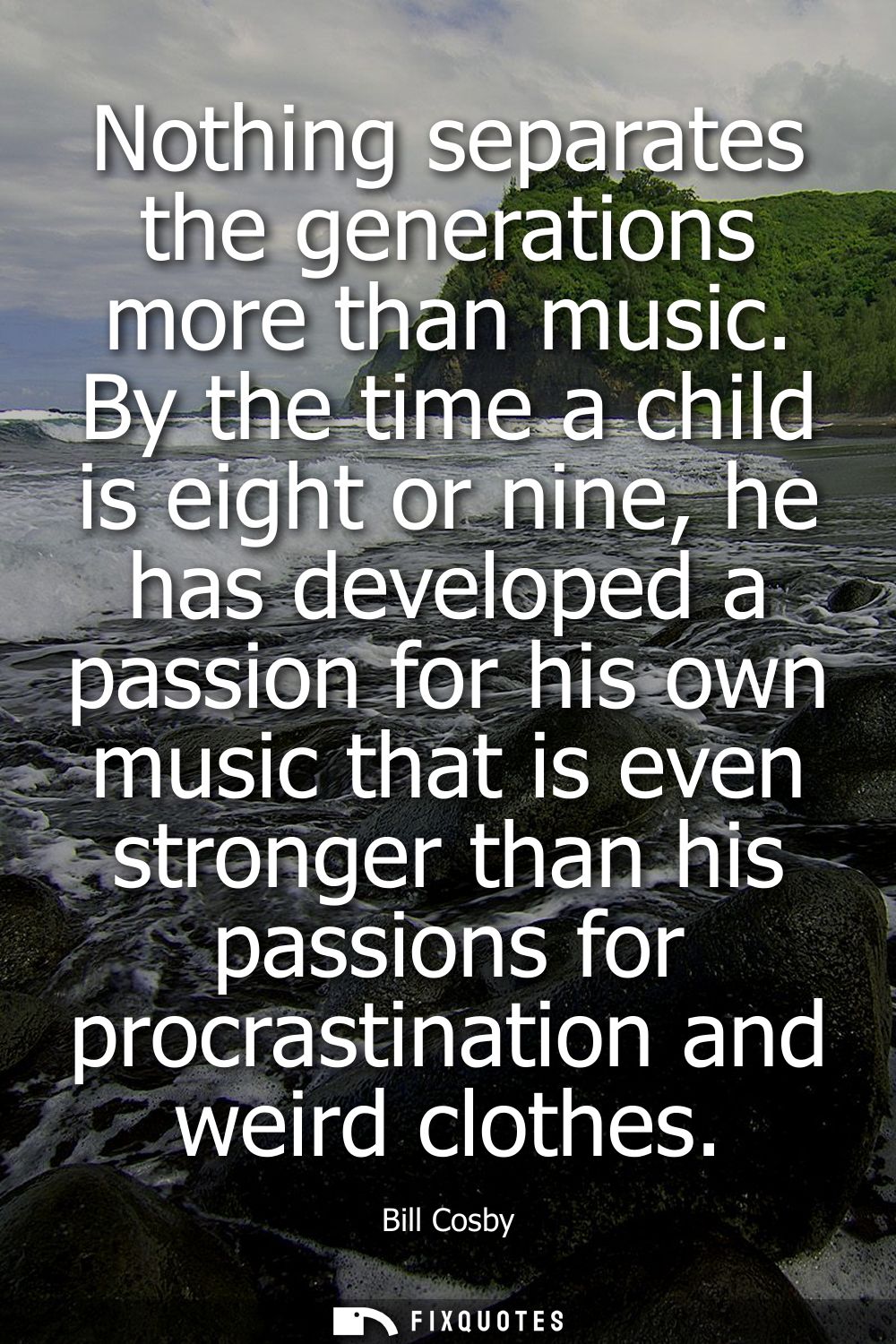
"Nothing separates the generations more than music. By the time a child is eight or nine, he has developed a passion for his own music that is even stronger than his passions for procrastination and weird clothes"
About this Quote
The specific intent is to get laughs from a recognition: adults don’t just dislike kids’ music, they feel excluded by it. Music becomes the earliest, loudest badge of autonomy. Eight or nine is chosen for precision, not accuracy; it’s an age that reads as comically young for “passion,” which heightens the absurdity of how fiercely kids will defend whatever feels like theirs. Calling it “his own music” is the key phrase. It frames taste as property, a private territory parents can’t annex.
The subtext is affectionate and slightly cynical: generational conflict isn’t primarily about politics or morals, it’s about symbols. The child’s playlist is a low-stakes rebellion that rehearses higher-stakes ones. Cosby’s rhythm also flatters the parent’s exasperation: you’re not out of touch, you’re encountering an inevitable rite of passage.
Contextually, it lands in a late-20th-century America where pop culture accelerated and youth markets hardened. Music stopped being background entertainment and became a portable identity, turning the living room into a border checkpoint. Note: Cosby’s later crimes complicate any nostalgia around his “family comedy” persona, but the line still illustrates how stand-up distilled cultural change into a household punchline.
Quote Details
| Topic | Music |
|---|---|
| Source | Help us find the source |
| Cite |
Citation Formats
APA Style (7th ed.)
Cosby, Bill. (2026, January 18). Nothing separates the generations more than music. By the time a child is eight or nine, he has developed a passion for his own music that is even stronger than his passions for procrastination and weird clothes. FixQuotes. https://fixquotes.com/quotes/nothing-separates-the-generations-more-than-music-15365/
Chicago Style
Cosby, Bill. "Nothing separates the generations more than music. By the time a child is eight or nine, he has developed a passion for his own music that is even stronger than his passions for procrastination and weird clothes." FixQuotes. January 18, 2026. https://fixquotes.com/quotes/nothing-separates-the-generations-more-than-music-15365/.
MLA Style (9th ed.)
"Nothing separates the generations more than music. By the time a child is eight or nine, he has developed a passion for his own music that is even stronger than his passions for procrastination and weird clothes." FixQuotes, 18 Jan. 2026, https://fixquotes.com/quotes/nothing-separates-the-generations-more-than-music-15365/. Accessed 26 Mar. 2026.