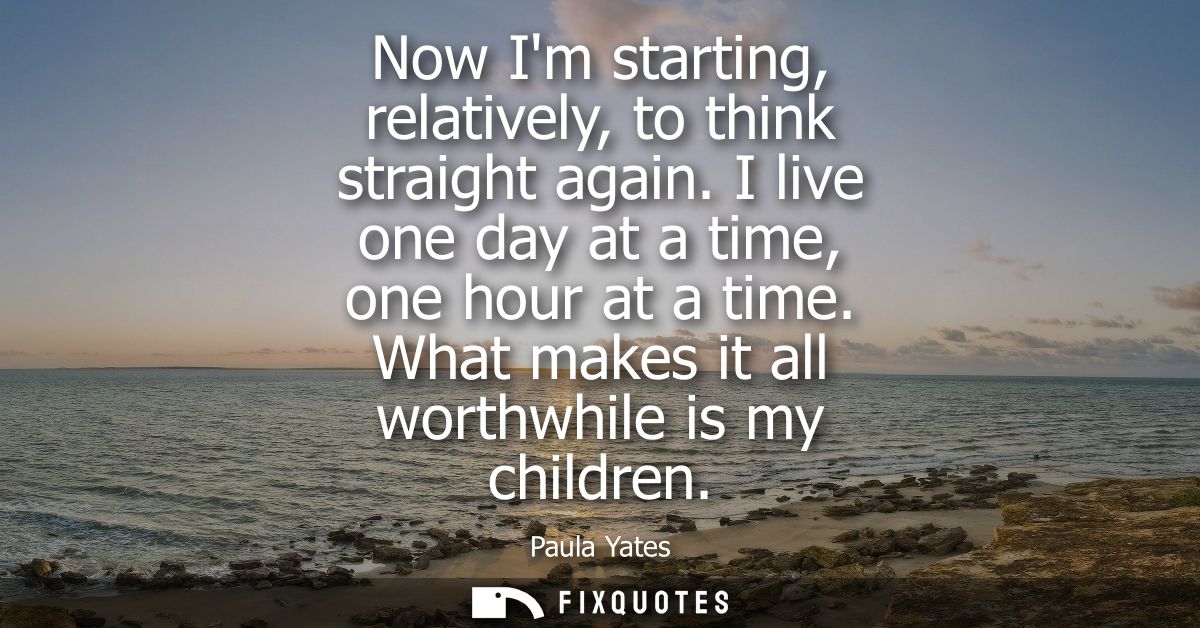
"Now I'm starting, relatively, to think straight again. I live one day at a time, one hour at a time. What makes it all worthwhile is my children"
About this Quote
Recovery talk rarely sounds glamorous, and that is exactly why Paula Yates's line lands. "Relatively" does a lot of work: it's a small, almost self-mocking qualifier that admits damage without turning it into a confession booth performance. She's not claiming redemption; she's describing the shaky mechanics of getting through a day when your brain and your life have been publicly disassembled.
The rhythm of the quote tightens into a coping strategy. "One day at a time, one hour at a time" is the language of rehab and survival, a mantra that refuses the grand narrative. In celebrity culture, where the expected arc is downfall-to-comeback packaged as entertainment, Yates insists on something less marketable: incremental stability. That repetition makes the sentence feel like breath control, like she's counting her way out of panic.
Then comes the pivot: "What makes it all worthwhile is my children". It's tender, but it also reads as a defensive perimeter. Motherhood becomes both motivation and shield, a socially legible reason to keep going when everything else might be judged as messy, selfish, or scandalous. In the late-90s tabloid ecosystem that fed on her relationships and struggles, anchoring meaning in her kids is a way of reclaiming moral center in a culture eager to deny her one.
The subtext is blunt: I may not be "fixed", but I am still responsible to someone who isn't the audience. That's not sentimentality; it's an assertion of priorities when fame has tried to turn her pain into content.
The rhythm of the quote tightens into a coping strategy. "One day at a time, one hour at a time" is the language of rehab and survival, a mantra that refuses the grand narrative. In celebrity culture, where the expected arc is downfall-to-comeback packaged as entertainment, Yates insists on something less marketable: incremental stability. That repetition makes the sentence feel like breath control, like she's counting her way out of panic.
Then comes the pivot: "What makes it all worthwhile is my children". It's tender, but it also reads as a defensive perimeter. Motherhood becomes both motivation and shield, a socially legible reason to keep going when everything else might be judged as messy, selfish, or scandalous. In the late-90s tabloid ecosystem that fed on her relationships and struggles, anchoring meaning in her kids is a way of reclaiming moral center in a culture eager to deny her one.
The subtext is blunt: I may not be "fixed", but I am still responsible to someone who isn't the audience. That's not sentimentality; it's an assertion of priorities when fame has tried to turn her pain into content.
Quote Details
| Topic | Parenting |
|---|
More Quotes by Paula
Add to List