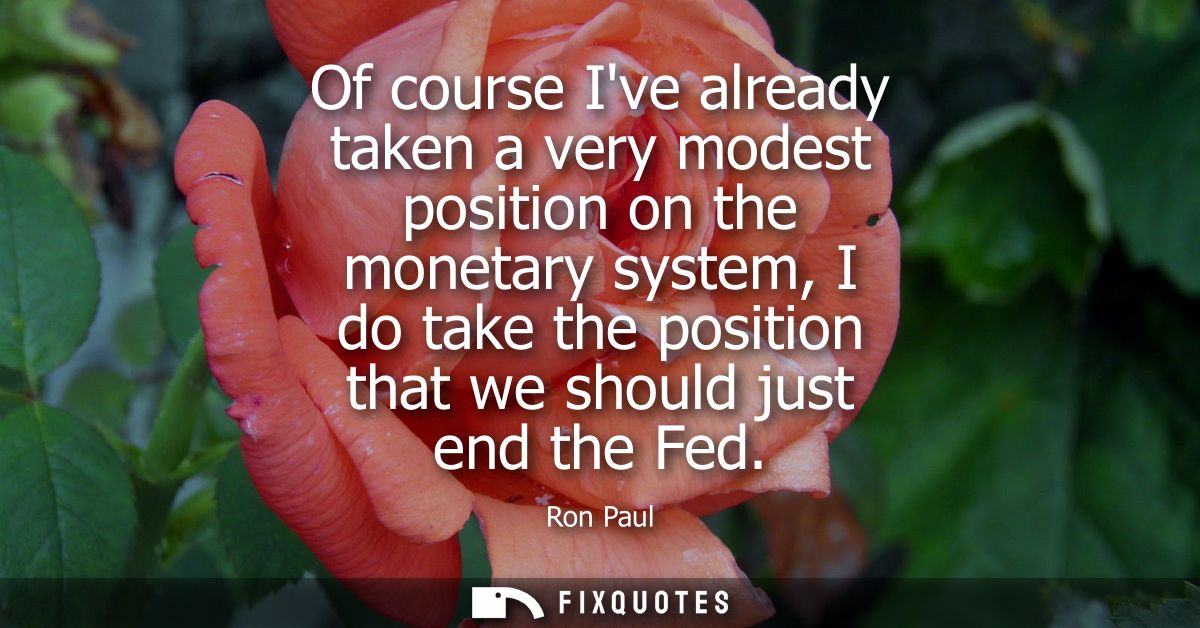
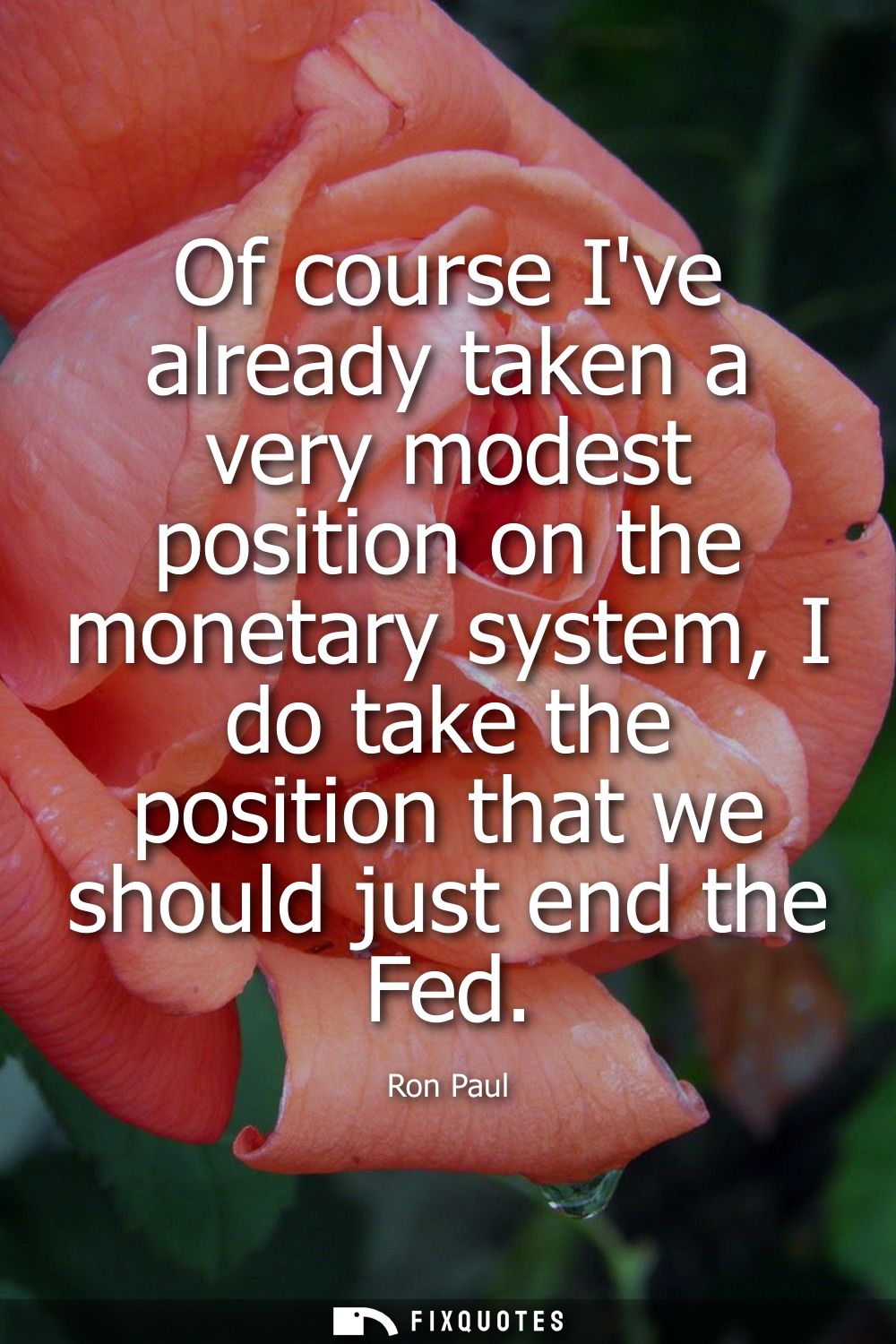
"Of course I've already taken a very modest position on the monetary system, I do take the position that we should just end the Fed"
About this Quote
Ron Paul’s assertion reveals a bold yet characteristically understated approach to what he regards as a fundamental issue: the existence of the Federal Reserve. By describing his viewpoint as a “very modest position,” Paul employs irony to highlight how, while his suggestion is quite radical in mainstream economic discourse, he views it as a straightforward solution to what he considers structural flaws in the US monetary system. The Federal Reserve, commonly referred to as “the Fed,” is the central banking system of the United States, responsible for regulating the nation’s money supply and interest rates. Over the years, Paul has become one of its harshest critics, frequently arguing that its actions erode the value of the dollar, enable reckless government spending through easy money, and ultimately distort free-market mechanisms.
His perspective comes from a libertarian, free-market tradition that sees centralized monetary policy as inherently corruptible and prone to mismanagement. Paul suggests that the answer to long-term economic stability and honest monetary value lies not in reforming or tweaking the Fed’s practices, but in abolishing the institution altogether, returning either to a commodity-backed currency such as gold or to a system where the market chooses the preferred mediums of exchange. The use of the word “just” further underscores the simplicity and obviousness with which he believes the solution should be regarded, elimination rather than adjustment.
By framing his position as modest, Paul points to a perceived timidity among policymakers to address foundational monetary concerns. He implies that proposals which stop short of ending the Fed are insufficient, perhaps even naïve, given what he regards as the extent of the damage caused by centralized control. In sum, Paul’s statement encapsulates his broader philosophy: a call toward radical decentralization, personal liberty in economic affairs, and skepticism toward governmental authority, especially when exercised through mechanisms as powerful and consequential as the nation’s central bank.
About the Author