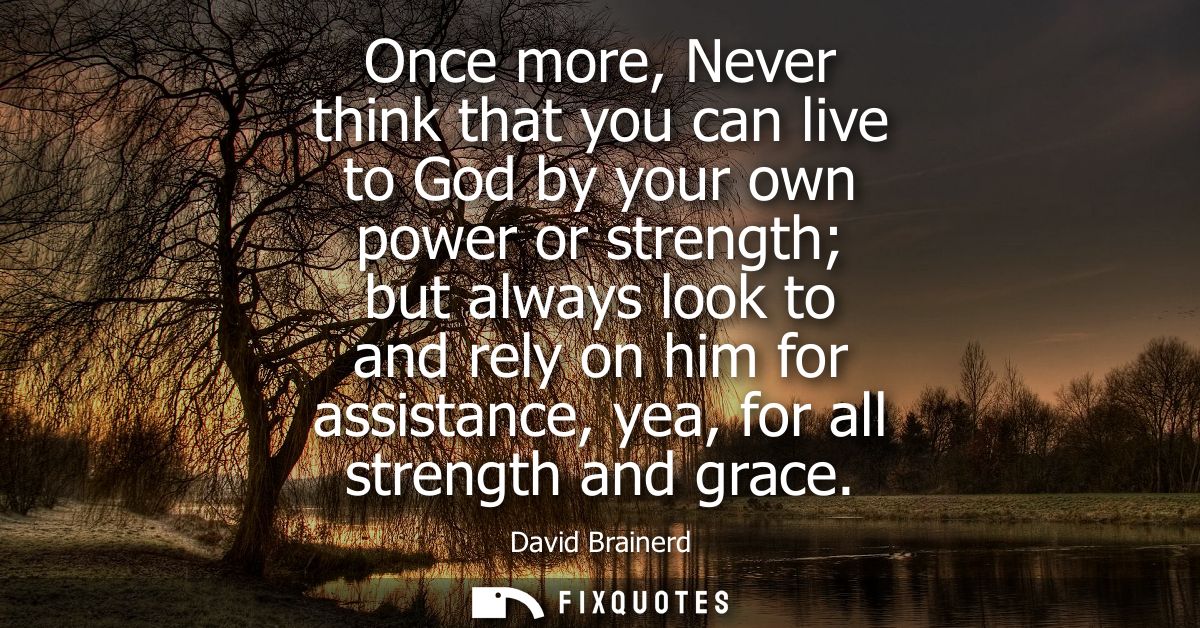
"Once more, Never think that you can live to God by your own power or strength; but always look to and rely on him for assistance, yea, for all strength and grace"
About this Quote
Urgency rings through the admonition. The impulse to muscle our way into holiness is strong, but the directive is stark: do not attempt to live a Godward life by native ability. To live to God means to have the whole self ordered toward him in love, obedience, and worship. That project, Brainerd insists, cannot be sustained by willpower. The soul does not manufacture its own fuel; it receives it. Strength and grace are not supplements for a basically capable self; they are the very conditions for spiritual life.
The language reflects a distinctly Reformed sensibility shaped by the Great Awakening. Human insufficiency is not a passing inconvenience but a foundational truth, and grace is not merely the doorway into faith but the atmosphere in which the believer breathes. The word choice matters. Always look to and rely on him portrays a posture, a continual orientation of attention and trust. Yea, for all strength and grace pushes the claim to its limit: nothing of lasting spiritual value originates in autonomous effort.
Brainerd knew this not as theory but as biography. A missionary to Native American communities in the 1740s, plagued by illness and discouragement, he kept a diary filled with self-scrutiny and prayer. Living on the margins of comfort and health, he saw that piety divorced from dependence collapses into either despair or pride. His counsel answers both: reliance frees the anxious from the burden of self-salvation and humbles the self-assured who imagine they can perform godliness on their own.
Yet dependence is not passivity. Looking to God is an active, persistent practice: prayer that asks, Scripture that feeds, obedience that leans rather than lifts alone. Once more signals a lesson learned repeatedly, as if reminding a forgetful heart. The message is bracingly simple and endlessly deep: spiritual vitality is received, not achieved, and the God who commands holiness also supplies the strength to live it.
The language reflects a distinctly Reformed sensibility shaped by the Great Awakening. Human insufficiency is not a passing inconvenience but a foundational truth, and grace is not merely the doorway into faith but the atmosphere in which the believer breathes. The word choice matters. Always look to and rely on him portrays a posture, a continual orientation of attention and trust. Yea, for all strength and grace pushes the claim to its limit: nothing of lasting spiritual value originates in autonomous effort.
Brainerd knew this not as theory but as biography. A missionary to Native American communities in the 1740s, plagued by illness and discouragement, he kept a diary filled with self-scrutiny and prayer. Living on the margins of comfort and health, he saw that piety divorced from dependence collapses into either despair or pride. His counsel answers both: reliance frees the anxious from the burden of self-salvation and humbles the self-assured who imagine they can perform godliness on their own.
Yet dependence is not passivity. Looking to God is an active, persistent practice: prayer that asks, Scripture that feeds, obedience that leans rather than lifts alone. Once more signals a lesson learned repeatedly, as if reminding a forgetful heart. The message is bracingly simple and endlessly deep: spiritual vitality is received, not achieved, and the God who commands holiness also supplies the strength to live it.
Quote Details
| Topic | God |
|---|
More Quotes by David
Add to List