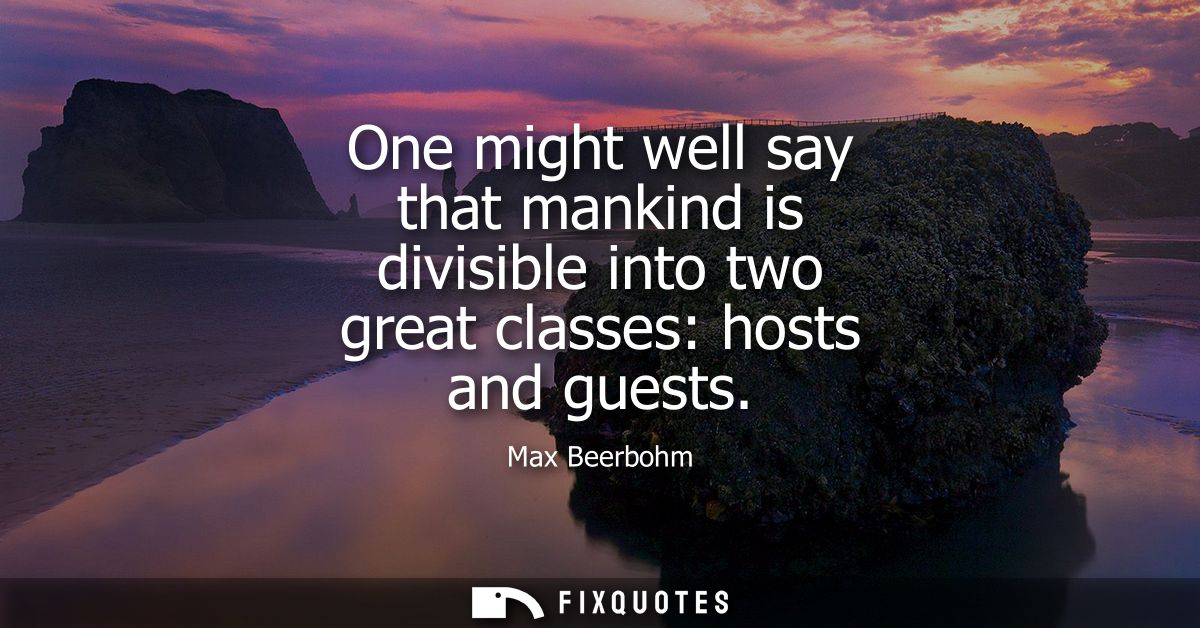
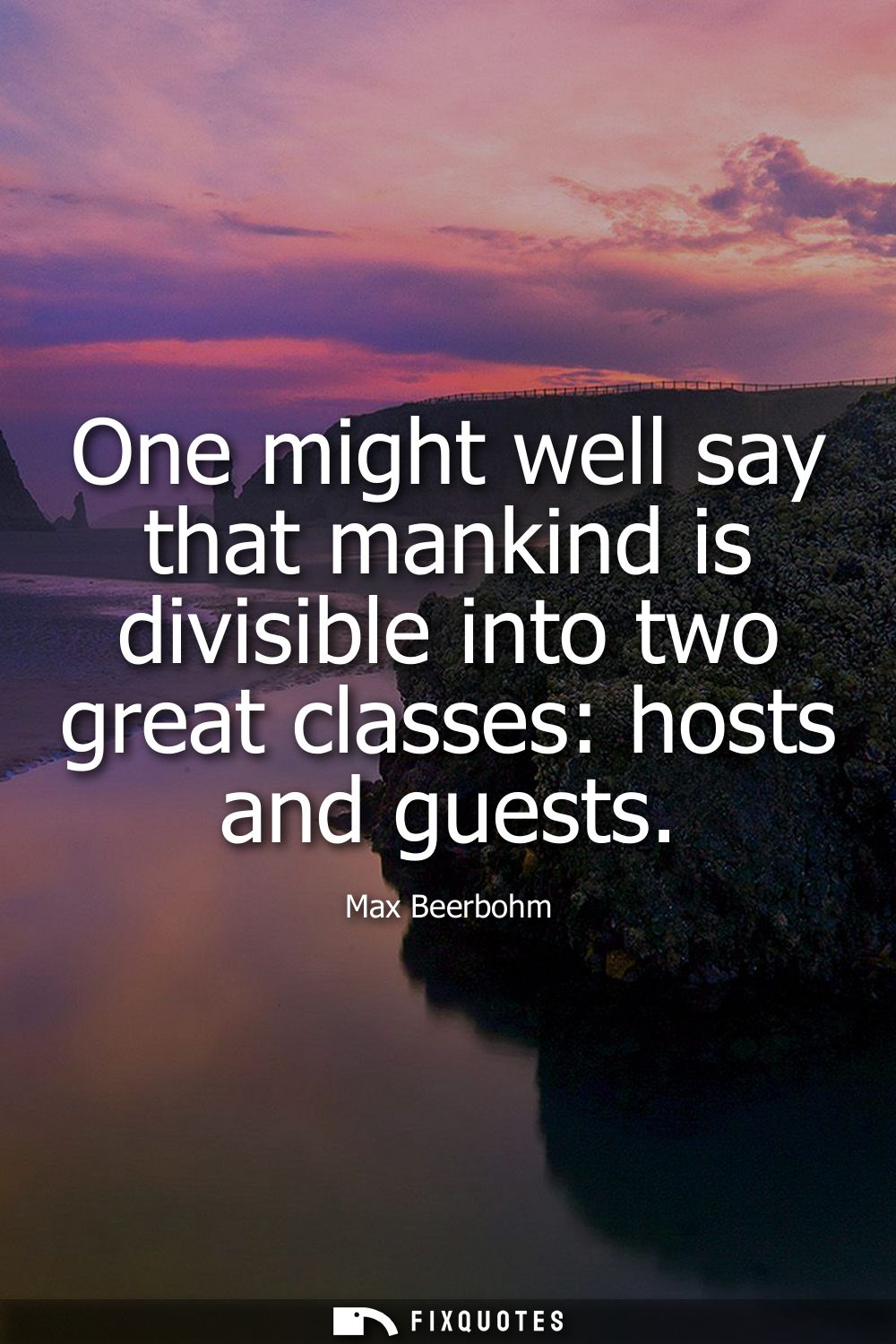
"One might well say that mankind is divisible into two great classes: hosts and guests"
About this Quote
The phrasing does half the work. “One might well say” is mock-modest, the conversational shrug of someone about to generalize with absolute confidence. “Mankind” gives it mock-grandeur, as if etiquette were the real engine of civilization. Then “divisible” lands like a Victorian scalpel: a clean cut, no messy middle. Of course there is a middle - people host sometimes and guest other times - but Beerbohm’s point is that we rarely feel that fluidity in the moment. Social life makes the roles feel fixed, like caste.
Context matters: Beerbohm came out of late-Victorian/Edwardian London, where invitations were currency and the drawing room was a soft battlefield. As an actor and man-about-town, he’d know how much of “personality” is really stagecraft demanded by the room. The joke has teeth because it flatters the reader’s self-recognition: everyone remembers the anxious calculus of being a guest, and everyone has fantasized about the serene authority of being the host.
Quote Details
| Topic | Witty One-Liners |
|---|---|
| Source | Help us find the source |
| Cite |
Citation Formats
APA Style (7th ed.)
Beerbohm, Max. (2026, January 15). One might well say that mankind is divisible into two great classes: hosts and guests. FixQuotes. https://fixquotes.com/quotes/one-might-well-say-that-mankind-is-divisible-into-120190/
Chicago Style
Beerbohm, Max. "One might well say that mankind is divisible into two great classes: hosts and guests." FixQuotes. January 15, 2026. https://fixquotes.com/quotes/one-might-well-say-that-mankind-is-divisible-into-120190/.
MLA Style (9th ed.)
"One might well say that mankind is divisible into two great classes: hosts and guests." FixQuotes, 15 Jan. 2026, https://fixquotes.com/quotes/one-might-well-say-that-mankind-is-divisible-into-120190/. Accessed 12 Feb. 2026.