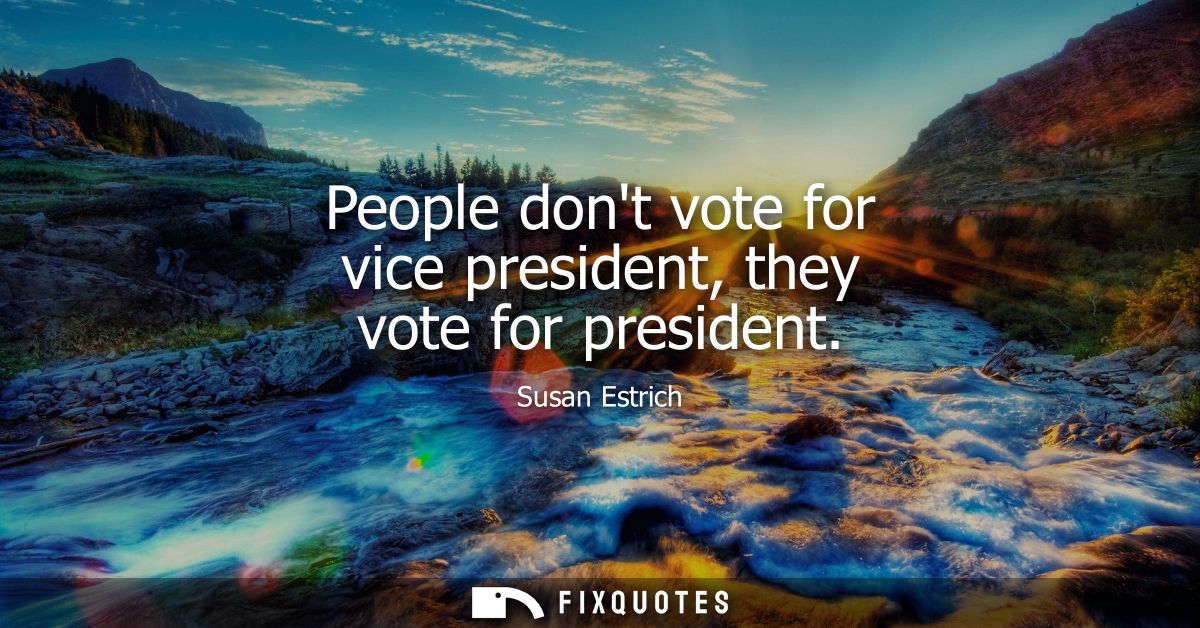
"People don't vote for vice president, they vote for president"
About this Quote
The quote by Susan Estrich, "People do not vote for vice president, they vote for president", encapsulates a widely held belief about the nature of electoral habits in governmental democracies, particularly in the United States. At its core, the statement recommends that when voters go to the surveys, their main focus is on the person at the top of the ticket-- the governmental candidate-- instead of the secondary candidate, the vice presidential pick.
This viewpoint is grounded in the idea that the president wields significantly more power and influence than the vice president, making the governmental choice a pivotal choice for voters. The president sets the policy agenda, represents the country on the international stage, and is frequently considered the face of the federal government. As such, voters are more likely to assess presidential prospects based upon their management qualities, policy positions, and vision for the nation. In contrast, the vice president is generally viewed as a supporting figure, with more restricted obligations and influence.
The selection of a vice governmental prospect, nevertheless, is not completely irrelevant. While Estrich's quote stresses the primacy of the governmental candidate in voters' minds, the vice governmental choice can still affect the election. Tactically selected vice presidential prospects can assist stabilize the ticket by expanding its interest various demographics or geographic regions. They can likewise offer competence in areas where the governmental prospect may be viewed as doing not have.
Nonetheless, Estrich's assertion highlights that, while the vice president can complement and boost a campaign, they are hardly ever the central factor driving voter decisions. Eventually, the fate of a ticket is closely tied to the public's perception of the presidential candidate's capability to lead and execute their vision. This insight reflects the political reality that the president is the linchpin of the executive branch and the primary focus of voter attention throughout elections.
More details
About the Author