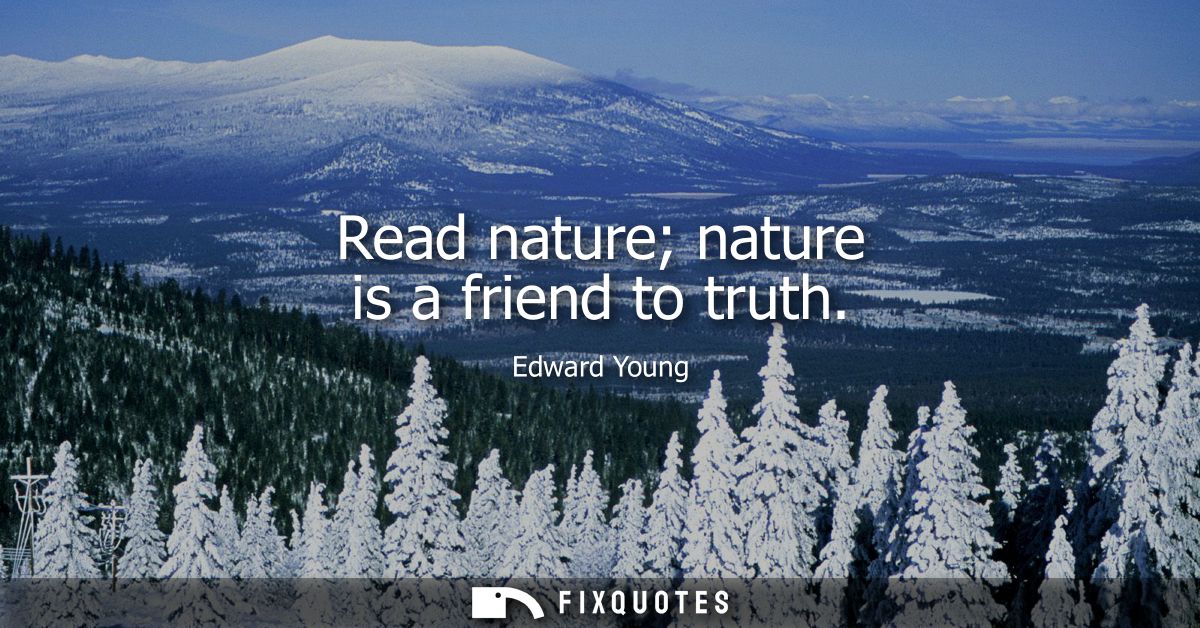
"Read nature; nature is a friend to truth"
About this Quote
Read nature; nature is a friend to truth is an Enlightenment-era summons delivered in the cadence of a preacher-poet. Edward Young, writing in the 1740s in Night Thoughts, turns the physical world into a legible text: the old Christian trope of the Book of Nature, made newly vivid by the age of Newton and Bacon. To read nature is to attend to creation with patience and humility, trusting that what is given in things as they are will correct what is false in us.
Young opposes the polish of fashion and the shimmer of wit to the candor of the night sky, the returning seasons, the grave. Society flatters; nature refuses to flatter. Leaves wither, bodies fail, stars wheel in their appointed courses, and the human heart discovers its limits. That is why nature is a friend to truth: it is an ally against self-deception. The regularities of the world disclose an order larger than appetite or fashion, and its changes teach mortality, dependence, and hope. For Young, such truths are not merely empirical; they are moral and theological. The heavens declare a grandeur that hints at eternity; decay reminds us of judgment and the soul; dawn intimates renewal. Observation becomes devotion.
The imperative read matters. Reading is active, interpretive work. It requires silence, time, and a readiness to be taught. In Night Thoughts, the contemplative hour is midnight, when public noise recedes and the mind can listen. To read nature is to practice a literacy of attention, to let the steady facts of the world check our impulses and test our beliefs.
This vision bridges science and piety. The methods of careful observation promise accuracy; the meanings drawn from creation orient conscience. Nature does not argue by sophistry; it points, presses, and persuades by being there. As friend, it is faithful and plain; as teacher, it leads from spectacle to wisdom, from astonishment to truth.
Young opposes the polish of fashion and the shimmer of wit to the candor of the night sky, the returning seasons, the grave. Society flatters; nature refuses to flatter. Leaves wither, bodies fail, stars wheel in their appointed courses, and the human heart discovers its limits. That is why nature is a friend to truth: it is an ally against self-deception. The regularities of the world disclose an order larger than appetite or fashion, and its changes teach mortality, dependence, and hope. For Young, such truths are not merely empirical; they are moral and theological. The heavens declare a grandeur that hints at eternity; decay reminds us of judgment and the soul; dawn intimates renewal. Observation becomes devotion.
The imperative read matters. Reading is active, interpretive work. It requires silence, time, and a readiness to be taught. In Night Thoughts, the contemplative hour is midnight, when public noise recedes and the mind can listen. To read nature is to practice a literacy of attention, to let the steady facts of the world check our impulses and test our beliefs.
This vision bridges science and piety. The methods of careful observation promise accuracy; the meanings drawn from creation orient conscience. Nature does not argue by sophistry; it points, presses, and persuades by being there. As friend, it is faithful and plain; as teacher, it leads from spectacle to wisdom, from astonishment to truth.
Quote Details
| Topic | Truth |
|---|
More Quotes by Edward
Add to List