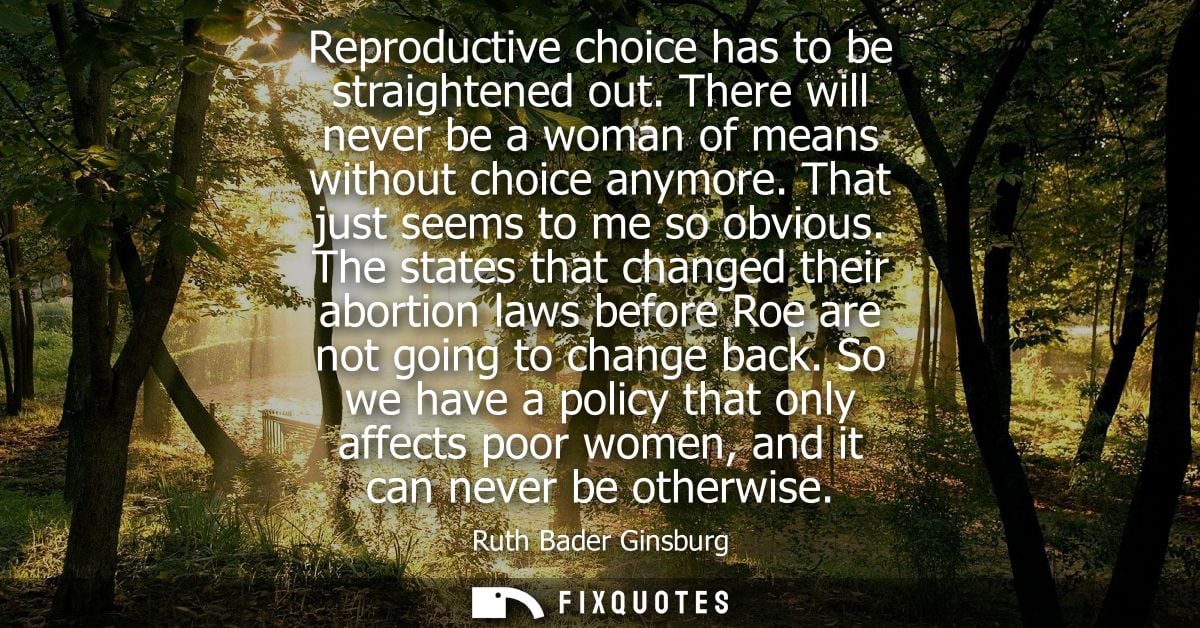
"Reproductive choice has to be straightened out. There will never be a woman of means without choice anymore. That just seems to me so obvious. The states that changed their abortion laws before Roe are not going to change back. So we have a policy that only affects poor women, and it can never be otherwise"
About this Quote
The subtext is a critique of American federalism as a sorting machine. If abortion access is left to states, the market fills the gaps for the affluent while geography and poverty harden into destiny for everyone else. Her phrase “straightened out” carries a jurist’s impatience with a system that claims neutrality while producing predictable, unequal outcomes. It’s not abstract fairness; it’s the lived asymmetry of who gets options and who gets punished for lacking them.
Context matters: Ginsburg often framed abortion rights less as a culture-war totem and more as an equality question embedded in social policy. She’s pointing to the pre-Roe landscape where reform had already begun in certain states, implying a one-way ratchet in the most resourced places. The sting is in “and it can never be otherwise”: unless the law is national, uniform, and enforceable, restrictions function as a tax on poverty. In typical Ginsburg fashion, the argument is quiet, surgical, and devastating: a “choice” that only some people can exercise is not a right, it’s a privilege with better branding.
Quote Details
| Topic | Human Rights |
|---|---|
| Source | Help us find the source |
| Cite |
Citation Formats
APA Style (7th ed.)
Ginsburg, Ruth Bader. (2026, January 15). Reproductive choice has to be straightened out. There will never be a woman of means without choice anymore. That just seems to me so obvious. The states that changed their abortion laws before Roe are not going to change back. So we have a policy that only affects poor women, and it can never be otherwise. FixQuotes. https://fixquotes.com/quotes/reproductive-choice-has-to-be-straightened-out-124920/
Chicago Style
Ginsburg, Ruth Bader. "Reproductive choice has to be straightened out. There will never be a woman of means without choice anymore. That just seems to me so obvious. The states that changed their abortion laws before Roe are not going to change back. So we have a policy that only affects poor women, and it can never be otherwise." FixQuotes. January 15, 2026. https://fixquotes.com/quotes/reproductive-choice-has-to-be-straightened-out-124920/.
MLA Style (9th ed.)
"Reproductive choice has to be straightened out. There will never be a woman of means without choice anymore. That just seems to me so obvious. The states that changed their abortion laws before Roe are not going to change back. So we have a policy that only affects poor women, and it can never be otherwise." FixQuotes, 15 Jan. 2026, https://fixquotes.com/quotes/reproductive-choice-has-to-be-straightened-out-124920/. Accessed 12 Feb. 2026.