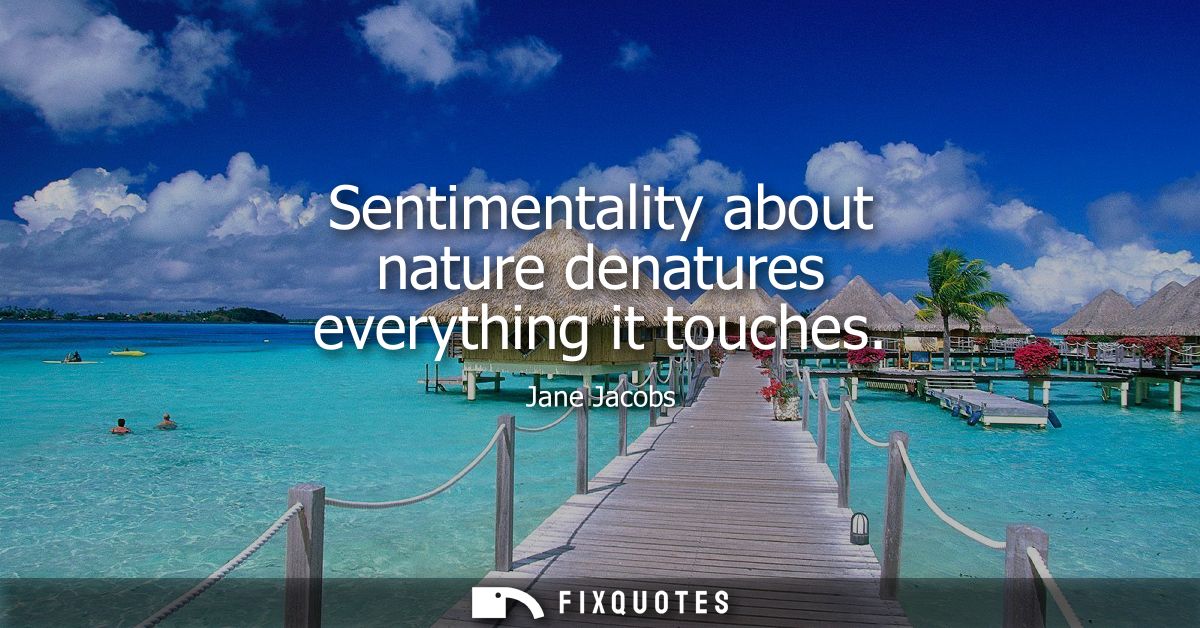
"Sentimentality about nature denatures everything it touches"
About this Quote
Jacobs skewers a very particular kind of modern piety: the habit of treating “nature” as a shrine instead of a system. Her phrasing is a controlled provocation. “Sentimentality” isn’t affection; it’s a soft-focus lens that edits out complexity, trade-offs, and human entanglement. And “denatures” is the surgical twist of the knife. The romantic worship of nature, she argues, doesn’t preserve the natural world; it strips it of its real characteristics by turning it into an aesthetic object, a moral alibi, or a marketing category.
The intent is less anti-environment than anti-kitsch. Jacobs came of age pushing back against top-down planning that bulldozed living neighborhoods in the name of “renewal,” and the same logic can hide inside green rhetoric: make a place “natural,” “clean,” “open,” “unspoiled,” then clear out the messy, working, inhabited reality that actually sustains it. In cities, that can mean park-making that erases street life; in policy, it can mean conservation fantasies that ignore economies and communities; in culture, it becomes Instagram wilderness that’s valued more as image than habitat.
Subtext: sentimentality is a power move. It lets institutions and tastemakers speak for “nature” while sidelining the people who live with it daily. Jacobs’s warning lands because it flips the expected moral hierarchy: the feel-good story about nature isn’t harmless. It’s a solvent. It dissolves specificity, and with it, accountability.
The intent is less anti-environment than anti-kitsch. Jacobs came of age pushing back against top-down planning that bulldozed living neighborhoods in the name of “renewal,” and the same logic can hide inside green rhetoric: make a place “natural,” “clean,” “open,” “unspoiled,” then clear out the messy, working, inhabited reality that actually sustains it. In cities, that can mean park-making that erases street life; in policy, it can mean conservation fantasies that ignore economies and communities; in culture, it becomes Instagram wilderness that’s valued more as image than habitat.
Subtext: sentimentality is a power move. It lets institutions and tastemakers speak for “nature” while sidelining the people who live with it daily. Jacobs’s warning lands because it flips the expected moral hierarchy: the feel-good story about nature isn’t harmless. It’s a solvent. It dissolves specificity, and with it, accountability.
Quote Details
| Topic | Nature |
|---|
More Quotes by Jane
Add to List