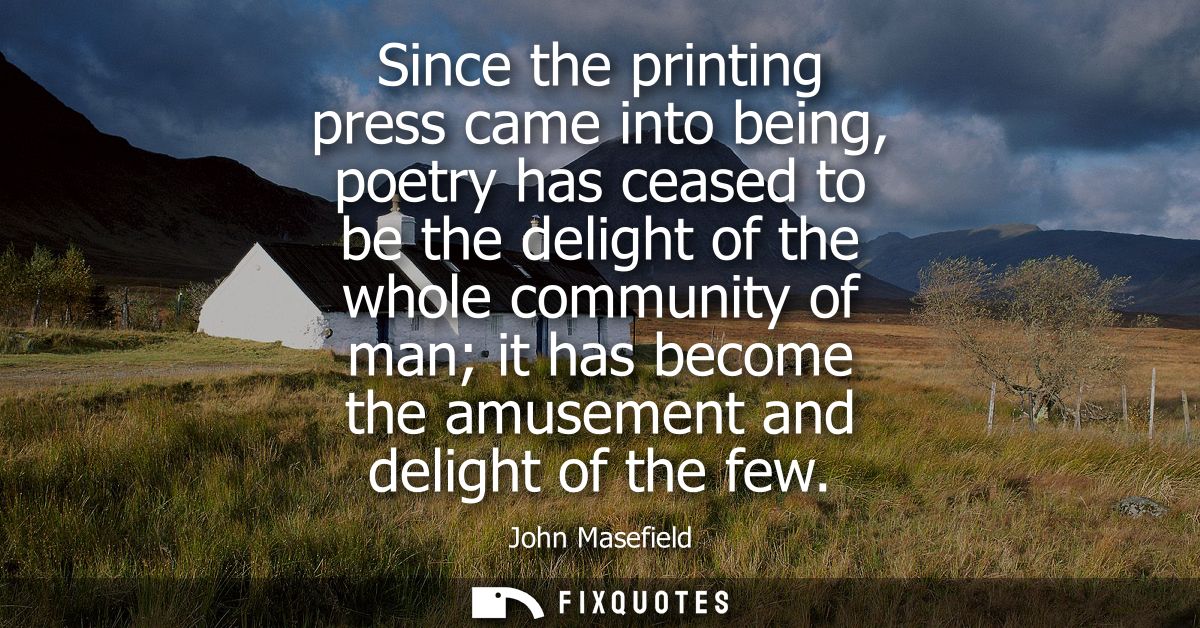
"Since the printing press came into being, poetry has ceased to be the delight of the whole community of man; it has become the amusement and delight of the few"
About this Quote
Masefield is pointing a finger at technology, but the real target is social power. The printing press, in his telling, didn’t just multiply poems; it quietly changed who poetry is for. Oral culture makes poetry public property: shared in rooms, fields, taverns, churches. You don’t need to own anything to participate, only to listen, remember, repeat. Print shifts the center of gravity from communal performance to private possession. Once poetry lives in books, it also lives behind literacy, leisure time, and the soft gatekeeping of taste.
The subtext is a lament about expertise hardening into class. “Amusement and delight of the few” isn’t only about audience size; it’s about a cultural narrowing where poetry becomes a marker of refinement, something you consume to prove you can. Print enables abundance, but abundance breeds curation, and curation breeds hierarchies. The mass distribution of text doesn’t guarantee mass access to meaning. It can even raise the entry fee: a canon, a syllabus, a “proper” way to read.
Context matters: Masefield, a poet laureate shaped by late Victorian and early modern Britain, watched art get professionalized and audiences stratified by education and urban modernity. His nostalgia isn’t naive, though; it’s strategic. By blaming the printing press, he’s smuggling in an argument about recoverable intimacy. Poetry, he implies, thrives when it behaves less like a collectible and more like a song: social, memorable, slightly unruly.
The subtext is a lament about expertise hardening into class. “Amusement and delight of the few” isn’t only about audience size; it’s about a cultural narrowing where poetry becomes a marker of refinement, something you consume to prove you can. Print enables abundance, but abundance breeds curation, and curation breeds hierarchies. The mass distribution of text doesn’t guarantee mass access to meaning. It can even raise the entry fee: a canon, a syllabus, a “proper” way to read.
Context matters: Masefield, a poet laureate shaped by late Victorian and early modern Britain, watched art get professionalized and audiences stratified by education and urban modernity. His nostalgia isn’t naive, though; it’s strategic. By blaming the printing press, he’s smuggling in an argument about recoverable intimacy. Poetry, he implies, thrives when it behaves less like a collectible and more like a song: social, memorable, slightly unruly.
Quote Details
| Topic | Poetry |
|---|
More Quotes by John
Add to List