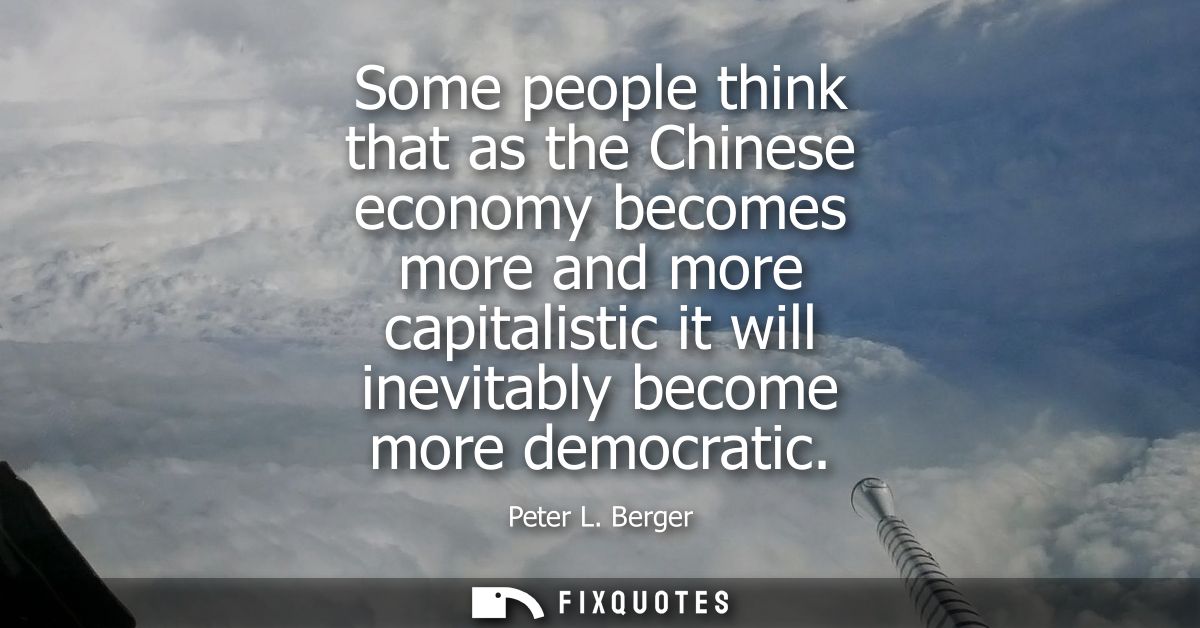
"Some people think that as the Chinese economy becomes more and more capitalistic it will inevitably become more democratic"
About this Quote
Peter L. Berger is pointing to a seductive but shaky article of faith in modernization thinking: that markets and democracy travel together. The proposition grew from observations of Western Europe, North America, and later parts of East Asia, where industrialization, urbanization, and a rising middle class coincided with representative institutions. Berger, a sociologist wary of historical inevitabilities, flags the belief precisely because China complicates it.
China has embraced vast swaths of market logic while preserving a Leninist party-state. The Chinese Communist Party has married capitalist dynamism to authoritarian control through a hybrid of state capitalism, party oversight within firms, and strategic sectors under direct command. Economic growth furnishes performance legitimacy; prosperity and stability are offered in exchange for political acquiescence. Rather than spawning pluralism, wealth can fund surveillance, censorship, and administrative capacity, allowing rulers to dampen the very pressures that modernization theory once treated as democratizing.
The middle class, often assumed to be democracy’s vanguard, is not uniformly liberal. Property owners and professionals may prioritize order, asset security, and national ascendancy over contestatory politics, especially when nationalism flourishes and when the state can deliver material gains. China has also developed sophisticated tools of rule by law rather than rule of law, enabling predictability in commerce without ceding judicial independence.
The trajectory since WTO accession underscores adaptation rather than convergence. Market reforms deepened, private enterprise expanded, and global integration widened, yet political centralization intensified under Xi Jinping through anti-corruption campaigns, party committees in companies, and tighter control of civil society and the internet. The result is not a transition toward liberal democracy but an agile authoritarianism.
Berger’s formulation cautions against teleology. Capitalism creates plural interests, information flows, and wealth; it does not, by itself, guarantee democratic institutions. Outcomes hinge on institutions, culture, state capacity, and contingent politics. China serves as a reminder that modernization can diversify, not dictate, political futures.
China has embraced vast swaths of market logic while preserving a Leninist party-state. The Chinese Communist Party has married capitalist dynamism to authoritarian control through a hybrid of state capitalism, party oversight within firms, and strategic sectors under direct command. Economic growth furnishes performance legitimacy; prosperity and stability are offered in exchange for political acquiescence. Rather than spawning pluralism, wealth can fund surveillance, censorship, and administrative capacity, allowing rulers to dampen the very pressures that modernization theory once treated as democratizing.
The middle class, often assumed to be democracy’s vanguard, is not uniformly liberal. Property owners and professionals may prioritize order, asset security, and national ascendancy over contestatory politics, especially when nationalism flourishes and when the state can deliver material gains. China has also developed sophisticated tools of rule by law rather than rule of law, enabling predictability in commerce without ceding judicial independence.
The trajectory since WTO accession underscores adaptation rather than convergence. Market reforms deepened, private enterprise expanded, and global integration widened, yet political centralization intensified under Xi Jinping through anti-corruption campaigns, party committees in companies, and tighter control of civil society and the internet. The result is not a transition toward liberal democracy but an agile authoritarianism.
Berger’s formulation cautions against teleology. Capitalism creates plural interests, information flows, and wealth; it does not, by itself, guarantee democratic institutions. Outcomes hinge on institutions, culture, state capacity, and contingent politics. China serves as a reminder that modernization can diversify, not dictate, political futures.
Quote Details
| Topic | Freedom |
|---|
More Quotes by Peter
Add to List