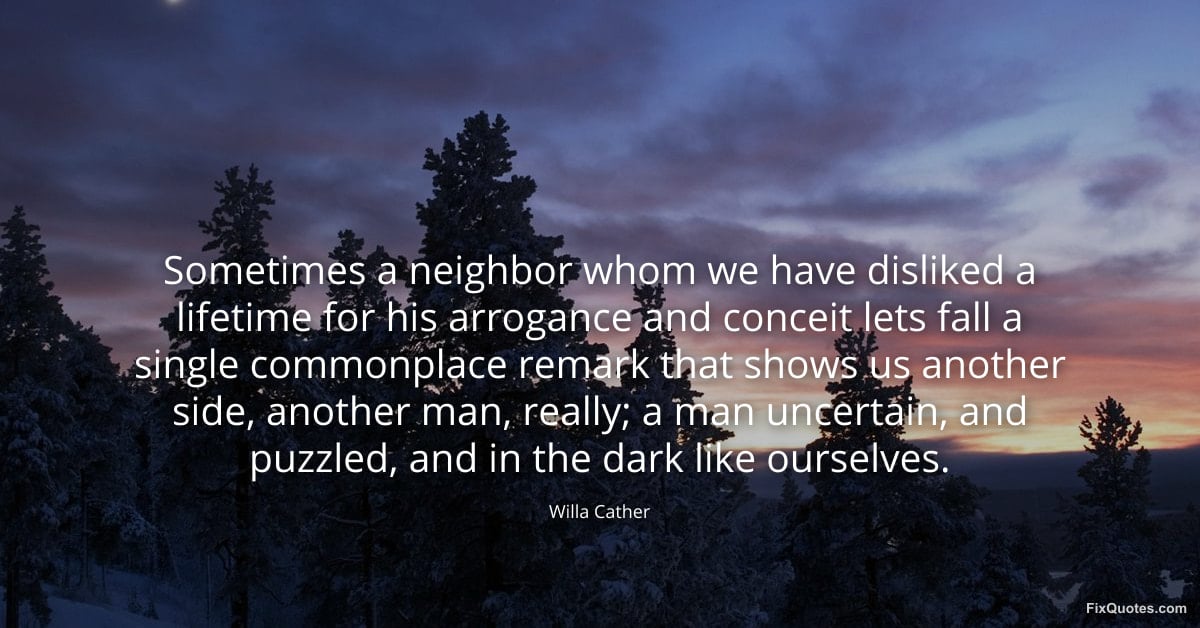
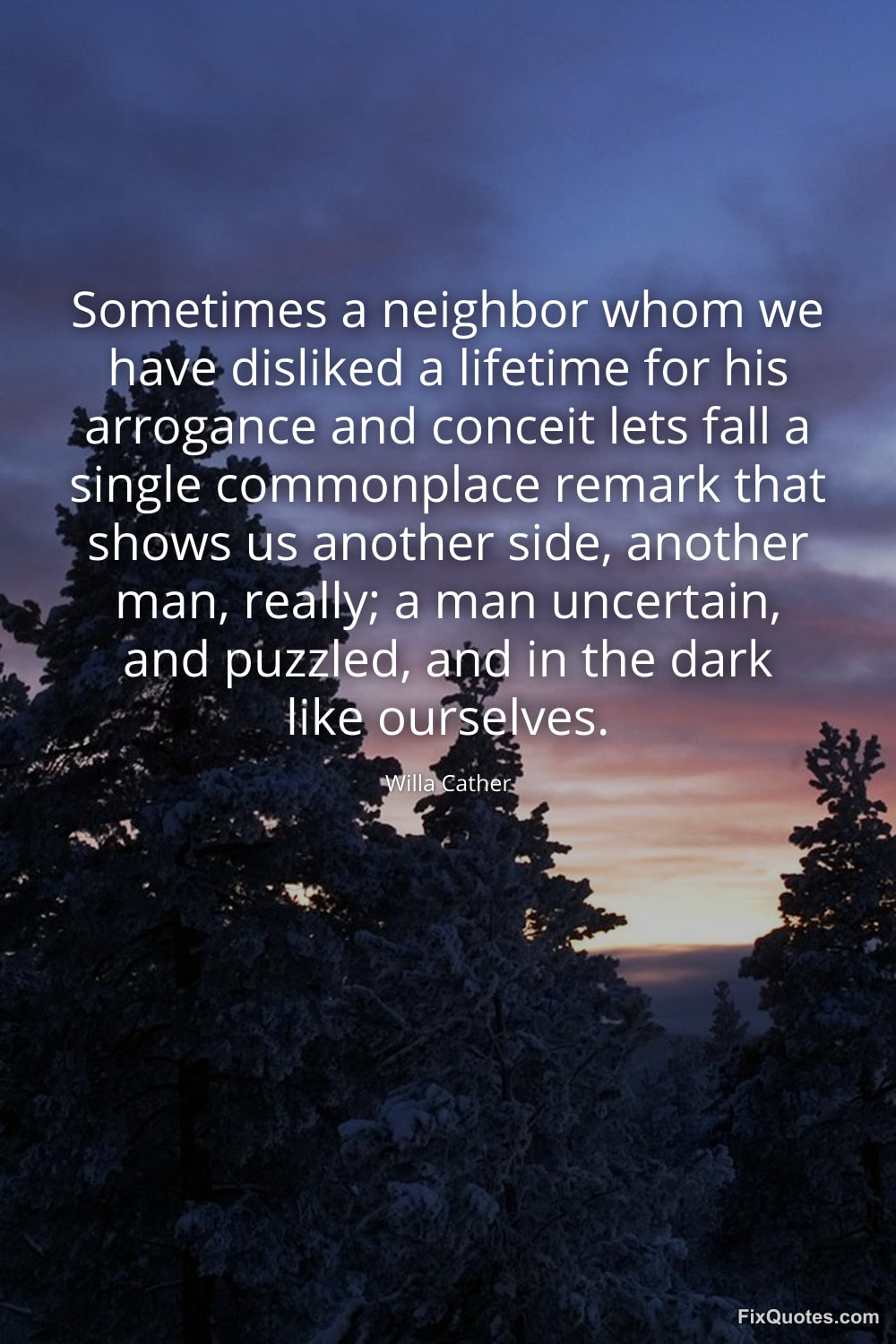
"Sometimes a neighbor whom we have disliked a lifetime for his arrogance and conceit lets fall a single commonplace remark that shows us another side, another man, really; a man uncertain, and puzzled, and in the dark like ourselves"
About this Quote
Cather turns a small social slip into a moral x-ray. The setup is almost petty in its specificity: the neighbor we have “disliked a lifetime” for “arrogance and conceit.” That phrasing matters. “Lifetime” admits how long we can nurse a story about someone; “arrogance” and “conceit” are not neutral observations but verdicts, a way of freezing a person into a type so we don’t have to revise our mental cast list.
Then she pivots on the supposedly unimpressive: “a single commonplace remark.” Commonplace is the key. It’s not a confession, not a dramatic apology, not a grand act of redemption. It’s an ordinary sentence that, by landing at the wrong angle, reveals the scaffolding behind the pose. Cather’s insight is that our judgments are often defeated not by new information but by banal evidence that the person we’ve caricatured has the same low-level confusion we do.
The subtext is as much about the listener as the neighbor. “Lets fall” suggests accident, not strategy; we’re the ones who finally hear what’s been there. The repeated “another” works like a slow door opening: another side, another man, really. And the final line refuses sentimentality while still delivering a jolt of solidarity: “uncertain, and puzzled, and in the dark like ourselves.” Cather isn’t preaching empathy as a virtue; she’s describing it as an involuntary shock, the moment your certainty about someone collapses and you recognize the shared human condition underneath the social performance.
Then she pivots on the supposedly unimpressive: “a single commonplace remark.” Commonplace is the key. It’s not a confession, not a dramatic apology, not a grand act of redemption. It’s an ordinary sentence that, by landing at the wrong angle, reveals the scaffolding behind the pose. Cather’s insight is that our judgments are often defeated not by new information but by banal evidence that the person we’ve caricatured has the same low-level confusion we do.
The subtext is as much about the listener as the neighbor. “Lets fall” suggests accident, not strategy; we’re the ones who finally hear what’s been there. The repeated “another” works like a slow door opening: another side, another man, really. And the final line refuses sentimentality while still delivering a jolt of solidarity: “uncertain, and puzzled, and in the dark like ourselves.” Cather isn’t preaching empathy as a virtue; she’s describing it as an involuntary shock, the moment your certainty about someone collapses and you recognize the shared human condition underneath the social performance.
Quote Details
| Topic | Humility |
|---|
More Quotes by Willa
Add to List