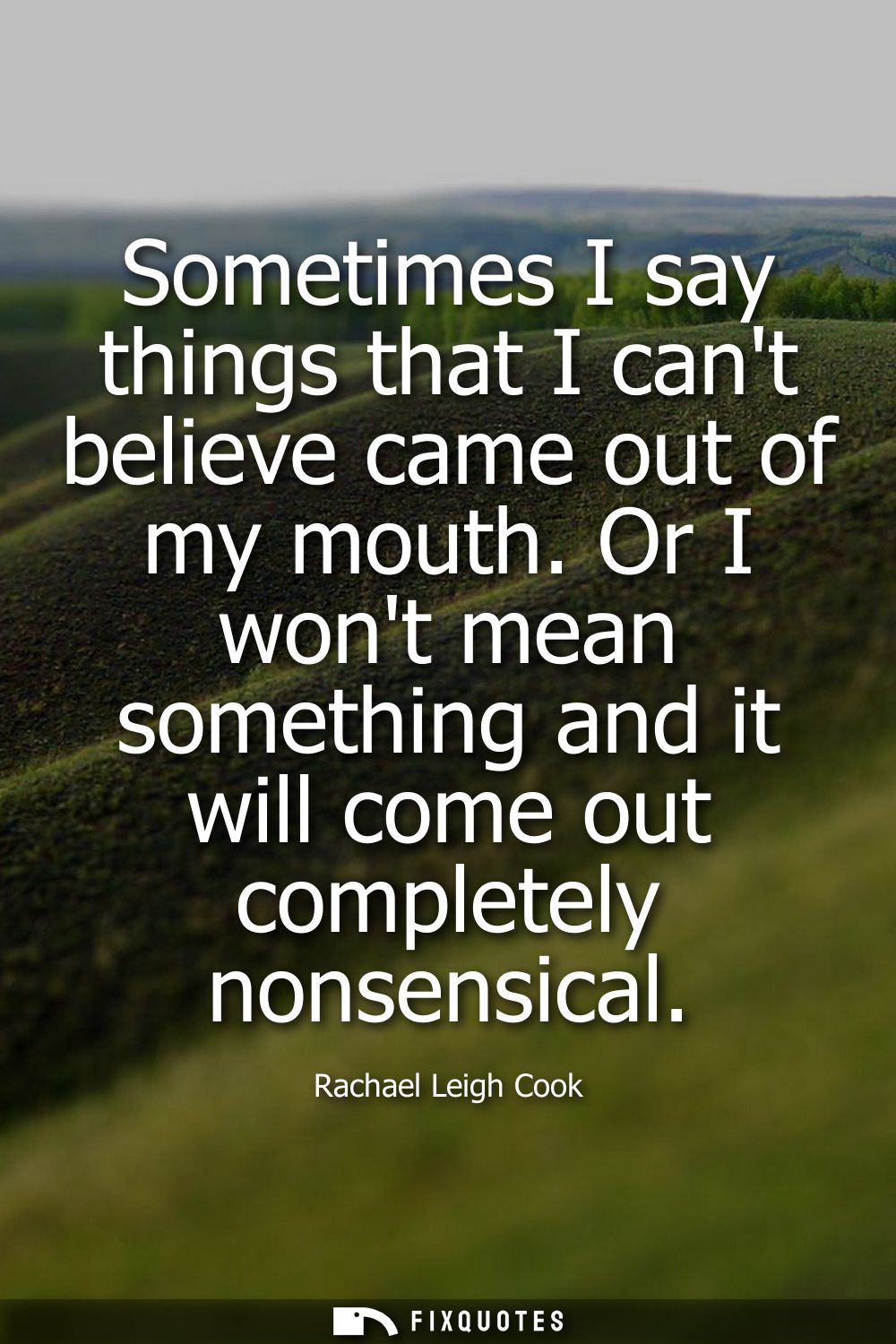
"Sometimes I say things that I can't believe came out of my mouth. Or I won't mean something and it will come out completely nonsensical"
About this Quote
Cook captures the unnerving moment when the mouth outruns the mind. Anyone who has heard themselves say something and immediately wanted to reel it back knows the odd dislocation she describes: the intention felt clear inside, but what emerged sounded garbled, exaggerated, or simply not what was meant. That gap between inner thought and outward speech exposes how fragile language can be under pressure. We imagine we are authors of our words; in practice, conversation is a live performance with no edits, and panic, fatigue, or the urge to seem clever can scramble delivery.
Coming from an actor known for the control and polish of scripted lines, the confession lands with particular irony. On set, timing, tone, and meaning are rehearsed and refined; in a press junket or a casual interview, the same person is suddenly expected to be spontaneous, succinct, and interesting on cue. The risk of nonsense grows as the volume of talk increases, especially for public figures whose every aside is captured and replayed. Cook’s candor underscores the pressure to be consistently articulate in environments that reward speed over reflection.
There is also a tender self-awareness here. Rather than invoking Freudian slips or hidden truths, she points to a simpler human tendency: sometimes the brain misfires, or the tongue reaches for a phrase and grabs the wrong one. The admission pushes back against the idea that public statements always reveal deep intention. It invites grace for the messy process of forming meaning aloud and acknowledges that vulnerability often hides behind clumsy phrasing.
The remark ultimately humanizes fame’s veneer. It validates the awkwardness many feel in everyday exchanges and highlights a broader truth about communication: clarity is collaborative. We correct, rephrase, and laugh at ourselves together. When words fail on the first try, the second attempt, and the willingness to be understood, matter more than the accidental nonsense that slipped out.
Coming from an actor known for the control and polish of scripted lines, the confession lands with particular irony. On set, timing, tone, and meaning are rehearsed and refined; in a press junket or a casual interview, the same person is suddenly expected to be spontaneous, succinct, and interesting on cue. The risk of nonsense grows as the volume of talk increases, especially for public figures whose every aside is captured and replayed. Cook’s candor underscores the pressure to be consistently articulate in environments that reward speed over reflection.
There is also a tender self-awareness here. Rather than invoking Freudian slips or hidden truths, she points to a simpler human tendency: sometimes the brain misfires, or the tongue reaches for a phrase and grabs the wrong one. The admission pushes back against the idea that public statements always reveal deep intention. It invites grace for the messy process of forming meaning aloud and acknowledges that vulnerability often hides behind clumsy phrasing.
The remark ultimately humanizes fame’s veneer. It validates the awkwardness many feel in everyday exchanges and highlights a broader truth about communication: clarity is collaborative. We correct, rephrase, and laugh at ourselves together. When words fail on the first try, the second attempt, and the willingness to be understood, matter more than the accidental nonsense that slipped out.
Quote Details
| Topic | Funny |
|---|
More Quotes by Rachael
Add to List