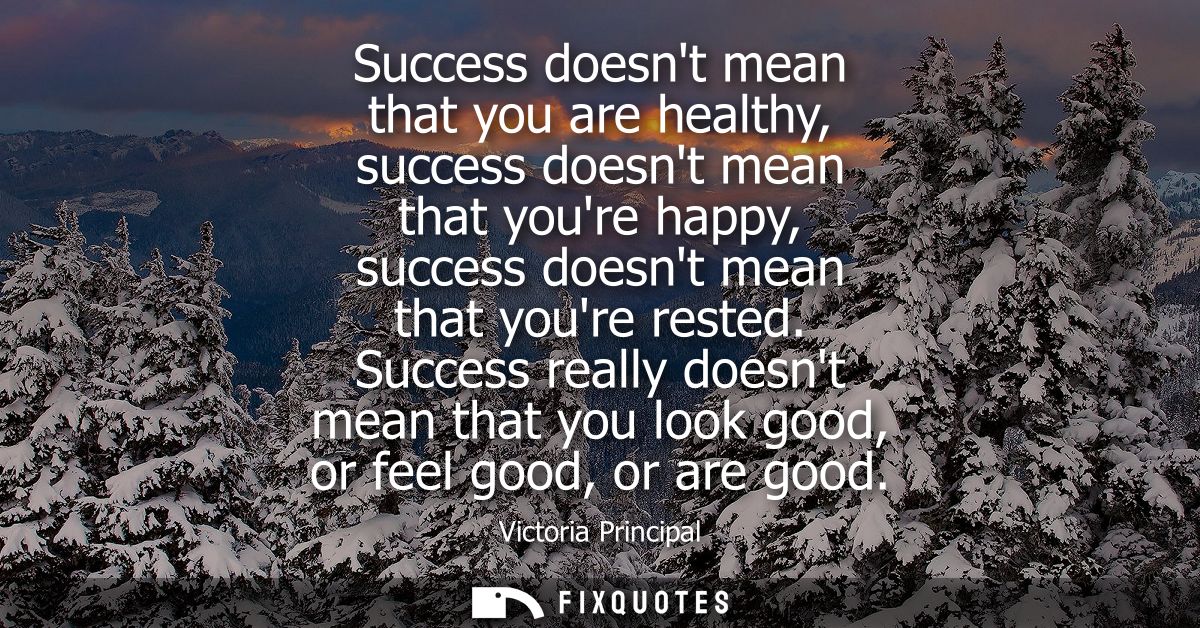
"Success doesn't mean that you are healthy, success doesn't mean that you're happy, success doesn't mean that you're rested. Success really doesn't mean that you look good, or feel good, or are good"
About this Quote
Success is not a synonym for a life well lived. Victoria Principal draws a sharp line between outward achievement and inner wellbeing, dismantling the comforting myth that one automatically delivers the other. The repetition of "doesn't mean" functions like a metronome, emphasizing distance: career wins do not guarantee a body that is healthy, a mind that is happy, or a schedule that allows rest. The second wave of negations raises the stakes. Looking good is not the same as feeling good, and feeling good still is not proof of being good. She moves from surface, to sensation, to character, puncturing the belief that prosperity validates virtue.
Her perspective carries weight because she occupied the epicenter of conventional success. As a star of the 1980s series Dallas, she navigated an industry built on image, glamor, and relentless pace. She later left the show and built a business around skincare and wellness, wrote about self-care, and devoted energy to philanthropy. That trajectory suggests hard-earned knowledge: fame and fortune can expand options, but they can also incentivize neglect of health, sleep, relationships, and integrity. The entertainment world is a dramatic example, yet the logic applies broadly in a culture that idolizes hustle and metrics. Titles, follower counts, and revenue offer crisp numbers; contentment and character resist quantification.
The line "or are good" delivers the deepest challenge. It rejects the moral halo that often settles on the successful, a bias that confuses power with worth. By prying apart achievement from goodness, Principal restores responsibility to the individual: ethics are chosen, not conferred by status.
Taken together, her words operate as both caution and clarification. Success can be meaningful, but it is a condition, not a cure. Health, happiness, rest, and goodness require their own deliberate practices. Without them, even the shiniest accomplishment is only a bright surface on an empty room.
Her perspective carries weight because she occupied the epicenter of conventional success. As a star of the 1980s series Dallas, she navigated an industry built on image, glamor, and relentless pace. She later left the show and built a business around skincare and wellness, wrote about self-care, and devoted energy to philanthropy. That trajectory suggests hard-earned knowledge: fame and fortune can expand options, but they can also incentivize neglect of health, sleep, relationships, and integrity. The entertainment world is a dramatic example, yet the logic applies broadly in a culture that idolizes hustle and metrics. Titles, follower counts, and revenue offer crisp numbers; contentment and character resist quantification.
The line "or are good" delivers the deepest challenge. It rejects the moral halo that often settles on the successful, a bias that confuses power with worth. By prying apart achievement from goodness, Principal restores responsibility to the individual: ethics are chosen, not conferred by status.
Taken together, her words operate as both caution and clarification. Success can be meaningful, but it is a condition, not a cure. Health, happiness, rest, and goodness require their own deliberate practices. Without them, even the shiniest accomplishment is only a bright surface on an empty room.
Quote Details
| Topic | Success |
|---|
More Quotes by Victoria
Add to List