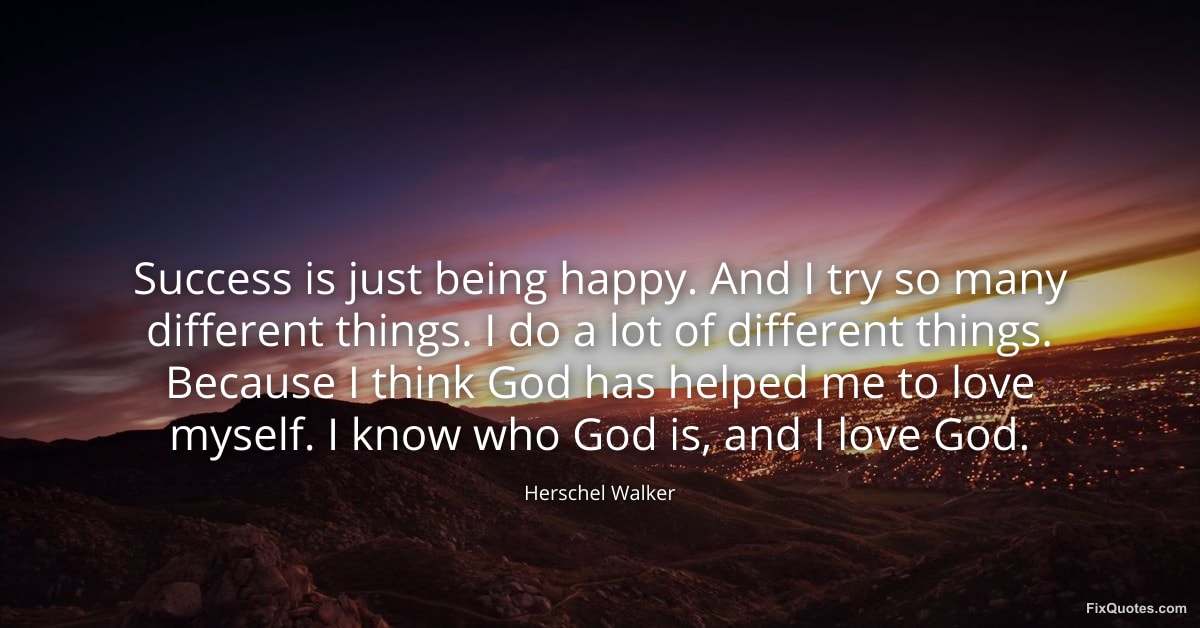
"Success is just being happy. And I try so many different things. I do a lot of different things. Because I think God has helped me to love myself. I know who God is, and I love God"
About this Quote
Success is redefined here as a state of being rather than a scoreboard. Happiness, not trophies, is the metric. That shift carries special weight coming from Herschel Walker, whose public life has been packed with measurable achievements: Heisman Trophy winner, NFL star, Olympian in bobsled, mixed martial arts competitor, entrepreneur, and later a political candidate. Saying success is just being happy pushes against the culture of performance that often surrounds elite athletes. It also explains his restless range of pursuits. Trying many different things becomes less a brand strategy and more a spiritual practice: a way of honoring gifts, staying curious, and refusing to be trapped by one identity.
The root he gives for this freedom is love of God and a belief that God has helped him love himself. That pairing matters. Self-love, as he frames it, is not self-worship or ego inflation; it is acceptance grounded in a relationship with the divine. Knowing who God is stabilizes self-worth when public opinion swings or when the body ages and records fade. For someone who has discussed mental health struggles, including dissociative identity disorder, the emphasis on God-enabled self-love also reads as a statement of healing. It signals integration: not erasing past pain, but locating worth beyond performance and past mistakes.
There is a quiet defiance in equating success with happiness. It resists transactional measures of value that can leave even winners hollow. It also reframes ambition. The point of trying many things is not to collect victories but to live fully and faithfully. For a figure whose career already blurs boundaries, that ethos explains the through line: a willingness to risk, to pivot, to learn.
The closing declaration, I know who God is, and I love God, anchors everything in relationship rather than achievement. Contentment, experimentation, and self-acceptance flow from that anchoring. Measured by that standard, success becomes accessible, renewable, and resilient, a daily practice rather than a finish line.
The root he gives for this freedom is love of God and a belief that God has helped him love himself. That pairing matters. Self-love, as he frames it, is not self-worship or ego inflation; it is acceptance grounded in a relationship with the divine. Knowing who God is stabilizes self-worth when public opinion swings or when the body ages and records fade. For someone who has discussed mental health struggles, including dissociative identity disorder, the emphasis on God-enabled self-love also reads as a statement of healing. It signals integration: not erasing past pain, but locating worth beyond performance and past mistakes.
There is a quiet defiance in equating success with happiness. It resists transactional measures of value that can leave even winners hollow. It also reframes ambition. The point of trying many things is not to collect victories but to live fully and faithfully. For a figure whose career already blurs boundaries, that ethos explains the through line: a willingness to risk, to pivot, to learn.
The closing declaration, I know who God is, and I love God, anchors everything in relationship rather than achievement. Contentment, experimentation, and self-acceptance flow from that anchoring. Measured by that standard, success becomes accessible, renewable, and resilient, a daily practice rather than a finish line.
Quote Details
| Topic | Self-Love |
|---|
More Quotes by Herschel
Add to List