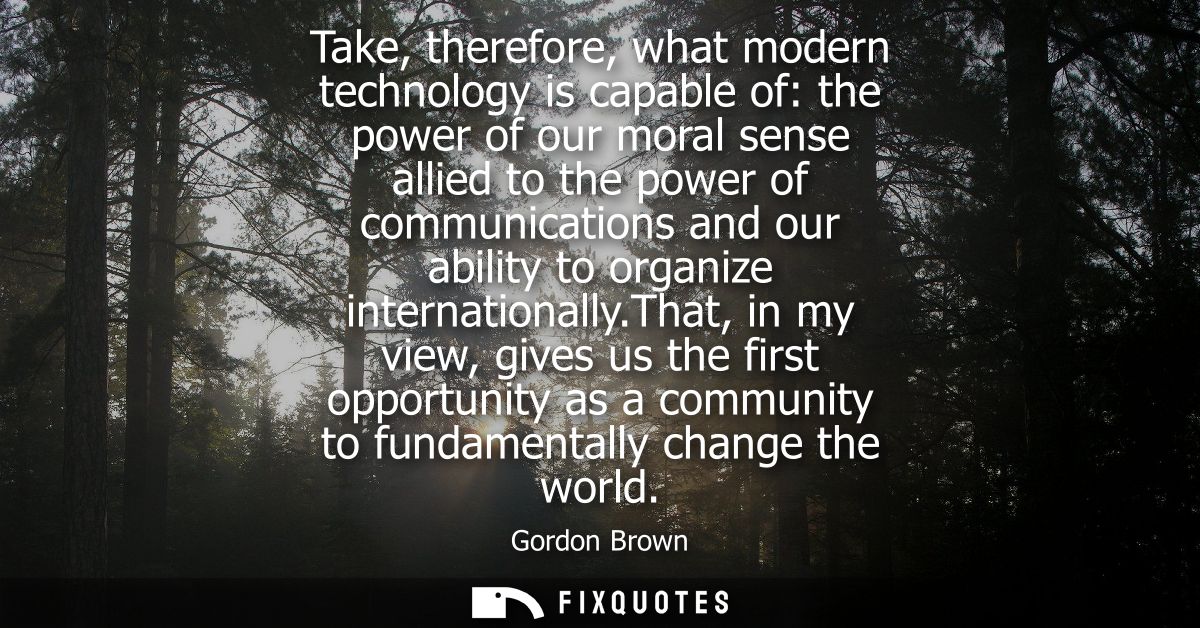
"Take, therefore, what modern technology is capable of: the power of our moral sense allied to the power of communications and our ability to organize internationally.That, in my view, gives us the first opportunity as a community to fundamentally change the world"
About this Quote
Gordon Brown links three forces that rarely align in history: a shared moral sense, technologies of communication, and the capacity to organize across borders. Technology alone does not transform the world; it becomes transformative when it scales conscience. When empathy can be broadcast, echoed, and coordinated in real time, private sentiment turns into public pressure and collective action. The line suggests an ethics-first view of innovation: tools matter because they carry values farther and faster.
The context is Brown’s advocacy, especially around 2009, for a global ethic in the aftermath of the financial crisis. As UK prime minister and a longtime student of Adam Smith, he often argued that markets require moral sentiments to function well. Here he extends that idea to geopolitics. The internet, mobile phones, and social platforms build a global public square; international institutions and networks of NGOs offer the scaffolding to turn that shared awareness into policy. Debt relief campaigns, climate mobilizations, and disaster responses hint at what becomes possible when communication and conscience reinforce each other.
Calling this the first opportunity to fundamentally change the world is a historical claim. Previous eras had strong moral movements and, later, mass media, but rarely both alongside durable mechanisms for international coordination. The digital age compresses time and distance, letting dispersed individuals act as a community rather than an audience. That shift invites a move from charity and outrage to rulemaking and enforcement, from moments of generosity to systems of justice.
Brown also implies a caution. Communications can polarize and misinform; organization without a shared ethic can entrench interests rather than elevate humanity. The alignment he urges is not automatic. It demands leadership and institutions that channel networked empathy into measurable commitments. When moral sense drives the use of technology and shapes international cooperation, the possibility opens for changing not only events but the structures that produce them.
The context is Brown’s advocacy, especially around 2009, for a global ethic in the aftermath of the financial crisis. As UK prime minister and a longtime student of Adam Smith, he often argued that markets require moral sentiments to function well. Here he extends that idea to geopolitics. The internet, mobile phones, and social platforms build a global public square; international institutions and networks of NGOs offer the scaffolding to turn that shared awareness into policy. Debt relief campaigns, climate mobilizations, and disaster responses hint at what becomes possible when communication and conscience reinforce each other.
Calling this the first opportunity to fundamentally change the world is a historical claim. Previous eras had strong moral movements and, later, mass media, but rarely both alongside durable mechanisms for international coordination. The digital age compresses time and distance, letting dispersed individuals act as a community rather than an audience. That shift invites a move from charity and outrage to rulemaking and enforcement, from moments of generosity to systems of justice.
Brown also implies a caution. Communications can polarize and misinform; organization without a shared ethic can entrench interests rather than elevate humanity. The alignment he urges is not automatic. It demands leadership and institutions that channel networked empathy into measurable commitments. When moral sense drives the use of technology and shapes international cooperation, the possibility opens for changing not only events but the structures that produce them.
Quote Details
| Topic | Human Rights |
|---|
More Quotes by Gordon
Add to List