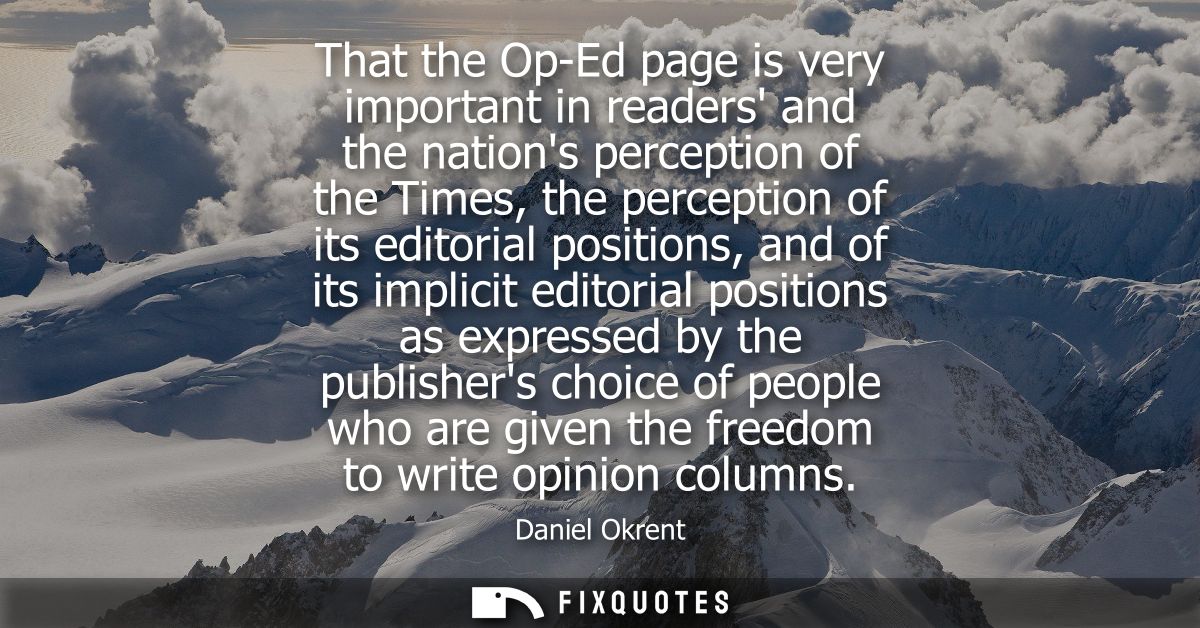
"That the Op-Ed page is very important in readers' and the nation's perception of the Times, the perception of its editorial positions, and of its implicit editorial positions as expressed by the publisher's choice of people who are given the freedom to write opinion columns"
About this Quote
His key move is the duplication of “perception.” Not truth, not accuracy, not even influence-perception. That word choice quietly admits that a paper’s authority rests on a fragile cultural contract: readers don’t just consume reporting; they infer motives. Then he sharpens the point with “implicit editorial positions,” a phrase that functions like a legal brief against deniability. The most consequential stances aren’t always the unsigned editorials; they’re the patterns embedded in selection.
The subtext is about power disguised as pluralism. “Given the freedom” sounds generous, but it’s a gated freedom. The publisher’s “choice of people” is the thesis. Op-ed pages present themselves as marketplaces of ideas, yet the market is curated, the stalls pre-approved, the range of dissent bounded by what the institution can safely host without destabilizing its brand.
Context matters: Okrent was the Times’ first public editor, a role created after credibility crises to reassure readers the paper could police itself. This line is that reassurance, and also a warning. If you want to understand what an outlet really believes, don’t just read its editorials. Watch whom it hires to argue on its behalf, and whom it never invites into the room.
Quote Details
| Topic | Writing |
|---|---|
| Source | Help us find the source |
| Cite |
Citation Formats
APA Style (7th ed.)
Okrent, Daniel. (2026, January 17). That the Op-Ed page is very important in readers' and the nation's perception of the Times, the perception of its editorial positions, and of its implicit editorial positions as expressed by the publisher's choice of people who are given the freedom to write opinion columns. FixQuotes. https://fixquotes.com/quotes/that-the-op-ed-page-is-very-important-in-readers-52305/
Chicago Style
Okrent, Daniel. "That the Op-Ed page is very important in readers' and the nation's perception of the Times, the perception of its editorial positions, and of its implicit editorial positions as expressed by the publisher's choice of people who are given the freedom to write opinion columns." FixQuotes. January 17, 2026. https://fixquotes.com/quotes/that-the-op-ed-page-is-very-important-in-readers-52305/.
MLA Style (9th ed.)
"That the Op-Ed page is very important in readers' and the nation's perception of the Times, the perception of its editorial positions, and of its implicit editorial positions as expressed by the publisher's choice of people who are given the freedom to write opinion columns." FixQuotes, 17 Jan. 2026, https://fixquotes.com/quotes/that-the-op-ed-page-is-very-important-in-readers-52305/. Accessed 7 Mar. 2026.