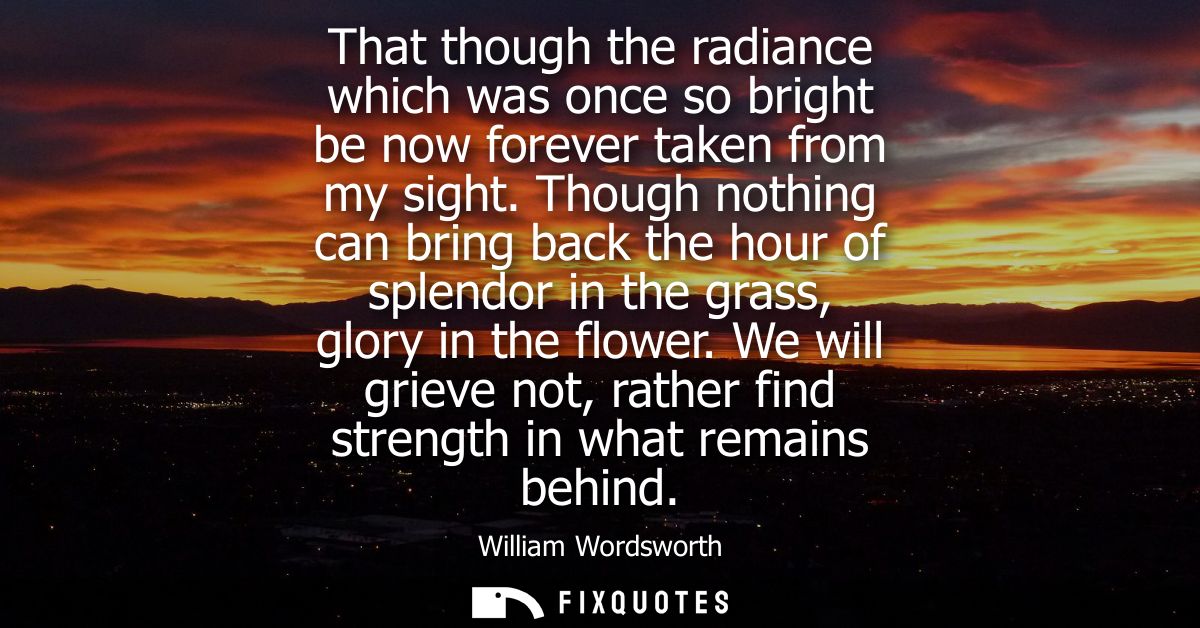
"That though the radiance which was once so bright be now forever taken from my sight. Though nothing can bring back the hour of splendor in the grass, glory in the flower. We will grieve not, rather find strength in what remains behind"
About this Quote
The craft is in the double gesture: permission to mourn, then a disciplined refusal to be ruled by mourning. “Though” repeats like a drumbeat of concession, piling up grief until it feels undeniable; only then does the poem make its ethical turn: “We will grieve not.” That “we” matters. Wordsworth isn’t diarizing; he’s recruiting the reader into a shared posture, a public philosophy of endurance. The subtext is almost defiant: you can’t negotiate with time, but you can decide what time gets to take from you.
Context sharpens it. This comes from the “Ode: Intimations of Immortality,” written as Romanticism began worrying about its own fading highs. The “splendor in the grass” and “glory in the flower” aren’t botanical trivia; they’re stand-ins for a vanished mode of seeing. Wordsworth’s consoling move isn’t denial but recalibration: when radiance leaves, meaning doesn’t have to. Strength is framed as salvage - not recovering what was, but learning how to live with the remainder and call it enough.
Quote Details
| Topic | Moving On |
|---|---|
| Source | William Wordsworth, 'Ode: Intimations of Immortality from Recollections of Early Childhood' (published 1807) — contains the lines 'Though nothing can bring back the hour / Of splendour in the grass, of glory in the flower; / We will grieve not, rather find strength in what remains behind.' |
| Cite |
Citation Formats
APA Style (7th ed.)
Wordsworth, William. (2026, January 14). That though the radiance which was once so bright be now forever taken from my sight. Though nothing can bring back the hour of splendor in the grass, glory in the flower. We will grieve not, rather find strength in what remains behind. FixQuotes. https://fixquotes.com/quotes/that-though-the-radiance-which-was-once-so-bright-11556/
Chicago Style
Wordsworth, William. "That though the radiance which was once so bright be now forever taken from my sight. Though nothing can bring back the hour of splendor in the grass, glory in the flower. We will grieve not, rather find strength in what remains behind." FixQuotes. January 14, 2026. https://fixquotes.com/quotes/that-though-the-radiance-which-was-once-so-bright-11556/.
MLA Style (9th ed.)
"That though the radiance which was once so bright be now forever taken from my sight. Though nothing can bring back the hour of splendor in the grass, glory in the flower. We will grieve not, rather find strength in what remains behind." FixQuotes, 14 Jan. 2026, https://fixquotes.com/quotes/that-though-the-radiance-which-was-once-so-bright-11556/. Accessed 9 Feb. 2026.