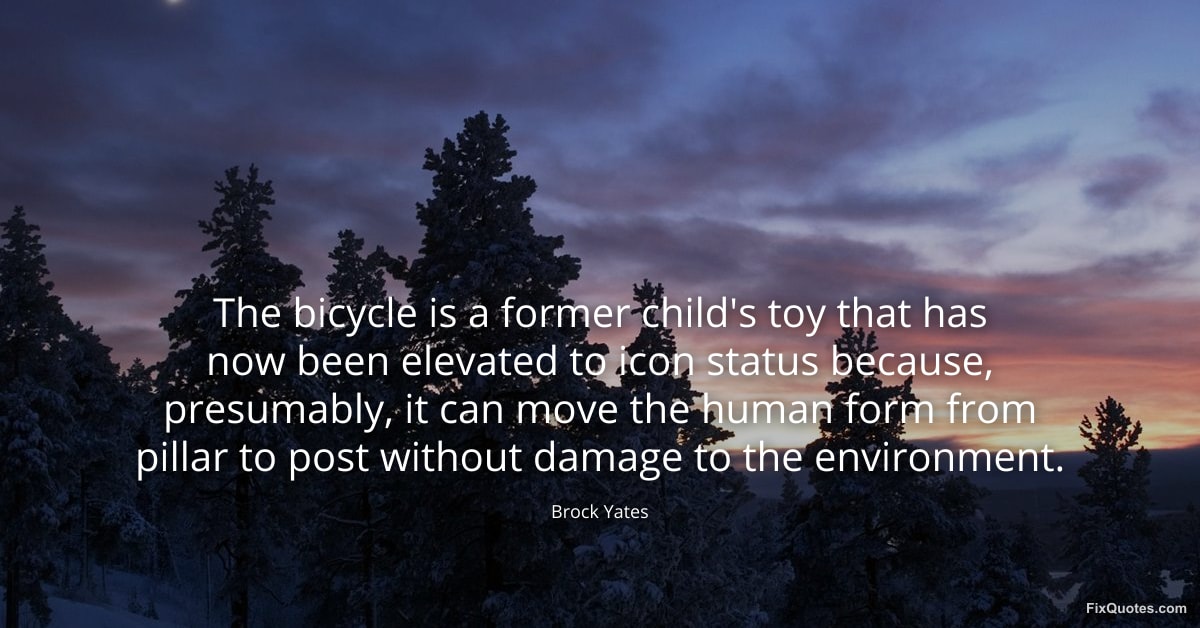
"The bicycle is a former child's toy that has now been elevated to icon status because, presumably, it can move the human form from pillar to post without damage to the environment"
About this Quote
A bicycle, in Brock Yates's hands, isn’t a wholesome symbol of freedom so much as a cultural résumé rewrite: yesterday’s kid’s plaything refurbished into a sanctified adult virtue. The jab is aimed less at bikes than at the story we tell about them. By calling it a "former child's toy", Yates punctures the earnestness surrounding cycling culture, implying that the reverence is a little performative, a little self-congratulatory. He’s not arguing the bicycle can’t do the job; he’s mocking the upgrade in status, the way an object becomes an "icon" once it’s drafted into moral signaling.
The hinge word is "presumably". It drips with editorial skepticism, a shrug disguised as a clause. Yates suggests the bike’s new prestige rests on a single, simplified claim: it moves bodies "from pillar to post without damage to the environment". That phrasing caricatures environmentalism as a kind of bureaucratic checkbox - transport, but cleaned of consequence - while also hinting that the cultural enthusiasm may exceed the practical reality. The bicycle becomes a fetish object of modern anxieties: guilt about emissions, nostalgia for simpler mechanics, desire for health without surrendering mobility.
Context matters: Yates built a reputation in car culture, especially at Car and Driver, where the automobile represented power, pleasure, and autonomy. From that vantage, the bike’s moral halo can look like an indictment of everything he loved about driving. The quote reads as a defensive satire from the combustion era, wary of a future where virtue outranks velocity.
The hinge word is "presumably". It drips with editorial skepticism, a shrug disguised as a clause. Yates suggests the bike’s new prestige rests on a single, simplified claim: it moves bodies "from pillar to post without damage to the environment". That phrasing caricatures environmentalism as a kind of bureaucratic checkbox - transport, but cleaned of consequence - while also hinting that the cultural enthusiasm may exceed the practical reality. The bicycle becomes a fetish object of modern anxieties: guilt about emissions, nostalgia for simpler mechanics, desire for health without surrendering mobility.
Context matters: Yates built a reputation in car culture, especially at Car and Driver, where the automobile represented power, pleasure, and autonomy. From that vantage, the bike’s moral halo can look like an indictment of everything he loved about driving. The quote reads as a defensive satire from the combustion era, wary of a future where virtue outranks velocity.
Quote Details
| Topic | Witty One-Liners |
|---|
More Quotes by Brock
Add to List