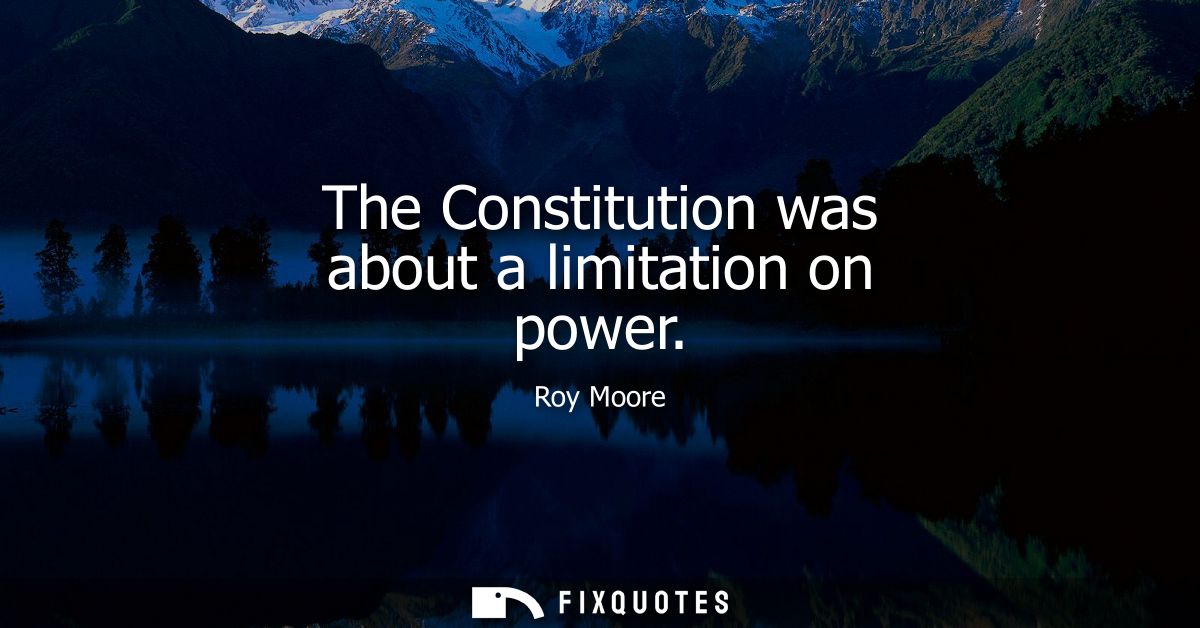
"The Constitution was about a limitation on power"
About this Quote
In nine plain words, Roy Moore tries to pull the Constitution down from the messy churn of modern politics and pin it to a single, morally tidy purpose: power must be chained. It’s a deceptively simple framing, and that’s the point. By reducing the document to “a limitation on power,” Moore positions himself as the adult in the room, the guardian of boundaries, the guy insisting the rules matter when everyone else is allegedly freelancing.
The subtext is less neutral. “Power” here isn’t abstract; it’s shorthand for the federal government, courts, and cultural elites who, in Moore’s worldview, have expanded rights and norms beyond what he considers legitimate. He’s not merely praising checks and balances. He’s building a rhetorical wedge against judicial interpretation that produces outcomes he dislikes, especially on church-state separation, sexuality, and civil rights. The phrase works because it sounds like civics class while smuggling in a political program: if you believe the Constitution’s core is restraint, then expansive readings of equality or liberty become suspect by definition.
Context matters because Moore’s career has been a running experiment in turning constitutional language into a weapon in a legitimacy fight. As Alabama chief justice, his defiance in high-profile disputes cast him as both jurist and insurgent. So the line functions as a slogan of constitutional minimalism that doubles as self-justification: he isn’t resisting authority, he’s resisting illegitimate power. It’s a neat inversion, and it plays well in a culture where “limit the government” can sound like principle even when it’s really a strategy.
The subtext is less neutral. “Power” here isn’t abstract; it’s shorthand for the federal government, courts, and cultural elites who, in Moore’s worldview, have expanded rights and norms beyond what he considers legitimate. He’s not merely praising checks and balances. He’s building a rhetorical wedge against judicial interpretation that produces outcomes he dislikes, especially on church-state separation, sexuality, and civil rights. The phrase works because it sounds like civics class while smuggling in a political program: if you believe the Constitution’s core is restraint, then expansive readings of equality or liberty become suspect by definition.
Context matters because Moore’s career has been a running experiment in turning constitutional language into a weapon in a legitimacy fight. As Alabama chief justice, his defiance in high-profile disputes cast him as both jurist and insurgent. So the line functions as a slogan of constitutional minimalism that doubles as self-justification: he isn’t resisting authority, he’s resisting illegitimate power. It’s a neat inversion, and it plays well in a culture where “limit the government” can sound like principle even when it’s really a strategy.
Quote Details
| Topic | Freedom |
|---|---|
| Source | Help us find the source |
| Cite |
Citation Formats
APA Style (7th ed.)
Moore, Roy. (2026, January 16). The Constitution was about a limitation on power. FixQuotes. https://fixquotes.com/quotes/the-constitution-was-about-a-limitation-on-power-85941/
Chicago Style
Moore, Roy. "The Constitution was about a limitation on power." FixQuotes. January 16, 2026. https://fixquotes.com/quotes/the-constitution-was-about-a-limitation-on-power-85941/.
MLA Style (9th ed.)
"The Constitution was about a limitation on power." FixQuotes, 16 Jan. 2026, https://fixquotes.com/quotes/the-constitution-was-about-a-limitation-on-power-85941/. Accessed 12 Feb. 2026.
More Quotes by Roy
Add to List