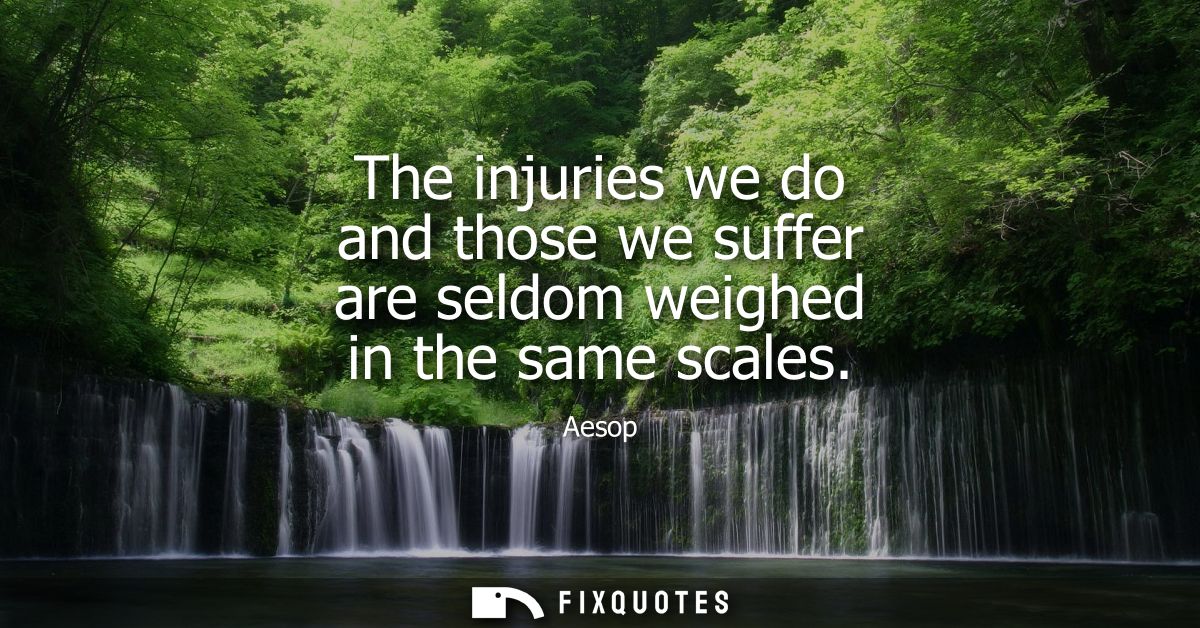
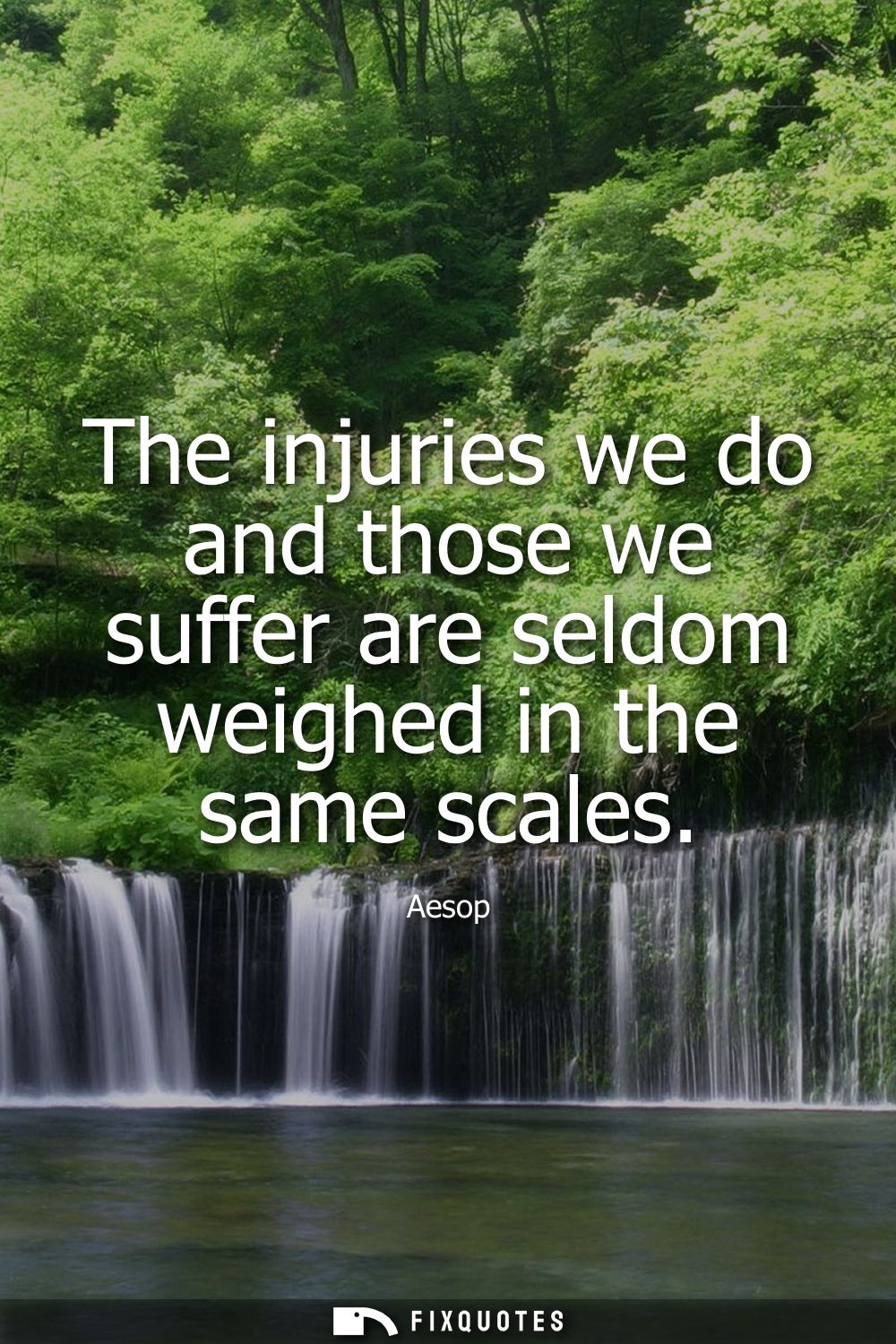
"The injuries we do and those we suffer are seldom weighed in the same scales"
About this Quote
The intent is practical, almost diagnostic. Aesop isn’t sermonizing about abstract justice; he’s pointing to a cognitive habit that makes community life combustible. The subtext is that moral self-assessment is less a mirror than a courtroom where we always represent ourselves. That asymmetry explains why apologies feel inadequate (they come from the “light” side of the perpetrator’s scale) and why resentment metastasizes (it’s constantly reweighed on the “heavy” side of the victim’s).
Context matters: Aesop’s fables were engineered for oral circulation, portable ethics for ordinary people navigating power, reputation, and survival. In hierarchical societies, the strong could normalize the injuries they dealt, while the weak had no such luxury. Read that way, the line isn’t just psychological; it’s political. It anticipates how institutions minimize the harms they cause as “unfortunate outcomes,” while individuals experience them as life-altering events. The brilliance is its economy: one image, two scales, and suddenly you can see the machinery of self-justification turning.
Quote Details
| Topic | Ethics & Morality |
|---|---|
| Source | Help us find the source |
| Cite |
Citation Formats
APA Style (7th ed.)
Aesop. (2026, January 15). The injuries we do and those we suffer are seldom weighed in the same scales. FixQuotes. https://fixquotes.com/quotes/the-injuries-we-do-and-those-we-suffer-are-seldom-144680/
Chicago Style
Aesop. "The injuries we do and those we suffer are seldom weighed in the same scales." FixQuotes. January 15, 2026. https://fixquotes.com/quotes/the-injuries-we-do-and-those-we-suffer-are-seldom-144680/.
MLA Style (9th ed.)
"The injuries we do and those we suffer are seldom weighed in the same scales." FixQuotes, 15 Jan. 2026, https://fixquotes.com/quotes/the-injuries-we-do-and-those-we-suffer-are-seldom-144680/. Accessed 12 Feb. 2026.