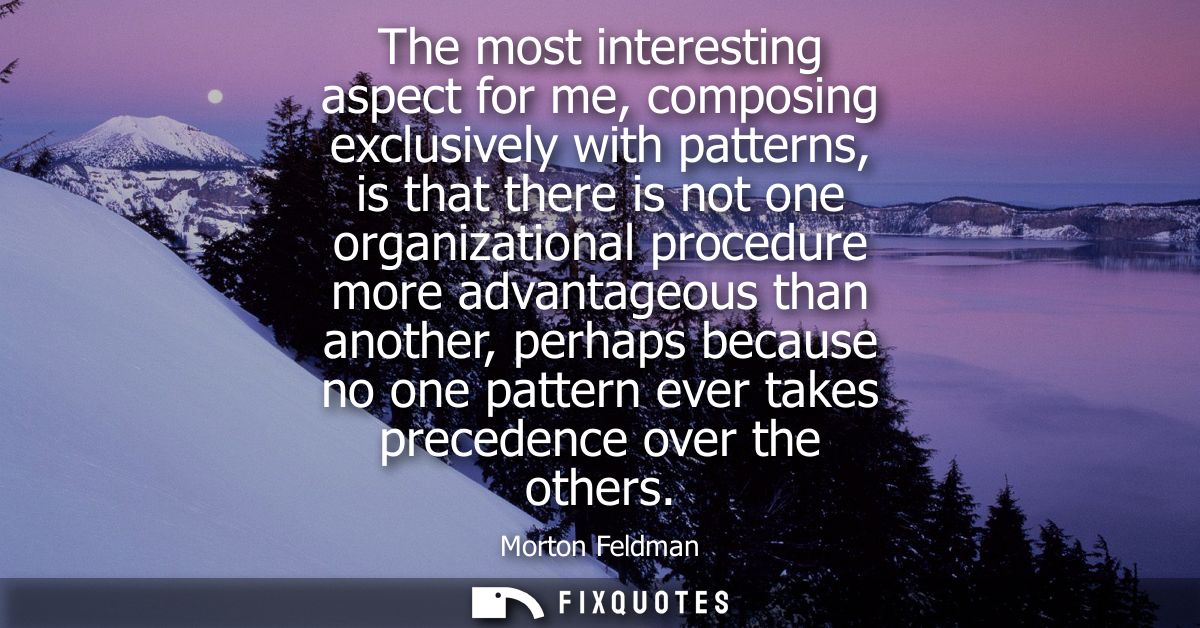
"The most interesting aspect for me, composing exclusively with patterns, is that there is not one organizational procedure more advantageous than another, perhaps because no one pattern ever takes precedence over the others"
About this Quote
Feldman is quietly detonating a core Western habit: the belief that good art is built on the right hierarchy. When he says no organizational procedure is “more advantageous,” he’s not shrugging off craft; he’s refusing the prestige economy of technique, where a method earns authority by subordinating everything else. The phrase “composing exclusively with patterns” sounds like a system-builder’s manifesto until he flips it: patterns don’t guarantee order, they dissolve it. If no pattern “takes precedence,” composition becomes less a march toward resolution and more a field where events simply coexist.
That stance lands squarely in Feldman’s postwar New York milieu: Cage’s anti-intentionality in the air, abstract expressionism on the walls, serialism looming as Europe’s high-modernist credential. Feldman shares the era’s suspicion of “procedures” that claim moral or historical inevitability. But his move is subtler than Cage’s provocation and softer than Boulez’s rigor. He’s describing an ethics of attention: listen without being told what matters most.
The subtext is also political in the small-p sense. Hierarchy in music is a kind of governance: theme over accompaniment, goal over detour, development over stasis. Feldman’s pattern-equality proposes another social contract, one where the ear isn’t coerced by climax. The reward is an uncanny intimacy with sound itself; the risk is that nothing announces itself as important, so the listener has to decide how to inhabit time. That demand, more than any “procedure,” is the point.
That stance lands squarely in Feldman’s postwar New York milieu: Cage’s anti-intentionality in the air, abstract expressionism on the walls, serialism looming as Europe’s high-modernist credential. Feldman shares the era’s suspicion of “procedures” that claim moral or historical inevitability. But his move is subtler than Cage’s provocation and softer than Boulez’s rigor. He’s describing an ethics of attention: listen without being told what matters most.
The subtext is also political in the small-p sense. Hierarchy in music is a kind of governance: theme over accompaniment, goal over detour, development over stasis. Feldman’s pattern-equality proposes another social contract, one where the ear isn’t coerced by climax. The reward is an uncanny intimacy with sound itself; the risk is that nothing announces itself as important, so the listener has to decide how to inhabit time. That demand, more than any “procedure,” is the point.
Quote Details
| Topic | Music |
|---|
More Quotes by Morton
Add to List