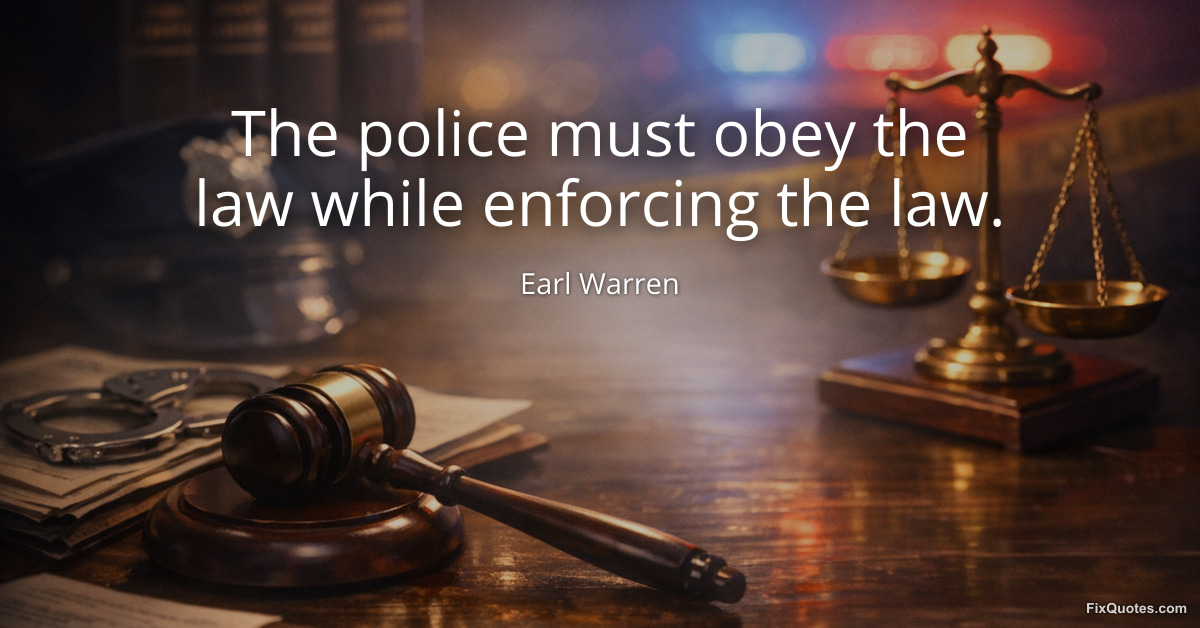
"The police must obey the law while enforcing the law"
About this Quote
A lot of power hides in the word "must". Warren isnt offering a civics-class platitude; hes laying down a constraint meant to bite in real life, when the temptation to cut corners is strongest. The line turns the familiar logic of policing inside out: enforcement is not a special zone where normal rules pause, its the moment when the legitimacy of the rules is tested. If the state can suspend the law in order to protect it, then the law becomes less a principle than a costume worn when convenient.
The subtext is aimed at a perennial argument from authority: that order requires discretion, that ends justify means, that the public cant afford procedural niceties. Warren rejects that bargain. By insisting police obey the law while enforcing it, he collapses the supposed distance between those who police and those who are policed. The badge doesnt elevate someone above the system; it binds them tighter to it, because they wield the systems most coercive tools.
Context matters: Warren, as Chief Justice, presided over a Supreme Court that dramatically expanded constitutional protections in the criminal process (think Mapp v. Ohio on the exclusionary rule, Miranda v. Arizona on interrogations). Critics framed these rulings as handcuffing police. Warren reframes the issue: the real handcuffs are constitutional limits that keep the governments force from becoming arbitrary. The line works because it makes legitimacy procedural, not performative; the rule of law isnt proved by arrests, but by restraint.
The subtext is aimed at a perennial argument from authority: that order requires discretion, that ends justify means, that the public cant afford procedural niceties. Warren rejects that bargain. By insisting police obey the law while enforcing it, he collapses the supposed distance between those who police and those who are policed. The badge doesnt elevate someone above the system; it binds them tighter to it, because they wield the systems most coercive tools.
Context matters: Warren, as Chief Justice, presided over a Supreme Court that dramatically expanded constitutional protections in the criminal process (think Mapp v. Ohio on the exclusionary rule, Miranda v. Arizona on interrogations). Critics framed these rulings as handcuffing police. Warren reframes the issue: the real handcuffs are constitutional limits that keep the governments force from becoming arbitrary. The line works because it makes legitimacy procedural, not performative; the rule of law isnt proved by arrests, but by restraint.
Quote Details
| Topic | Justice |
|---|---|
| Source | Later attribution: Above the Law (Skolnick Fyfe, 2010) modern compilationISBN: 9781439118641 · ID: Z-Y8fbVSBe0C
Evidence:
... Earl Warren was unwilling to settle for that standard . Beyond the " inherent untrustworthiness " of involuntary ... the police must obey the law while enforcing the law ; that in the end life and liberty can be as much endangered ... |
| Cite |
Citation Formats
APA Style (7th ed.)
Warren, Earl. (2026, March 11). The police must obey the law while enforcing the law. FixQuotes. https://fixquotes.com/quotes/the-police-must-obey-the-law-while-enforcing-the-66975/
Chicago Style
Warren, Earl. "The police must obey the law while enforcing the law." FixQuotes. March 11, 2026. https://fixquotes.com/quotes/the-police-must-obey-the-law-while-enforcing-the-66975/.
MLA Style (9th ed.)
"The police must obey the law while enforcing the law." FixQuotes, 11 Mar. 2026, https://fixquotes.com/quotes/the-police-must-obey-the-law-while-enforcing-the-66975/. Accessed 23 Mar. 2026.
More Quotes by Earl
Add to List