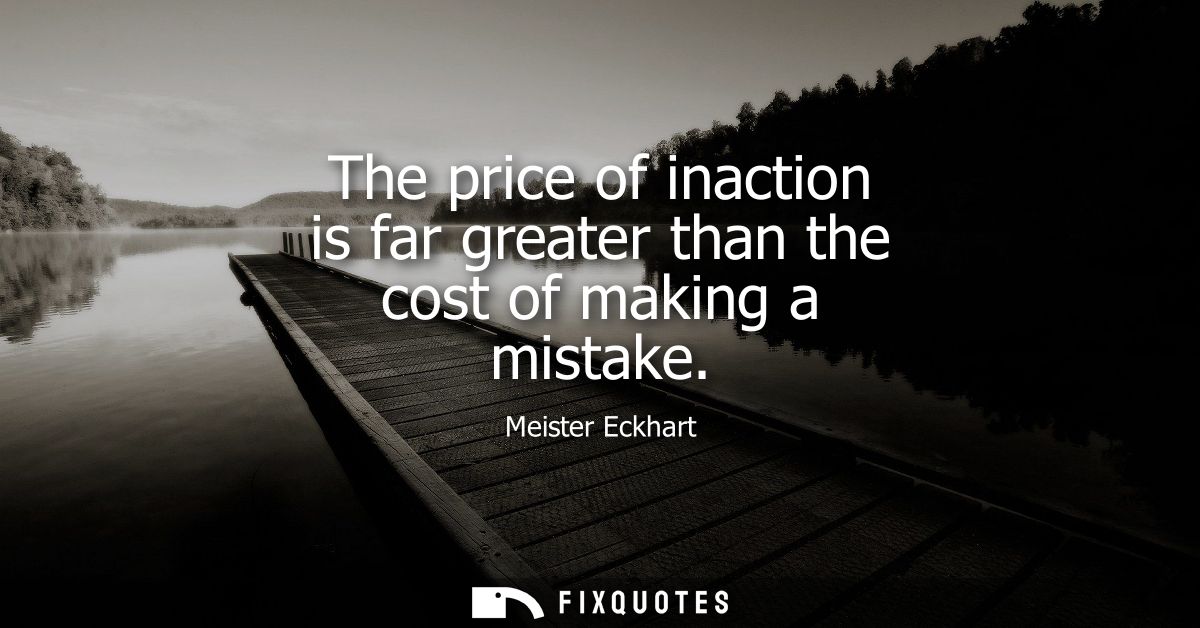
"The price of inaction is far greater than the cost of making a mistake"
About this Quote
Eckhart’s line lands like a rebuke to the timid conscience: the truly expensive choice isn’t the wrong step, it’s refusing to step at all. Coming from a medieval mystic-philosopher who preached detachment and inner transformation, the provocation isn’t a hustle-culture slogan about “taking risks.” It’s a spiritual diagnosis. Inaction, for Eckhart, isn’t neutral; it’s a form of self-protection that calcifies into a way of being, a quiet commitment to the small self he spent his career trying to dissolve.
The phrase “price of inaction” smuggles in a moral economy. Time, attention, and possibility aren’t abstract; they’re spendable, and they’re being spent whether we like it or not. The subtext is that passivity has an invisible interest rate: resentment grows, fear becomes infrastructure, the life you might have lived turns into a permanent counterfactual. By contrast, “the cost of making a mistake” is framed as finite, containable, even instructive. A mistake has edges. Inaction is ambient.
Context matters: Eckhart wrote and preached in a Church culture that prized obedience and doctrinal safety, and he was eventually investigated for heresy. That backdrop makes the sentiment sharper. He’s not romanticizing error; he’s insisting that spiritual and ethical growth requires movement, and movement courts risk. The line works because it flips the usual calculus. Safety isn’t safe if it prevents the only kind of progress that counts: the inner act of choosing, committing, and being changed by it.
The phrase “price of inaction” smuggles in a moral economy. Time, attention, and possibility aren’t abstract; they’re spendable, and they’re being spent whether we like it or not. The subtext is that passivity has an invisible interest rate: resentment grows, fear becomes infrastructure, the life you might have lived turns into a permanent counterfactual. By contrast, “the cost of making a mistake” is framed as finite, containable, even instructive. A mistake has edges. Inaction is ambient.
Context matters: Eckhart wrote and preached in a Church culture that prized obedience and doctrinal safety, and he was eventually investigated for heresy. That backdrop makes the sentiment sharper. He’s not romanticizing error; he’s insisting that spiritual and ethical growth requires movement, and movement courts risk. The line works because it flips the usual calculus. Safety isn’t safe if it prevents the only kind of progress that counts: the inner act of choosing, committing, and being changed by it.
Quote Details
| Topic | Decision-Making |
|---|---|
| Source | Later attribution: 101 Motivational and Inspirational Quotes: Words of Wisdo... (Nathan Pynnos, 2023) modern compilationID: pPi6EAAAQBAJ
Evidence:
... The price of inaction is far greater than the cost of making a mistake." - Meister Eckhart Reflection: Meister Eckhart emphasizes that inaction often poses a greater risk than making mistakes or encountering failure. Taking action, even ... |
| Cite |
Citation Formats
APA Style (7th ed.)
Eckhart, Meister. (2026, February 8). The price of inaction is far greater than the cost of making a mistake. FixQuotes. https://fixquotes.com/quotes/the-price-of-inaction-is-far-greater-than-the-411/
Chicago Style
Eckhart, Meister. "The price of inaction is far greater than the cost of making a mistake." FixQuotes. February 8, 2026. https://fixquotes.com/quotes/the-price-of-inaction-is-far-greater-than-the-411/.
MLA Style (9th ed.)
"The price of inaction is far greater than the cost of making a mistake." FixQuotes, 8 Feb. 2026, https://fixquotes.com/quotes/the-price-of-inaction-is-far-greater-than-the-411/. Accessed 1 Apr. 2026.
More Quotes by Meister
Add to List