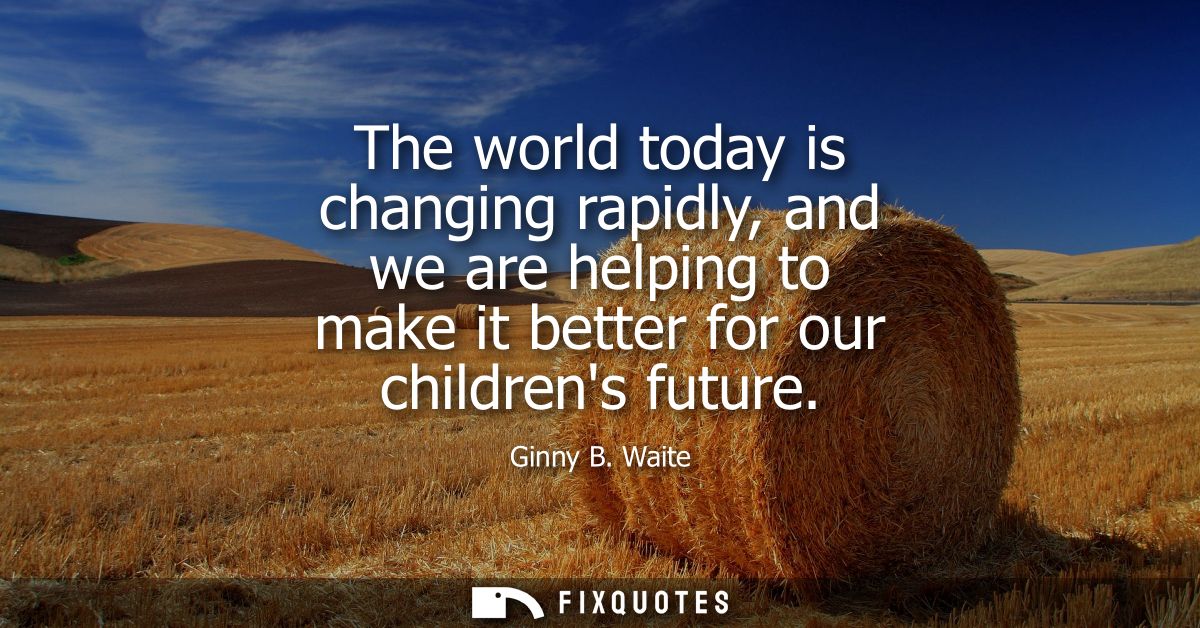
"The world today is changing rapidly, and we are helping to make it better for our children's future"
About this Quote
Progress gets framed here as a relay race: the present generation runs hard, hands off a cleaner baton, and earns moral credit for “helping to make it better.” That phrasing isn’t accidental. “The world today is changing rapidly” establishes urgency without naming a culprit. It’s a flexible alarm bell: it can gesture toward climate anxiety, AI disruption, political volatility, economic precarity. By staying non-specific, the line invites agreement from almost any listener, regardless of what they think the actual crisis is.
The second half pivots from description to reassurance. “We are helping” is the key softener. It implies agency and goodness while leaving the scale of contribution undefined. In public-facing rhetoric - nonprofit appeals, corporate ESG statements, school board messaging, campaign stump lines - that ambiguity is a feature. It makes the speaker’s “we” roomy enough to include donors, voters, employees, congregations, or neighbors. You get to belong to the virtuous group just by nodding along.
The subtext is both comforting and strategic: yes, things feel unstable, but your side is responsible, future-minded, and on the right side of history. “Our children’s future” functions as an emotional shield; it’s hard to argue against kids without sounding callous. That’s the line’s quiet power and its risk. It can motivate collective action, but it can also launder hard choices into a warm glow of intention, where optimism stands in for specifics. The sentiment works because it offers a simple bargain: accept the fear of rapid change, receive the relief of shared purpose.
The second half pivots from description to reassurance. “We are helping” is the key softener. It implies agency and goodness while leaving the scale of contribution undefined. In public-facing rhetoric - nonprofit appeals, corporate ESG statements, school board messaging, campaign stump lines - that ambiguity is a feature. It makes the speaker’s “we” roomy enough to include donors, voters, employees, congregations, or neighbors. You get to belong to the virtuous group just by nodding along.
The subtext is both comforting and strategic: yes, things feel unstable, but your side is responsible, future-minded, and on the right side of history. “Our children’s future” functions as an emotional shield; it’s hard to argue against kids without sounding callous. That’s the line’s quiet power and its risk. It can motivate collective action, but it can also launder hard choices into a warm glow of intention, where optimism stands in for specifics. The sentiment works because it offers a simple bargain: accept the fear of rapid change, receive the relief of shared purpose.
Quote Details
| Topic | Parenting |
|---|---|
| Source | Help us find the source |
More Quotes by Ginny
Add to List